In the back of a downtown taxi crawling up Manhattan’s FDR Highway, feminist icon Gloria Steinem offered a piece of profound, deceptively simple advice to author and foundation fellow Erin Grau: a parent’s ultimate job is not to mold a child into a preconceived image, but to discover who their daughters truly are—and then build a world that genuinely deserves them.
This poignant exchange encapsulates the core philosophy of a woman who spent over six decades at the vanguard of the global feminist movement. Though Steinem famously never had biological children of her own, her relationship with modern motherhood was neither distant nor theoretical. Instead, she viewed child-rearing through the lens of radical liberation, structural reform, and deep philosophical curiosity.
This article explores the intersections of Steinem’s public legacy and private mentorship, examining how her perspectives on storytelling, family dynamics, and political resilience continue to shape contemporary parenting. By tracing her personal interactions with the next generation—exemplified by her bond with Grau’s daughters, Matilda and Frankie—we uncover a blueprint for raising resilient, self-actualized children in an era defined by cultural polarization and rapid technological change.
Detailed Chronology: From the FDR Highway to the Manhattan Living Room
The Philosophy of the Back Seat
Steinem’s connection to the rhythms of everyday life was famously anchored in her preference for urban transit. As documented in her memoir My Life on the Road, she frequently sought out taxis as mobile classrooms, using them to converse with drivers and absorb the grassroots perspectives of local communities.
It was within this signature setting—slowly navigating New York City traffic after a holiday gathering—that Steinem crystallized her thoughts on raising girls. In a culture that often pressures young women to shrink, conform, or perform, Steinem insisted that the developmental trajectory of a daughter should be one of unfolding self-discovery rather than parental imposition.
Mentorship and the Next Generation
Years after this taxi ride, Grau became an inaugural resident at Gloria’s Foundation, a nonprofit dedicated to advancing the feminist movement and preserving Steinem’s historic Manhattan apartment—a legendary hub for activism for nearly sixty years.
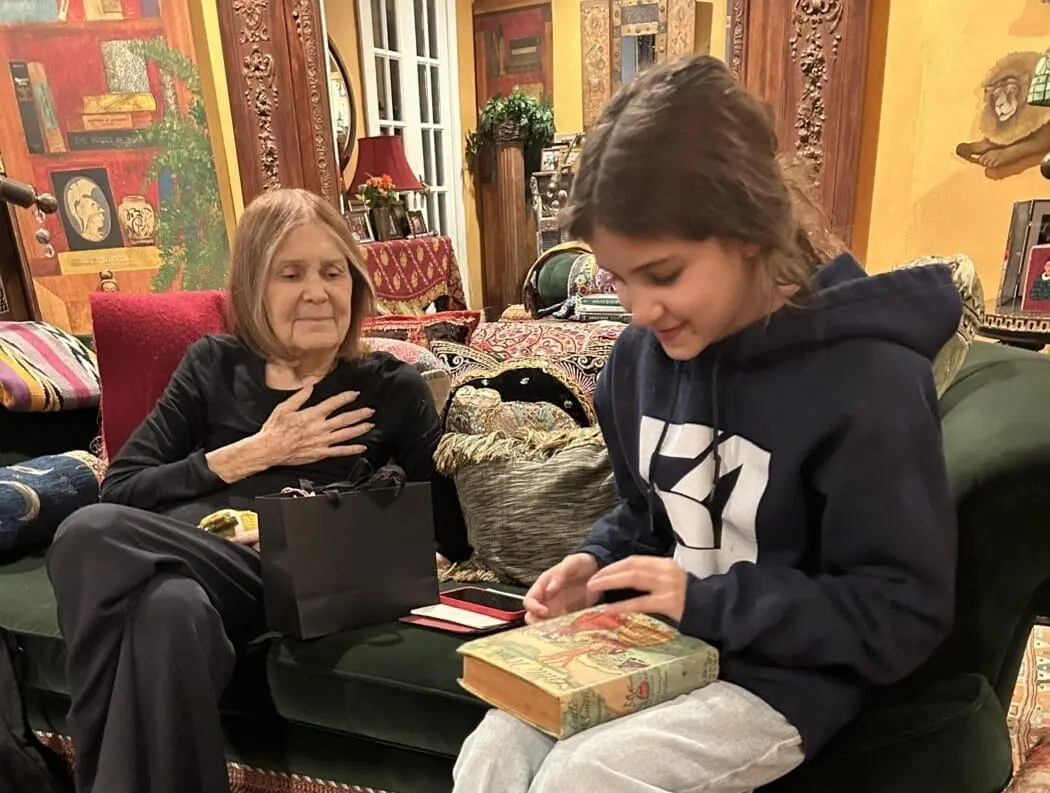
During these afternoon work sessions at the intersection of women, artificial intelligence, and power, Steinem frequently welcomed Grau’s daughter, Matilda. Over hot chocolate and holiday cookies, intergenerational bridges were built. In one memorable encounter, Matilda cradled Steinem’s personal first-edition copy of Louisa May Alcott’s Little Women—a novel that Steinem credited as a foundational text of her own childhood worldview. In return, the children gifted Steinem a yellow taxi ornament for her holiday tree, cementing a warm, reciprocal bond rooted in mutual respect and shared literary imagination.
+-------------------------------------------------------------------------+
|                  CHRONOLOGICAL MILESTONES OF MENTORSHIP                 |
+-------------------------------------------------------------------------+
|  Year / Era      | Event / Interaction                                  |
+------------------+------------------------------------------------------+
|  Pre-Memoir      | Steinem's formative engagement with *Little Women*   |
|  Dec. (Prior Yr) | The FDR Highway taxi conversation on parenting       |
|  Foundation Era  | Grau's residency at Gloria's Foundation in NYC       |
|  Holiday Visit   | Matilda and Frankie meet Steinem; literary exchange  |
|  Post-Passing    | Community memorials and sidewalk chalk tributes      |
+-------------------------------------------------------------------------+
Supporting Context & Metrics: The Modern Landscape of Raising Girls
Steinem’s philosophy arrives at a critical juncture in contemporary child development and sociological research. Raising self-actualized daughters requires navigating a cultural landscape fraught with systemic pressures, digital saturation, and shifting societal expectations.
Recent data from organizations such as the Girl Scouts of the USA highlights a sobering reality: more than half of modern girls express fear regarding adulthood, overwhelmed by economic uncertainty, shifting gender norms, and intense societal scrutiny. Furthermore, sociological research consistently points to the family unit as a primary site where traditional hierarchies and structural inequalities are first internalized. Steinem’s critique of the family as "too often the birthplace of inequality" challenges parents to intentionally deconstruct patriarchal patterns within the domestic sphere.
+-------------------------------------------------------------------------+
|              SOCIOLOGICAL INDICATORS IN RAISING DAUGHTERS               |
+-------------------------------------------------------------------------+
| Metric / Finding              | Context & Source                        |
+-------------------------------+-----------------------------------------+
| >50% of Girls                 | Report fear and anxiety regarding       |
|                               | entering adulthood (GSUSA data).        |
+-------------------------------+-----------------------------------------+
| Family as Structural Unit     | Identified by feminist theorists as a   |
|                               | primary vector for gender socialization.|
+-------------------------------+-----------------------------------------+
| Cultural Polarization         | Ongoing backlash against feminist gains |
|                               | impacting modern identity formation.    |
+-------------------------------+-----------------------------------------+
To combat these systemic pressures, Steinem advocated for radical empathy—treating empathy not merely as a passive sentiment, but as a revolutionary emotional tool. By listening closely and asking probing questions, parents can help children view the status quo not as immutable destiny, but as a temporary arrangement subject to reimagination.
Official Statements and Reflections
The passing of Gloria Steinem marked the end of an era, yet the resonance of her work continues to animate activists, writers, and parents alike.
Erin Grau reflected on the dual nature of receiving parental guidance from an icon without biological children:
"There is something funny about getting parenting advice from a feminist icon who never had children of her own, and something very right about getting that advice in the back of a taxi… To discover who my children are, I needed to borrow Gloria’s curiosity. Ask more questions, listen more closely, practice greater empathy."
Amy Richards, a prominent activist, close friend, and collaborator of Steinem, describes the ongoing struggle for gender equality not as a burden, but as a "beautiful responsibility." This sentiment captures Steinem’s enduring refusal to view cultural progress or regression as permanent fixtures of history. Steinem maintained that treating societal setbacks as final would be "boring," actively encouraging her peers and mentees to hold space for righteous anger while resolutely anchoring themselves in hope.
Following Steinem’s passing, this ethos manifested in concrete acts of public mourning and community-building. Grau, alongside her daughters Matilda (age 12) and Frankie (age 9), traveled to Steinem’s Manhattan apartment. Joining hundreds of mourners leaving floral tributes and copies of Little Women, the young girls utilized chalk to adorn the sidewalk. Frankie inscribed a simple note—"Thank you, Gloria"—while Matilda sketched an iconic portrait of Steinem in her signature aviator glasses alongside a yellow taxicab, symbolizing the continuation of an unvarnished, forward-moving legacy.
Future Outlook: Unfinished Business and the Next Generation
As society grapples with the intersection of emerging technologies, shifting workforce dynamics, and persistent gender gaps—often termed the "motherhood tax"—Steinem’s framework provides an essential navigational tool.
The mandate to "build a world that deserves them" requires systemic transformation across multiple sectors:
Workplace Reform: Redesigning parental leave and corporate structures so that caregiving is valued as essential infrastructure rather than an economic penalty.
Technological Ethics: Ensuring that emerging tools, including artificial intelligence, are developed with an acute awareness of gender equity and representation, as explored during Grau’s fellowship at Gloria’s Foundation.
Domestic Egalitarianism: Fostering shared domestic labor and open dialogues within households to dismantle inequality at its root.
Ultimately, the future of the feminist movement rests in the hands of the next generation—children like Matilda and Frankie, equipped with curiosity, encouraged to question destiny, and supported by a framework of radical hope. Steinem’s unfinished business is vast, but her blueprint ensures that daughters do not need to shrink to fit the world; rather, the world must expand to meet their boundless potential.