
Executive Overview
Parenthood has long been romanticized as a natural, fulfilling milestone, a journey defined by unconditional love and quiet domestic bliss. Yet, beneath the surface of glossy family portraits and curated social media grids lies a vastly different, rarely discussed reality: an unrelenting mental and physical toll borne disproportionately by mothers.
Recent crowdsourced disclosures from thousands of mothers reveal a landscape of profound systemic burnout, chronic emotional isolation, and staggering operational responsibility. Far from isolated gripes, these anonymous testimonies paint a cohesive, systemic picture of women functioning as the invisible administrative, financial, and emotional engines of their households—often with little to no structural support.
This crisis goes beyond simple fatigue. It encompasses the crushing weight of household management, deteriorating marital satisfaction, financial precarity, physical health crises, and the agonizing guilt of feeling inadequate in a role that demands near-superhuman endurance. As cultural conversations begin to scrutinize the gendered division of domestic labor, the unfiltered voices of mothers offer a stark, urgent diagnostic of a society failing to sustain its primary caregivers.
Detailed Chronology & Evolution of the Modern Domestic Burden
To understand how modern motherhood reached this tipping point, one must examine the compounding evolution of parental expectations over the last half-century.
The Shift from Community to Isolation
Historically, child-rearing was distributed across extended family networks, agrarian communities, or close-knit neighborhoods. Mothers had a village. Over the latter half of the 20th century, rapid urbanization, the rise of the nuclear family, and geographic mobility systematically dismantled these support structures.
The "Supermom" Trap of the Late 20th Century
As women entered the formal workforce en masse during the 1970s, 80s, and 90s, society failed to recalibrate domestic expectations. Instead of redistributing household and caregiving tasks, the cultural narrative pivoted to the myth of the "Supermom"—the woman who could "have it all" by simultaneously excelling in a career, maintaining a spotless home, and flawlessly raising children. This era normalized the silent exhaustion of women working a grueling "second shift" at home after a full day at the office.
The Hyper-Intensive Parenting Era (2000s–Present)
The contemporary iteration of motherhood is defined by "intensive parenting"—a child-rearing philosophy that demands massive investments of time, emotional energy, and financial capital. Mothers are now expected to curate every aspect of their children’s cognitive, emotional, and social development.
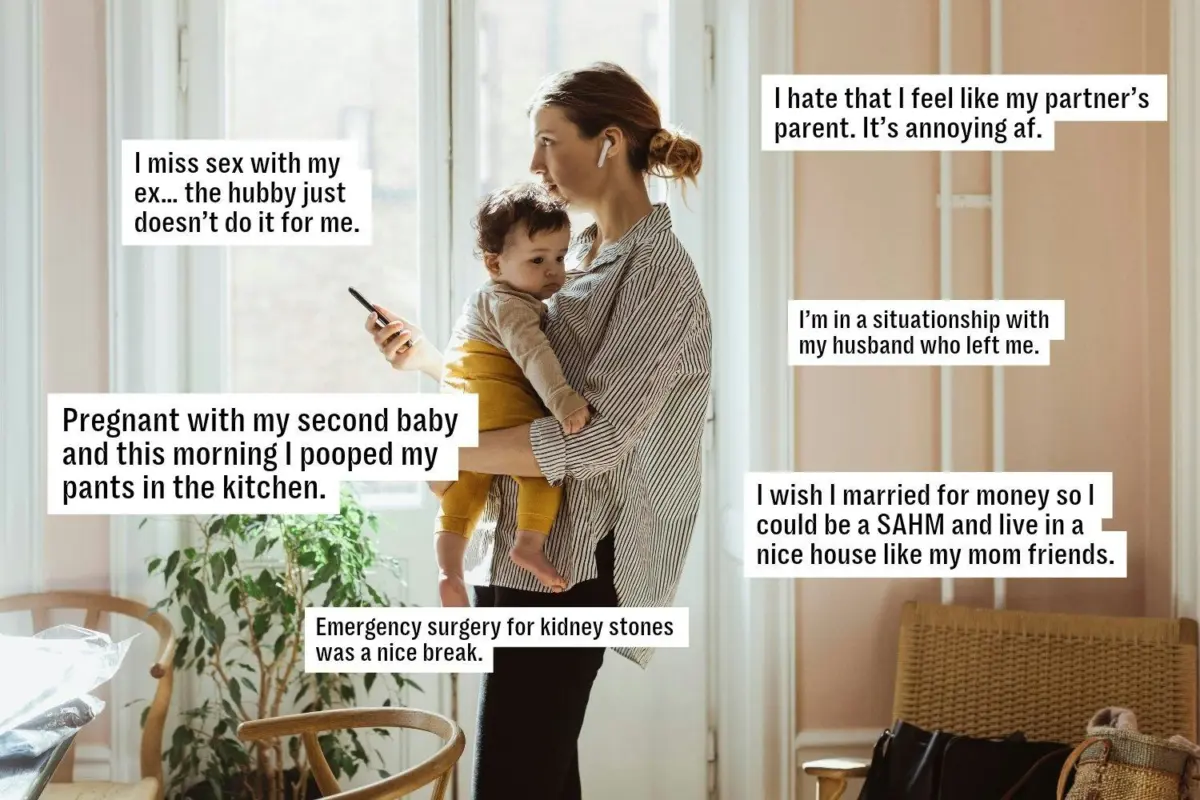
Anonymous confessions from contemporary platforms highlight the breaking point of this trajectory. Women report feeling like "the parentified partner" to husbands who contribute minimally, experiencing deep alienation within marriages, and carrying an invisible operational load—such as anticipating household needs, scheduling medical appointments, managing academic trajectories, and processing emotional labor—that leaves them entirely depleted.
Supporting Context & Metrics: The Anatomy of Modern Motherhood
The weight carried by contemporary mothers is not merely anecdotal; it is substantiated by socioeconomic trends, psychological studies, and thousands of raw, unfiltered accounts.
The Invisible Labor Disparity
Sociological research consistently demonstrates that even in dual-income households where both partners work full-time, women shoulder the vast majority of unpaid domestic labor and mental load. The mental load—the anticipatory, administrative, and managerial burden of running a household—is almost exclusively owned by women.
This dynamic is sharply reflected in recent disclosures:
- Marital Disconnect and Resentment: Many mothers report feeling like they are managing "three teenagers" instead of a partnership. One anonymous contributor noted: “My husband hasn’t had a job for seven years. It feels like I have three teenagers at home.” Others express a deep desire for separation, hindered solely by economic barriers: “I want a separation but can’t afford it.”
- Physical and Mental Health Crises: The chronic stress of caregiving manifests physically. Mothers report severe burnout, exacerbated by health issues ranging from emergency surgeries (such as back and kidney stone procedures) to chronic anxiety and depression. Tragically, some view unexpected medical procedures not with dread, but as a rare, forced respite from their responsibilities: “Emergency surgery for kidney stones was a nice break.”
- The Taboo of Regret: Perhaps the most culturally sensitive metric of this crisis is the whispered confession of maternal ambivalence. Women who fiercely love their children simultaneously grapple with profound grief for their pre-motherhood autonomy. “I love my kids, but sometimes I wish I didn’t become a mom. The responsibility feels too heavy,” reads one typical disclosure.
Official Statements & Expert Perspectives
Sociologists, psychologists, and family therapists have increasingly sounded the alarm regarding the systemic unsustainability of modern parenting models.
Dr. Sarah Allen, a prominent family psychologist specializing in maternal mental health, notes that the modern nuclear family structure places an unnatural burden on individual mothers.
"We are asking women to function as corporations with a staff of one," Dr. Allen explains. "When a mother breaks down under the weight of financial stress, marital neglect, child-rearing demands, and household logistics, society treats it as a personal failure of coping, rather than a predictable outcome of a broken systemic design."
Economists and gender studies scholars point to the lack of structural safety nets—such as universal childcare, paid family leave, and subsidized healthcare—as core drivers of domestic strain.
"Imagine what women would achieve if we too had a wife," notes Julie Sprankles, reflecting on a viral feminist maxim. "The reality is that mothers are keeping the wheels of society turning while operating without a safety net, navigating everything from winter heating oil poverty to crumbling marriages, all while being told to smile and cherish every moment."
Clinical perspectives emphasize that when maternal mental health deteriorates, the entire family unit suffers. Experts urge partners to move beyond performing occasional, requested chores ("babysitting" one’s own children) and instead transition to cognitive co-ownership of the household.
Future Outlook: Reimagining the Architecture of Care
The sheer volume of unfiltered, raw disclosures from mothers signals a cultural boiling point. As the myth of effortless, self-sacrificing motherhood continues to unravel, what lies ahead for family dynamics and societal support structures?
1. Radical Transparency and De-stigmatization
The cultural appetite for sanitized depictions of motherhood is rapidly diminishing. Platforms that allow for anonymous, unfiltered expression are providing a vital psychological valve for women. By bringing taboo topics—such as maternal ambivalence, marital dissatisfaction, and the desire for autonomy—into the public square, society is slowly dismantling the shame that has historically kept mothers isolated in their suffering.
2. Structural and Policy Reforms
Individual self-care strategies, such as setting boundaries or practicing mindfulness, are insufficient remedies for systemic exhaustion. The future of sustainable family life hinges on macro-level policy changes:
- Universal, affordable childcare to alleviate the crushing financial and logistical burdens on young families.
- Comprehensive paid parental and sick leave.
- Reforming workplace cultures to accommodate the realities of caregiving without penalizing working mothers.
3. Redefining Domestic Partnerships
Within the home, younger generations of couples are attempting to forge more equitable partnerships, explicitly dividing the mental load rather than defaulting to traditional gender roles. However, as current data demonstrates, millions of women remain trapped in legacy dynamics that prioritize male comfort at the expense of female well-being.
Conclusion
The modern mother’s mental load is an urgent public health and sociological issue. Until society shifts from romanticizing motherhood to actively supporting mothers—through equitable partnerships, robust economic safety nets, and cultural validation of their multi-faceted humanity—women will continue to bear an invisible, unsustainable weight. The collective cry of "Mama needs a minute" is not just a plea for a brief pause; it is an indictment of a system that asks too much and gives too little in return.

