
EXECUTIVE OVERVIEW
For educators, instructional designers, and academic technologists, walking into a massive convention hall for a premier professional gathering like the Online Learning Consortium (OLC) conference can trigger a complex mix of excitement and isolation. Beneath the surface of jam-packed itineraries, keynote speeches, and high-tech poster sessions lies a universal human reality: the daunting feeling of scanning a crowded room and wondering where to go, who to talk to, and whether anyone else feels just as lost.
Enter Stephanie Heald, a veteran educator and 2026 First-Year Field Guide Leader for the OLC conference, who is championing a paradigm shift in how professional development is experienced. In a comprehensive manifesto on the psychology of conference attendance, Heald unpacks a foundational philosophy she calls the "Power of One"—the profound realization that a single person, a single impromptu conversation, or a single unscripted opportunity can catalyze an institutional transformation far beyond the walls of any scheduled breakout room.
This report explores the architectural design of modern academic conferences, the psychological barriers attendees face when navigating large-scale networking environments, and the critical interventions—such as the OLC Field Guide program—that convert overwhelming convention spaces into incubators for collaboration. Drawing on insider perspectives, structural analyses of professional networking, and a roadmap for maximizing the conference lifecycle, this article examines how accidental hallway chats often outweigh the structured agenda in driving long-term educational innovation.
1. The Anatomy of Academic Isolation: Why Conferences Can Overwhelm
Modern academic and technological conferences are marvels of logistics. Attendees pore over digital schedules months in advance, color-coding tracks, bookmarking keynote addresses, and cross-referencing speaker bios to ensure maximum return on investment for their institutional travel budgets. Yet, this meticulous planning often creates a hidden vulnerability: tunnel vision.
When professionals treat a conference strictly as a sequence of scheduled academic events, they run the risk of missing the organic ecosystem that exists in the margins. The journey from registration to the convention floor is fraught with subtle psychological hurdles:
- The Imposter Syndrome Trap: First-time attendees or solo travelers often look at seasoned groups laughing and collaborating, falsely assuming everyone else arrived with an established network.
- The Overwhelm of Choice: With concurrent sessions spanning artificial intelligence in the classroom, accessibility, instructional design frameworks, and executive leadership, attendees can experience decision fatigue before the first morning keynote even concludes.
- The Comfort Zone Anchor: It is human nature to gravitate toward familiar faces—colleagues from one’s own institution or LinkedIn connections. While comforting, this insular behavior defeats one of the primary justifications for attending a national conference: cross-pollinating ideas with disparate institutions.
Heald notes that the anxiety of the unknown dissolves the moment an external catalyst occurs—a friendly "hello," an open invitation to share a table, or a casual remark while waiting for morning coffee. "That simple moment," Heald observes, "is one of the things I love most about professional conferences… suddenly the room feels a little smaller."
2. Detailed Chronology: Maximizing the Conference Lifecycle
To truly harness the Power of One, attendees must conceptualize their conference experience not as a static event, but as a dynamic chronology divided into three distinct phases: Pre-Conference Preparation, In-The-Moment Navigation, and Post-Conference Integration.
Phase I: Pre-Conference Calibration (The Setup)
Weeks before stepping foot on-site, participants build their itinerary. While picking sessions is critical, veteran leaders recommend building intentional white space into the schedule.
- Actionable Strategy: Do not book every single hour. Leave 30- to 45-minute buffers between major sessions. This protects against session run-over times and provides the mental runway required to linger in hallways, talk to adjacent attendees, and approach presenters.
Phase II: On-Site Engagement (The Execution)
The moment the conference doors open, the real work begins. This is where Heald issues her core challenge to the OLC community: "Find your one."
- Meet One Stranger: Introduce yourself to someone outside your institutional network. Ask simple, open-ended questions: "What brought you to OLC this year?" or "What session are you most looking forward to?"
- Engage the Presenters: Do not just take notes and leave. Walk up to a speaker whose ideas disrupted your usual thinking. Share a specific institutional pain point you are trying to solve.
- Break Bread Strategically: Deliberately sit at a table in the dining hall where you do not know a single soul.
Phase III: Post-Conference Translation (The Legacy)
The conference does not end when the closing plenary wraps up. The true metric of success is what happens when the educator returns to their campus. The connections forged over coffee or in breakout sessions must be translated into actionable institutional strategies, policy updates, or cross-institutional research partnerships.
3. Supporting Context & Metrics: The ROI of Serendipitous Networking
While hard data in higher education often focuses on student retention metrics, learning management system (LMS) adoption rates, and grant acquisition, the ROI of professional networking is notoriously difficult to quantify—yet universally acknowledged as vital.
Industry studies on professional development consistently highlight that informal peer learning outperforms formal top-down training in driving behavioral change.
[Traditional Top-Down Training]
   └── Yields: Compliance, baseline knowledge absorption.

[Informal Peer Networking (The Power of One)]
   └── Yields: Radical innovation, shared problem-solving, empathy, long-term institutional partnerships.
When an instructional designer from a small liberal arts college talks over lunch with a Chief Information Officer from a massive state university system, they realize their hurdles regarding online student engagement are strikingly similar. This realization reduces professional burnout, fosters a sense of collective efficacy, and accelerates problem-solving. Rather than reinventing the wheel in isolation, educators leverage the collective intelligence of a national network.
4. Official Statements & The Field Guide Intervention
Recognizing that navigating these vast academic seas can be daunting, the Online Learning Consortium established specialized support systems to bridge the gap between isolation and community.
As a first-year Field Guide Leader for the upcoming OLC conference, Stephanie Heald emphasizes that the Field Guide program is specifically engineered to dismantle the barriers of convention-floor anxiety.
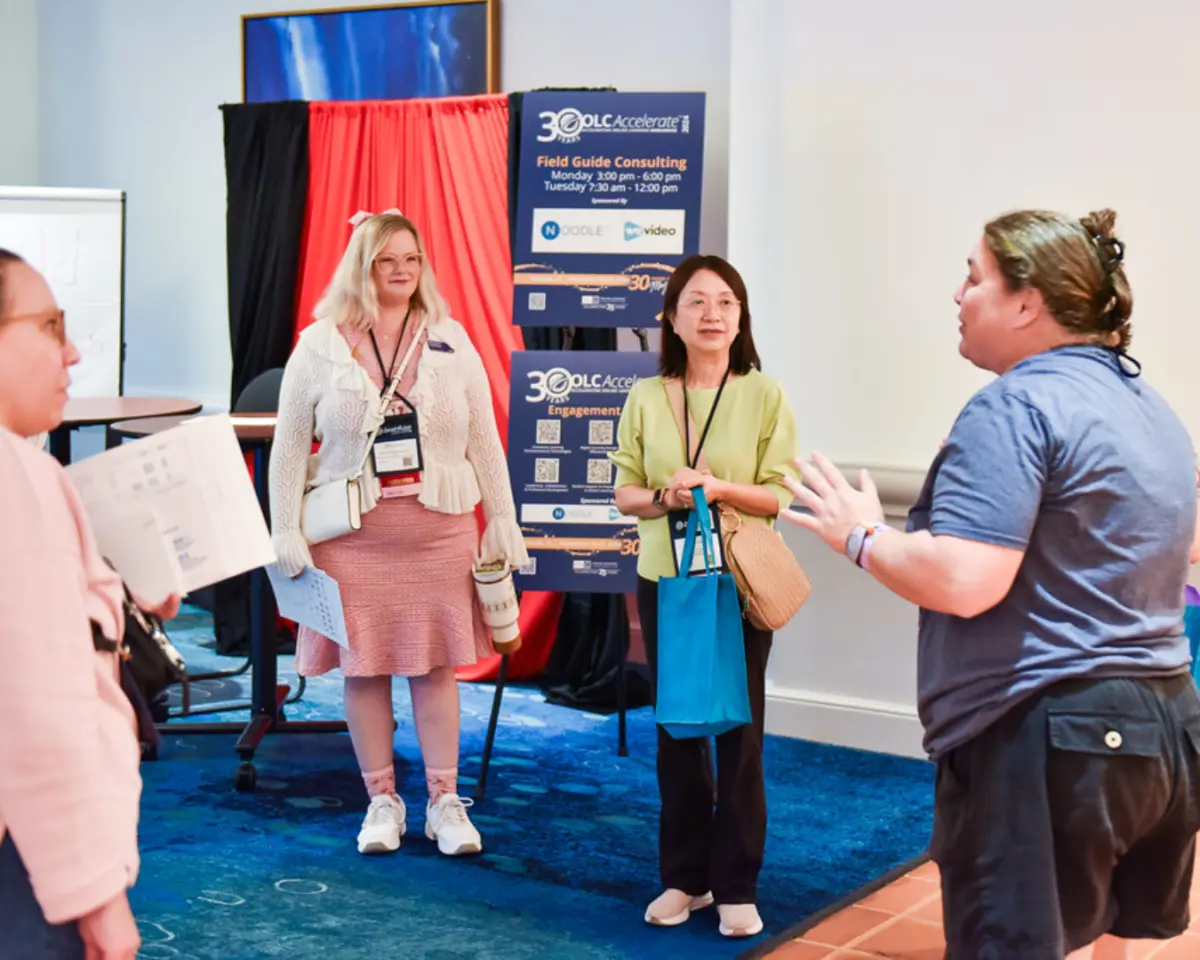
"Field Guides are there to help make the conference feel more manageable and personal," Heald states. "We can help you navigate the conference, talk through sessions that might match your interests, answer questions, and help you make connections. If you are attending alone, come tell us. If you have no idea which session to choose, ask us."
The Field Guides serve as human wayfinders—not merely directing traffic to Room 204 or the main auditorium, but acting as social anchors. They bridge the gap for first-time attendees, solo travelers, and introverted professionals who might otherwise spend their days eating lunch alone in a hotel room or clinging tightly to their mobile devices to avoid eye contact.
Furthermore, Heald underscores the reciprocity of professional growth. Attendees must shed the imposter syndrome mindset that whispers they have nothing valuable to contribute.
"You are not only coming to OLC to gain something. You are bringing something with you," Heald emphasizes. "Your experiences, ideas, successes, mistakes, questions, and perspectives may be exactly what someone else needs to hear. The conversation you almost did not start could introduce someone to a new idea."
5. Future Outlook: The Evolution of Professional Conferences in Higher Education
As higher education continues to navigate post-pandemic shifts, hybrid learning modalities, and rapid technological innovations like generative artificial intelligence, the role of professional conferences is undergoing a profound metamorphosis.
Conferences can no longer rely solely on the traditional "sage on the stage" model where passive audiences sit in darkened rooms listening to lectures. Information is ubiquitous; journal articles, webinars, and asynchronous videos deliver content instantly. Therefore, the true value proposition of attending a physical conference like OLC is communal immersion—the irreducible human element of physical presence, shared laughter, debate, and spontaneous brainstorming.
Looking ahead, initiatives like the Field Guide program point toward a more empathetic, inclusive, and human-centric future for academic gatherings. By intentionally designing spaces for accidental collisions of thought, conferences maximize their intellectual output.
Key Takeaways for the 2026 OLC Attendee:
- Embrace the Unscripted: Acknowledge that the best breakout session of your week might happen in the coffee line, not on the formal agenda.
- Weaponize Curiosity: Drop the pressure to "network" in a corporate, transactional sense. Instead, simply be curious about your peers.
- Seek Out the Guides: If you feel lost, overwhelmed, or isolated, look for the OLC Field Guides. They are explicitly deployed to be your familiar face in an unfamiliar room.
- Recognize Your Value: Your unique institutional struggles and creative failures are pedagogical gold mines for someone else in the room. Share them freely.
In the end, as Heald aptly reminds us, long after the slide decks are archived, the breakout room numbers are forgotten, and the travel receipts are filed away, the human connections remain. One person, one conversation, and one unexpected connection truly are all it takes to shift the trajectory of an educational career.

