
Executive Overview
The American K-12 public education system is navigating a monumental structural shift. According to the third annual update of Bellwether’s analysis of the U.S. Census Bureau’s Annual Survey of School System Finances, fiscal year (FY) 2024 data reveals a nationwide school funding landscape that looks profoundly different from the turbulent pandemic era.
For two years, districts nationwide relied heavily on one-time federal COVID-19 relief to drive funding growth. However, as those federal funds wind down ahead of their final deadlines, state governments have increasingly stepped in to fill the expanding fiscal gaps. At the same time, nationwide student enrollment declines have accelerated, returning with a vengeance after a brief mid-pandemic pause.
This comprehensive longitudinal view exposes both the successes and vulnerabilities of public education finance. While inflation-adjusted total per-pupil funding reached historic highs in FY24, the underlying dynamics signal an impending fiscal reckoning. States and school districts that used temporary federal relief to cover recurring, long-term operational costs rather than building sustainable, recurring revenues now face severe budget cliffs.
Coupled with sustained, long-term enrollment drops driven by falling national birth rates, education leaders face difficult structural choices. As we look past the final liquidation of federal Elementary and Secondary School Emergency Relief (ESSER) funds, the future of K-12 equity and resource stability will rest squarely on the shoulders of state policymakers.
Detailed Chronology: The Evolution of K-12 Funding from Pandemic Peaks to FY24
To understand where school finance stands today, it is vital to trace the rapid evolution of federal, state, and local investments from the onset of the COVID-19 pandemic through FY24.
The Pandemic Apex (FY20–FY22)
When the COVID-19 pandemic disrupted public schooling in early 2020, Congress responded with unprecedented fiscal interventions. Through successive legislative packages—culminating in the American Rescue Plan—the federal government pumped roughly $190 billion into K-12 education via ESSER funds.
Between FY20 and FY21, this injection of capital triggered historic funding growth. During this peak period, an astounding 48 states saw total per-pupil funding increase. Federal dollars cushioned school districts against economic volatility, allowing them to hire additional staff, upgrade ventilation systems, implement high-dosage tutoring, and address acute student mental health crises.
This momentum persisted into FY22, where 47 states continued to experience high levels of federal per-pupil funding infusions. Yet, even as money flowed into school systems, warning signs flickered. Analysts and economists cautioned that districts were absorbing temporary monies into permanent budget lines—such as salary bumps and expanded programming—that would outlive the federal relief checks.
The Great Reversal (FY23)
By fiscal year 2023, the tide began to turn. The initial wave of federal relief had plateaued, and school districts began racing to obligate their remaining ESSER dollars ahead of regulatory deadlines.
The impact on total per-pupil funding (combining local, state, and federal sources) was immediate and stark. Between FY22 and FY23, the number of states experiencing increases in total per-pupil funding plummeted from nearly all of them to just 23 states. Federal per-pupil funding dropped in 38 states, as the massive COVID-19 infusions began to recede in rearview mirrors. State governments had not yet scaled up their contributions enough to offset the federal withdrawal, creating a brief valley in overall funding trajectories.
The State-Led Resurgence (FY24)
The newly released FY24 data captures the next chapter in this financial saga: a broad-based state-level rescue.
In FY24—the final fiscal year in which districts could newly obligate one-time ESSER funds—state governments stepped into the breach. While federal per-pupil funding fell in 36 states, state funding surged in 39 states. This state-level rebound pushed inflation-adjusted total per-pupil funding up to $21,389 nationally, the highest level recorded in Bellwether’s analysis, and roughly $2,000 more per student than pre-pandemic FY20 levels.
However, this national upward trend was not universal. Eleven states experienced declines in total per-pupil funding, proving that local realities varied wildly depending on regional economic health, state legislative priorities, and pre-existing funding formulas.
Supporting Context & Metrics: Breaking Down the Numbers
A deeper dive into the Census Bureau data reveals striking granular shifts across funding streams, federal phase-outs, and enrollment patterns.
1. Total Per-Pupil Funding Reaches New Highs
- The Metric: Nationally, inflation-adjusted total per-pupil funding climbed to $21,389 in FY24.
- The Context: Thirty-nine states saw total per-pupil funding increase from FY23 to FY24, a massive rebound from the sluggish 23-state increase recorded between FY22 and FY23.
- The Disparity: Despite broad national gains, 11 states bucked the trend, seeing total per-pupil funding decline even as the rest of the country enjoyed an infusion of state-level resources.
2. The Rapid Retreat of Federal Support
- The Metric: National inflation-adjusted federal per-pupil funding dropped from $2,667 to $2,479 between FY23 and FY24—a sharp 7% decline.
- The Context: This marks the second consecutive year of broad federal declines, following peak increases in 49 states in FY21 and 47 states in FY22.
- The Deadline Pressure: This reduction directly mirrors the race by school districts to obligate remaining ESSER dollars before the strict September 30, 2024 federal obligation deadline. By August 2024, data indicates that states and districts nationwide had spent approximately $170 billion—roughly 90%—of the total $190 billion ESSER allocation. While districts have until March 2026 to officially liquidate remaining funds, the window for new spending has slammed shut.
3. State Revenues Fill the Gap
- The Metric: Inflation-adjusted per-pupil state funding climbed to an all-time analysis high of $9,716 nationally.
- The Context: In a mirror image of the federal retreat, 39 states increased per-pupil state funding between FY23 and FY24 (compared to just nine states between FY21 and FY22).
- State Leaders: Nevada, New Mexico, Vermont, Minnesota, and Idaho posted the largest per-pupil dollar increases in state funding nationwide. Conversely, 11 states experienced per-pupil decreases in state funding.
- Complex Intersections: The data shows intricate cross-currents: 35 states saw both total and state per-pupil funding rise. However, anomalies existed—Colorado, Florida, Illinois, and Oregon saw total funding grow despite state funding dropping, while Connecticut, Iowa, Nebraska, and Washington saw state funding rise even as their total per-pupil funding fell.
4. The Resurgence of Student Enrollment Declines
- The Metric: Forty-two states saw student enrollment fall between FY23 and FY24. Only eight states—Alaska, Delaware, Maryland, Montana, New Jersey, North Dakota, South Carolina, and Washington—gained students over the same timeframe.
- The Pandemic-Era Baseline: Across the broader pandemic timeline, 45 out of 50 states maintain lower student enrollments in FY24 than they did in FY20.
- The Root Cause: These losses are not merely a lingering artifact of remote learning; they are driven by a deeper demographic shift. Falling birth rates are the primary culprit, with the national birth rate plummeting by 15% between 2012 and 2024. Every single state experienced at least a 6% decline in birth rates over that period, guaranteeing that smaller kindergarten cohorts will continue to ripple upward through the K-12 system for years to come.
Official Perspectives & Expert Insights
As education finance analysts, state legislators, and district superintendents digest the FY24 data, experts emphasize that the numbers tell a story of systemic transition.
Education finance researchers note that the transition period between FY24 and FY27 will separate fiscally prudent school systems from those that engaged in short-sighted budgeting. States and districts that used temporary federal relief to fund one-time capital improvements, technology upgrades, or targeted short-term programs are well-positioned. Conversely, districts that used ESSER funds to hire permanent personnel or establish ongoing academic programs without securing recurring state or local revenue streams are now staring down severe budgetary precipices.
Furthermore, policy groups tracking education funding highlight the compounding pressure of declining enrollments. When student populations drop, traditional funding models—which often rely heavily on per-pupil formulas—mean district revenues drop automatically. When this occurs simultaneously with the evaporation of federal ESSER relief, local administrators are forced into painful compromises: freezing hiring, cutting elective programming, or closing neighborhood schools entirely.
Future Outlook: What Lies Ahead for K-12 Education Finance
The release of the FY24 finance data serves as both a snapshot of past resilience and a warning flare for future challenges. As the public education sector moves deeper into the post-ESSER era, several critical milestones and headwinds will shape the landscape:
1. The 2026 Liquidation Deadline and FY27 Reality
While the final deadline to obligate ESSER funds passed in September 2024, the federal government permitted districts to liquidate remaining funds through March 2026. Because this liquidation window stretches deep into FY25 and FY26 school budgets, remnants of federal COVID-19 aid will continue to appear on financial ledgers.
Consequently, fiscal year 2027 will represent the true "fiscal cliff"—the first fiscal year in which federal COVID-19 relief will be entirely absent from school district financial statements. Budget shortfalls tied to expired federal funds will manifest acutely in FY25 and FY26 budgets, but FY27 will expose the naked reality of districts’ recurring revenue baselines.
2. Unrelenting Enrollment Pressures
Demographic projections suggest that student population contractions are here to stay. According to the National Center for Education Statistics (NCES), public K-12 enrollment will continue to fall across the vast majority of the country. Projections indicate that 40 out of 50 states will record lower student enrollment in fall 2031 than they did in fall 2022.
For school districts, declining enrollment requires proactive, strategic right-sizing. Districts that fail to manage facility utilization and staff-to-student ratios proactively will find themselves spending an unsustainable percentage of their budgets on fixed overhead costs rather than direct classroom instruction.
3. Tightening State Budgets and Proposed Federal Cuts
Compounding the loss of ESSER funds and shrinking student bodies, state macroeconomic conditions are beginning to cool. Many states that enjoyed robust budget surpluses during the pandemic are seeing revenue growth slow down.
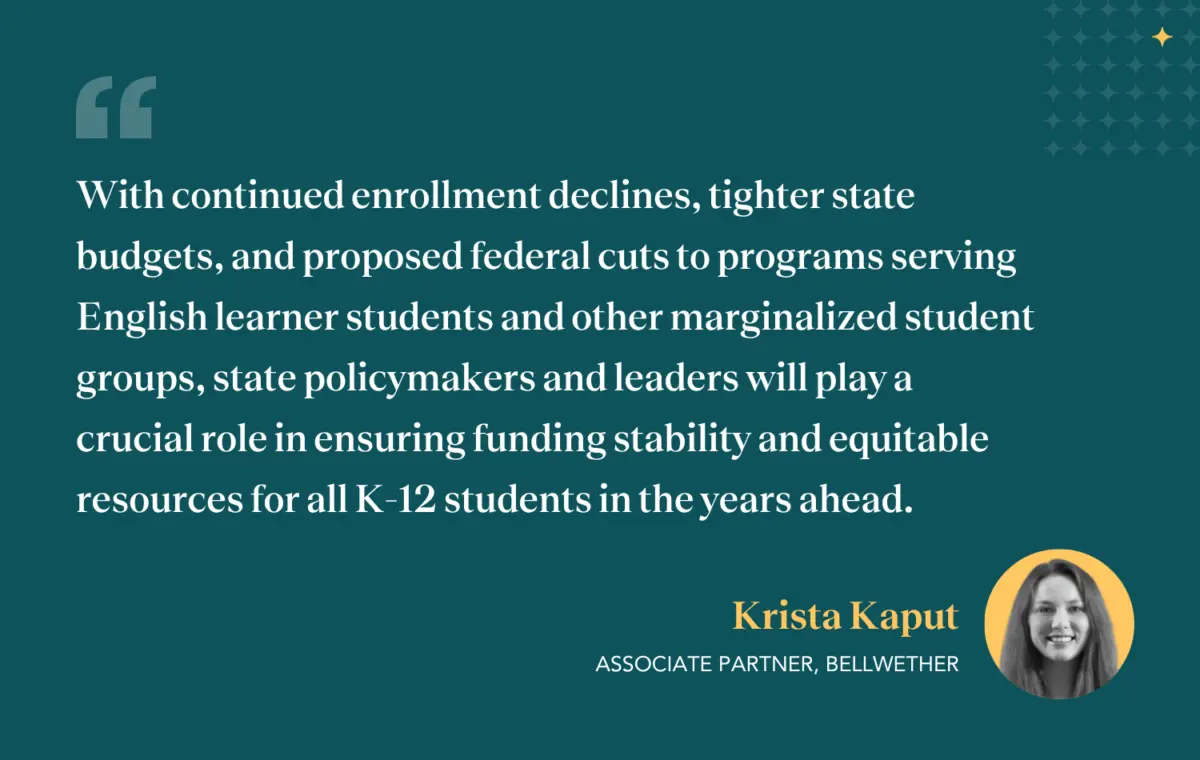
At the same time, policy discussions at the federal level point toward potential cuts in targeted federal programs. Proposed reductions to funding streams supporting English learner (EL) students, low-income districts (Title I), and other marginalized student populations threaten to exacerbate funding inequities.
Conclusion
The journey from pandemic emergency funding to post-pandemic fiscal normalization is fraught with peril, but it also offers a moment of clarity. State policymakers, local school boards, and community leaders must take proactive steps to fortify funding structures, protect vulnerable student populations, and modernize school funding formulas to match declining demographic realities.
Tools like Bellwether’s Fortifying Funding Interactive Finance Tool provide communities with the empirical foundation needed to understand these trends. Ultimately, ensuring long-term financial stability and equitable resource distribution for all K-12 students will require visionary leadership, disciplined budgeting, and an unwavering commitment to public education.

