

Executive Overview
As organizations globally transition from experimenting with standalone generative AI models to deploying autonomous, execution-oriented systems—commonly referred to as agentic AI—the underlying infrastructure demands have shifted dramatically. Enterprises no longer simply require isolated sandbox environments for training or testing large language models (LLMs). Instead, they need robust, secure, and unified operational frameworks capable of running production-grade AI agents shoulder-to-shoulder with mission-critical virtualized and containerized applications.
Addressing this paradigm shift, Nutanix has significantly expanded the capabilities of the Nutanix Cloud Platform (NCP). Announced on August 26, the latest wave of updates introduces Nutanix Enterprise AI (NAI) 2.8—which is generally available today—alongside the upcoming release of the Nutanix Kubernetes Platform (NKP) 2.19. Furthermore, the company has rolled out Service Provider Central (SP Central), a new multitenant control plane designed to streamline infrastructure, application, cloud-native, and AI services across distributed environments.
At the heart of this product evolution is Nutanix’s signature "dual-native" architectural philosophy, which treats virtual machines (VMs) and containers as first-class citizens of the data center. By unifying these deployment models under a single governance and management plane, Nutanix aims to eliminate the friction that forces IT and engineering teams to silo their AI initiatives away from core business operations.
In the words of Thomas Cornely, Executive Vice President of Product Management at Nutanix: "Enterprise AI should not require customers to rebuild the systems that already run their business." This article provides an in-depth, structured analysis of these platform updates, exploring how NAI 2.8, NKP 2.19, and advanced Model Context Protocol (MCP) governance are reshaping enterprise infrastructure strategies.

Detailed Chronology of Recent Product Releases and Updates
The expansion of the Nutanix Cloud Platform for production agentic AI represents the culmination of a targeted, rapid product rollout strategy throughout mid-2026. Understanding the chronological sequence of these developments highlights how Nutanix is systematically bridging the gap between infrastructure operations and developer-centric AI tooling:
- August 10, 2026 — Open-Source MCP Server for NCP: Nutanix laid the groundwork for agentic integration by releasing an open-source Model Context Protocol (MCP) server designed specifically for the Nutanix Cloud Platform. Leveraging the Nutanix Prism v4 API, this software bridges the gap between AI assistants (such as GitHub Copilot, Claude Code, and Cursor) and enterprise infrastructure. The integrated Prism v4 API Gateway instantly established critical enterprise guardrails, including role-based access control (RBAC), request throttling, metering, and detailed auditing.
- August 26, 2026 — Comprehensive AI Platform Enhancements: Nutanix officially announced the broader platform expansion. This wave included the immediate general availability of Nutanix Enterprise AI (NAI) 2.8, the preview announcement for Nutanix Kubernetes Platform (NKP) 2.19, and the commercial rollout of Service Provider Central (SP Central).
- Late Q3 2026 (Upcoming) — General Availability of NKP 2.19: Slated for release in the near future, NKP 2.19 is positioned to extend enterprise-grade container management seamlessly across both virtualized environments and bare-metal physical servers, bolstered by a dedicated AI Applications Catalog.
This measured cadence demonstrates a deliberate strategy: first establishing secure API-level hooks for external AI agents, then layering on centralized agent gateway governance (in NAI 2.8), and finally expanding the foundational container and bare-metal architecture (in NKP 2.19).
Core Technical Innovations in Nutanix Enterprise AI 2.8
The release of NAI 2.8 introduces vital features engineered to tame the operational chaos of deploying agentic systems in production. Chief among these are advanced MCP governance mechanisms, optimized private inference capabilities, and granular security controls.
Masterminding Governance via Nutanix Agent Gateway
As AI agents evolve from passive text generators into active decision-makers capable of modifying databases, invoking APIs, and executing code, securing their access paths becomes paramount. NAI 2.8 addresses this challenge by introducing generally available MCP server management within the Nutanix Agent Gateway.
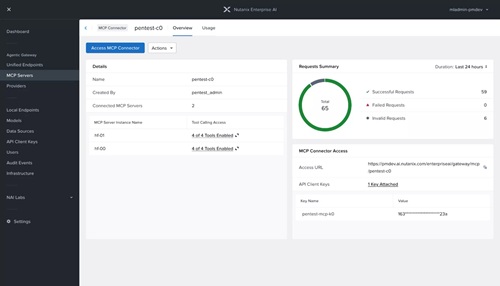
The Agent Gateway acts as an intelligent, centralized chokepoint mediating communication between autonomous AI agents and underlying MCP servers—whether those servers are deployed locally within the secure perimeter of the NAI environment or hosted remotely.
- Granular Tool Permissions: System administrators can assign precise tool-level permissions tied directly to specific user accounts or API keys. This ensures an AI agent only accesses the exact datasets and execution tools required for its assigned task.
- Rolling Updates: Locally deployed MCP servers now support seamless, non-disruptive rolling updates, ensuring that developer tooling can evolve without introducing downtime to AI-driven business workflows.
This architecture creates a powerful division of labor between Nutanix’s two primary MCP components:
- NCP MCP Server: Exposes infrastructure operations (via Prism v4 APIs) directly to compatible AI developer assistants, empowering them to interact with cloud resources.
- Nutanix Agent Gateway: Governs and secures agent access to MCP servers, establishing a vital administrative perimeter around enterprise data and tools.
Extending Nutanix Private Inference and Tech Previews
To optimize performance and data privacy, NAI 2.8 enhances Nutanix Private Inference with capabilities tailored for enterprise security mandates:
- Fine-Tuning & Air-Gapped NIMs: Organizations can now fine-tune models containing fewer than 8 billion parameters entirely on-premises. Furthermore, NAI 2.8 supports the deployment of NVIDIA NIM microservices directly within completely air-gapped environments, ensuring sensitive corporate data never leaves the secure local perimeter.
- Tech Preview Capabilities: Nutanix has introduced technical previews for multi-node and multi-GPU inference—designed specifically to support massive models exceeding 100 billion parameters. Additionally, KV (Key-Value) cache offloading from high-performance GPU memory to host CPU memory has entered tech preview. Note: Nutanix explicitly cautions that all features designated as technical previews are intended strictly for evaluation and must not be deployed in production environments.
NKP 2.19: Bridging Bare-Metal and AI Container Workloads
While NAI 2.8 focuses on agent governance and model execution, the upcoming Nutanix Kubernetes Platform (NKP) 2.19 targets the foundational container infrastructure required to host complex, distributed machine learning pipelines.

NKP Metal and AHV Integration
NKP 2.19 expands container management flexibility by bridging virtualized and bare-metal architectures:
- NKP Metal: This capability extends the familiar, automated Nutanix operational model directly to physical bare-metal servers. Leveraging underlying Nutanix Foundation and Lifecycle Manager technologies, NKP Metal automates node deployment, operating system configuration, and firmware lifecycle management.
- NKP on AHV: For virtualized environments, NKP running on the Acropolis Hypervisor (AHV) can be tightly integrated with Nutanix Flow. This combination delivers robust, network-level microsegmentation to isolate AI agents, preventing lateral movement in the event of a security compromise.
- CNCF Certification: Demonstrating strict adherence to cloud-native standards, NKP has officially achieved CNCF Kubernetes AI Conformant Platform certification.
The AI Applications Catalog
To accelerate time-to-value for machine learning engineering teams, NKP 2.19 introduces a curated AI Applications Catalog. This catalog simplifies the deployment of heavily vetted AI and machine learning software frameworks. Notable platforms available out-of-the-box include:
- Kubeflow: For orchestrating complex, scalable machine learning workflows on Kubernetes.
- Milvus: A high-performance, cloud-native vector database essential for powering retrieval-augmented generation (RAG) and semantic search in agentic architectures.
- Slurm: A battle-tested cluster management and job scheduling system widely used for high-performance computing (HPC) and heavy model training workloads.
Supporting Context, Metrics, and Architectural Philosophy
The strategic rationale behind these updates is rooted in the realities of modern enterprise IT spending and architectural fatigue. For years, organizations rushed to adopt public cloud platforms or specialized, standalone AI clusters, resulting in fractured data silos, soaring egress fees, and operational complexity.
Nutanix’s "dual-native" architecture directly challenges this fragmentation. By engineering NCP to treat VMs and containers with equal priority, enterprises can colocate data-intensive AI workloads directly alongside existing relational databases, enterprise resource planning (ERP) systems, and legacy applications.

Key Architectural & Operational Highlights:
- Eliminating Data Migration Friction: Running AI agents near existing data repositories eliminates the latency, cost, and security risks associated with copying terabytes of corporate data across disparate cloud silos.
- Unified Multitenant Control: Through the general availability of Service Provider Central (SP Central), infrastructure administrators gain a unified multitenant control plane capable of overseeing infrastructure, native applications, cloud-native deployments, and AI services from a single pane of glass.
- Enterprise-Grade Guardrails: By combining Prism v4 API security controls—such as role-based access, throttling, metering, and auditing—with the new Agent Gateway MCP governance, Nutanix provides the rigorous compliance framework demanded by CISOs and compliance officers.
Official Statements and Industry Perspective
Industry analysts and company leadership agree that the transition to agentic AI represents a fundamental turning point for enterprise software. Unlike passive chat interfaces, agentic systems execute actions across corporate systems, making security, governance, and infrastructure proximity non-negotiable requirements.
Thomas Cornely emphasized this philosophy during the August 26 announcement:
"Enterprise AI should not require customers to rebuild the systems that already run their business. By delivering a dual-native platform that treats virtual machines and containers with equal importance, we are giving organizations the freedom to run production agentic AI their way—securely, efficiently, and alongside their existing applications."
By streamlining the integration of advanced tools like NVIDIA NIM microservices, local MCP servers, and bare-metal Kubernetes clusters, Nutanix is positioning its cloud platform as a comprehensive operating system for the next generation of intelligent, automated enterprise workflows.

Future Outlook
As the enterprise AI landscape matures through the remainder of 2026 and into 2027, the battleground for infrastructure providers will be defined by governance, scalability, and seamless integration. The ability to deploy autonomous agents will no longer be viewed as a standalone novelty; it will be evaluated against strict enterprise criteria: How securely is it governed? How efficiently does it utilize hardware? And how easily does it integrate with legacy corporate systems?
With the release of Nutanix Enterprise AI 2.8 and the impending rollout of Nutanix Kubernetes Platform 2.19, Nutanix has established a compelling blueprint for the hybrid enterprise. By solving the complex challenges of MCP server governance, private fine-tuning in air-gapped environments, and unified container management across virtual and bare-metal assets, the company is well-equipped to support the mainstream adoption of production agentic AI.
Organizations looking to modernize their infrastructure without sacrificing security or operational consistency would do well to evaluate these platform updates as part of their long-term enterprise AI roadmap. For further technical documentation and release notes, visit the official Nutanix website.

