
Executive Overview
Artificial intelligence has swept into K-12 classrooms at a blistering pace, leaving most educators to navigate an unprecedented technological shift without a formal roadmap. Generative AI tools, led by platforms like ChatGPT, have fundamentally altered the mechanics of modern education. In mere seconds, these systems can draft comprehensive lesson plans, personalize practice problems for struggling learners, and clear hours of administrative friction off an evening grading pile.
Yet, this rapid integration brings profound systemic vulnerabilities. Classrooms now grapple with sophisticated plagiarism, unverified hallucinations masquerading as objective facts, and the looming risk of intellectual over-reliance among students. Rather than serving as an autonomous replacement for human pedagogy, artificial intelligence operates best as a high-speed digital teaching assistant. When bounded by clear instructional guardrails and an unwavering commitment to fact-checking, AI can revolutionize productivity without eroding the vital human judgment that underpins true teaching.
Detailed Chronology: The Rapid Ascent of Classroom AI
The integration of generative artificial intelligence into educational environments did not happen through a slow, deliberate institutional rollout. It arrived abruptly, forcing schools to pivot from passive observation to active management.

The Initial Disruption (Late 2022 – Early 2023)
When OpenAI launched ChatGPT to the public in late 2022, the immediate reaction across academic institutions was reactionary. School districts nationwide scrambled to implement blanket bans. Administrators worried about the instantaneous generation of five-paragraph essays, mathematical proofs, and homework assignments completed by algorithms rather than students. Detection software companies rushed to market, promising foolproof identification of machine-generated text, though early iterations struggled with high rates of false positives and negatives.
The Shift Toward Integration (2023 – 2024)
By mid-2023, institutional perspectives began to evolve. Major educational bodies, including the U.S. Department of Education’s Office of Educational Technology, began tracking the shift and emphasizing policy frameworks over prohibition. Influential industry voices—including OpenAI CEO Sam Altman—drew parallels to historical technological disruptions, such as the introduction of the pocket calculator. Just as mathematics education adapted to calculators rather than banning them, educational theorists argued that literacy, critical thinking, and testing methodologies needed to evolve alongside generative AI.
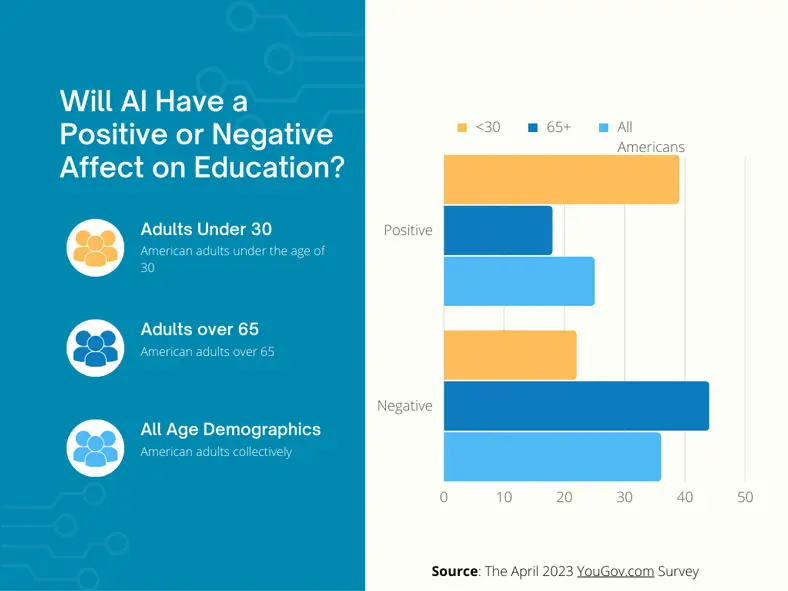
Data from a YouGov survey in April 2023 underscored this cultural shift: 52% of U.S. adults asserted that schools should focus on teaching students how to use AI appropriately, compared to only 24% who favored prevention. Furthermore, 61% of respondents recognized AI literacy as a necessary competency for future career paths.
Maturation and Policy Fragmentation (2025 – Present)
Today, the educational landscape is characterized by decentralized policy-making. Federal guidance encourages digital literacy, but local implementation varies wildly. Some school districts embrace AI as an administrative and instructional equalizer, while others maintain strict prohibitions. Teachers are increasingly moving past the existential fear of replacement, focusing instead on practical boundaries: treating AI outputs as raw drafts that require rigorous human verification and critical analysis.
Supporting Context & Metrics: Where AI Helps, Where It Falls Short, and Economic Realities
To understand AI’s true footprint in education, one must examine its practical utility, its inherent limitations, and the broader economic framework governing the teaching profession.
Where AI Actually Helps Teachers
Used strategically, generative AI functions as a virtual teaching assistant, shouldering the weight of repetitive tasks and allowing educators to refocus on high-impact student interactions. Primary use cases include:

- Administrative and Lesson Drafting: Instantly generating rough drafts for weekly newsletters, unit outlines, and multi-tiered lesson plans.
- Differentiation: Modifying complex texts or reading assignments on the fly for English Language Learners (ELL) or students requiring specialized reading support.
- Brainstorming and Prompt Engineering: Creating diverse discussion questions that push students to analyze literary tone and structure, or providing alternate framings for student writing assignments.
For students, AI acts as an interactive tutor. When a student struggles to grasp a textbook’s phrasing, they can prompt the AI to rephrase the concept in simpler terms, provided they cross-reference that explanation with foundational classroom instruction.
+-----------------------------------------------------------------+
|                  AI AS A TEACHING ASSISTANT                     |
|                                                                 |
|  [Teacher Prompt] ---> [Generative AI] ---> [Draft Material]    |
|                                                    |            |
|                                                    v            |
|  [Student Success] <--- [Human Verification] <--- (Review)      |
+-----------------------------------------------------------------+
Where AI Falls Short: Accuracy and Academic Integrity
Generative AI is not an authoritative source of truth. Chatbots are prone to "hallucinations"—confidently presenting fabricated facts, historical dates, or nonexistent citations as absolute facts. This vulnerability makes blind reliance dangerous, though it also creates a unique pedagogical opportunity: teachers can turn fact-checking AI outputs into dynamic research exercises.
Plagiarism and academic dishonesty remain persistent challenges. While detection software exists—such as Winston AI for flagging synthetic text and Turnitin’s integrated detectors—industry leaders openly acknowledge that no tool is infallible. False positives can unfairly penalize honest students, complicating disciplinary processes. Consequently, institutional guidelines remain fractured, requiring educators to verify local district policies before setting classroom expectations.
Classroom Activity Spotlight: Using AI to Teach Essay Structure and Fact-Checking
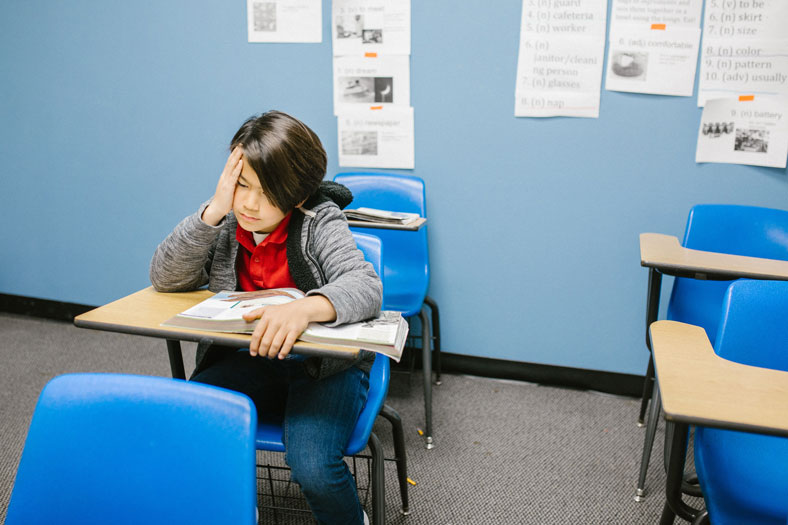
Instead of banning writing tools, high school educators are increasingly deploying structured reverse-engineering exercises. Students intentionally prompt an AI to write an essay on a historical or literary topic, and then work in groups to identify logical fallacies, verify historical dates, cross-check citations against peer-reviewed databases, and rewrite the weak sections manually. This approach transforms a cheating risk into a masterclass in media literacy and critical thinking.
Economic and Professional Metrics in Education
The integration of educational technology occurs against a backdrop of evolving labor dynamics. According to data from the U.S. Bureau of Labor Statistics (BLS) and employment projections from Projections Central, the teaching profession remains robust despite technological disruptions:
- National Median Salaries (May 2025 BLS Data):
- Elementary School Teachers: $63,820
- Middle School Teachers: $64,370
- High School Teachers: $72,040
- Job Growth Projections (2024–2034): While employment in specific core K-12 roles is projected to see modest adjustments, substantial annual job openings will persist. These openings are driven primarily by natural workforce turnover—including retirements and career transitions—rather than displacement by artificial intelligence.
Official Statements and Institutional Perspectives
Educational authorities and labor organizations maintain a nuanced stance on artificial intelligence, balancing the promise of technological efficiency against the irreplaceable value of human mentorship.

- The U.S. Department of Education: Through its Office of Educational Technology, federal guidance consistently emphasizes that AI should empower educators rather than automate them. Policies stress data privacy, equity in access, and the mitigation of algorithmic bias.
- OpenAI Leadership: Executive leadership has frequently compared generative AI to foundational historical disruptions like the personal computer or the internet. The official stance advocates for systemic adaptation—redesigning assessments to measure critical thinking, synthesis, and analysis rather than rote memorization.
- Educational Unions and Associations: While acknowledging the potential for AI to alleviate burnout by reducing administrative burdens, major teaching organizations emphasize that technology cannot replicate emotional intelligence, behavioral observation, or the nuanced interpersonal rapport required to guide a struggling child.
Future Outlook: The Human-Centric Horizon
Looking toward the next decade, the trajectory of artificial intelligence in K-12 education will depend on intentional governance and professional development. Blanket bans are increasingly recognized as unsustainable relics of an early transitional phase. As students experiment with these tools independently outside of school walls, educational institutions must proactively teach digital discernment.
Workshops, peer-led professional development communities, and collaborative lesson-planning sessions are proving far more effective than top-down mandates. Teachers who experiment collectively develop a practical consensus: AI excels at generating first drafts, differentiated worksheets, and administrative outlines, but it requires relentless human oversight for grading, nuanced feedback, and emotional intervention.
Ultimately, artificial intelligence will not replace teachers. The core of education relies on human presence, empathy, and moral judgment—qualities no algorithm can replicate. By treating AI as a sophisticated assistant rather than an oracle, modern classrooms can harness technological efficiency while keeping the human teacher firmly at the center of the learning experience.

