
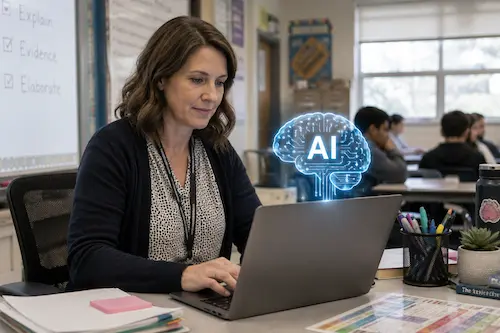
Executive Overview
The landscape of primary and secondary education has undergone a profound structural shift regarding artificial intelligence. Just a few academic cycles ago, school administrators and classroom educators were largely consumed by foundational questions surrounding academic integrity, technology bans, and basic instructional compliance. Early reactions to generative artificial intelligence ranged from defensive measures designed to detect machine-written essays to tentative, isolated experiments with automated lesson planning.
Today, as school systems across North America prepare for the 2026–2027 academic year, that initial panic has given way to institutional maturity. The central debate is no longer whether artificial intelligence belongs in the modern classroom, but rather how its adoption can be deliberately structured to enhance human pedagogy.
School districts are now establishing enterprise-level AI governance frameworks, funding specialized professional learning ecosystems, and adopting purpose-built educational platforms. Concurrently, the operational focus of educators has evolved. Teachers are moving past basic automated text generation ("Can AI write a lesson plan?") to engage with deeper pedagogical questions: "How can AI augment my capacity as an expert practitioner while safeguarding the human connections essential to learning?"
This journalistic inquiry examines this paradigm shift, drawing upon frameworks highlighted by educational leaders, including Timothy Montalvo, Assistant Principal at Fox Lane Middle School and adjunct professor at Iona University and the College of Westchester. The consensus among forward-looking educators is clear: artificial intelligence must not be deployed to replace human professional judgment or turn instruction into an automated pipeline. Instead, its primary value lies in its ability to absorb administrative burden, thereby liberating educator time for the relational, social-emotional, and diagnostic work that technology cannot replicate.
Detailed Chronology: The Evolution of AI in K–12 Classrooms (2022–2026)
The path from technological resistance to intentional integration has unfolded in distinct, rapidly accelerating phases across the educational landscape:
+-----------------------------------------------------------------------------------+
| CHRONOLOGICAL PARADIGM SHIFT IN K-12 AI ADOPTION                                   |
+-----------------------------------------------------------------------------------+
| [2022–2023] PHASE 1: DISRUPTION & REACTION                                        |
| • Emergency bans on open-access LLMs across major public school districts.        |
| • Focus centered heavily on plagiarism detection and academic honesty enforcement. |
+-----------------------------------------------------------------------------------+
                                         |
                                         v
+-----------------------------------------------------------------------------------+
| [2023–2024] PHASE 2: TENTATIVE EXPERIMENTATION                                    |
| • Grassroots adoption led by tech-forward "early adopter" educators.             |
| • Initial shift toward automated lesson planning and basic administrative prompts.  |
+-----------------------------------------------------------------------------------+
                                         |
                                         v
+-----------------------------------------------------------------------------------+
| [2024–2025] PHASE 3: POLICY & PLATFORM INTEGRATION                                |
| • Widespread district guidance, data privacy standards, and vendor vetting.        |
| • Emergence of specialized, FERPA-compliant edtech AI platforms.                   |
+-----------------------------------------------------------------------------------+
                                         |
                                         v
+-----------------------------------------------------------------------------------+
| [2026–2027 Horizon] PHASE 4: RELATIONAL PEDAGOGY & WORKFLOW SYSTEMATIZATION       |
| • Focus pivots to human-centric workflow integration and AI literacy curriculum.  |
| • Operational metrics measure success by time reclaimed for student connection.   |
+-----------------------------------------------------------------------------------+
Phase 1: Emergency Reaction and Containment (Late 2022 – Mid 2023)
Following the public launch of large language models (LLMs) in late 2022, school systems faced immediate disruption. Major municipal school districts initially issued network-level blocks on generative tools. Administrative priorities focused almost entirely on academic dishonesty, cheating countermeasures, and third-party detection software, much of which subsequently proved unreliable and prone to false positives.
Phase 2: Grassroots Exploration and Tool-Centric Usage (2023 – 2024)
As early bans proved structurally unenforceable on personal devices, educators transitioned toward cautious experimentation. Teachers independently began testing AI for localized, isolated administrative tasks—drafting standardized rubrics, generating reading comprehension questions, and composing routine parent emails. However, usage remained ad-hoc, fragmented, and largely detached from broader district instructional strategies.
Phase 3: Infrastructure, Policy, and Enterprise EdTech (2024 – 2025)
State departments of education and local school boards began releasing formal policy frameworks addressing student data privacy (compliant with FERPA and COPPA), algorithmic bias, and equitable access. Edtech providers embedded tailored LLM interfaces directly into Learning Management Systems (LMS), creating walled-garden environments that prioritized student data safety over public, open-ended interfaces.
Phase 4: Institutionalization and Relational Pedagogy (2026 – 2027 Horizon)
Entering the 2026–2027 school year, leading educational entities have institutionalized AI. The conversation has matured from managing software tools to optimizing human instructional workflows. Priority is now given to protecting human-centric teaching, advancing critical student AI literacy, and deploying automation purposefully to reclaim time for direct, face-to-face mentorship.
Supporting Context & Strategic Implementation: The 5 Pillars
To understand how high-performing instructional leaders are structuring this transition, education analysts emphasize five core operational strategies that define mature classroom AI adoption.
1. Transitioning from Toolkits to Cohesive AI Workflows
In the early stages of adoption, educators often sought a single, all-encompassing software solution. Today’s pedagogical consensus recognizes that reliance on a single tool is inefficient. Just as modern instruction utilizes distinct software platforms for grading, email communication, learning management, and data visualization, effective educators build multi-tiered AI workflows tailored to specialized tasks.
Rather than asking, "What is the best AI tool?" practitioners are trained to evaluate, "Which engine best addresses this specific cognitive or administrative task?"
| Operational Category | Workflow Function | Primary Pedagogical Objective |
|---|---|---|
| Administrative Synthesis | Drafting routine communications, formatting agendas, structuring newsletters. | Reclaim operational hours for direct student interactions. |
| Curricular Augmentation | Rewriting texts across reading levels, scaffolding complex materials. | Universal access to content without diluting academic expectations. |
| Formative Analysis | Pattern identification in student assessment datasets. | Rapid targeted group interventions and real-time instructional pivots. |
| Socratic Co-Tutor | Interactive, guided inquiry and structured feedback generation. | Deepen critical thinking and reflective iteration for students. |
Building a tailored workflow prevents digital burnout, protects data security, and ensures that technology serves systemic instructional goals rather than novelty.
2. Accelerated Differentiation Without Diluting Academic Expectations
Differentiation has long been recognized as a cornerstone of effective teaching, yet its manual execution is historically one of the most time-intensive demands placed on teachers. Crafting a single lesson plan across multiple reading levels, language proficiencies, and neurodiverse learning profiles traditionally required hours of manual adaptation.
Modern AI applications enable educators to generate differentiated learning materials in minutes, including:
- Multilevel text passages aligned to identical core vocabulary and concepts.
- Targeted graphic organizers customized for specific processing profiles.
- Scaffolding prompts and sentence stems for Multilingual Learners (MLLs).
- Alternative assessment pathways designed to accommodate varied physical or learning needs.
Crucially, experts emphasize that differentiation through AI must not serve as a mechanism to lower academic standards. The goal is accessibility, not simplification. By removing unnecessary barrier tasks (such as dense syntax or unfamiliar formatting), teachers preserve high cognitive expectations while giving every student a viable pathway to meet them.
TRADITIONAL DIFFERENTIATION WORKFLOW (High Effort / High Friction)
[Single Complex Text] ---> Manual Adaptation (3-4 Hours) ---> Static, Fixed Groups

AI-AUGMENTED DIFFERENTIATION WORKFLOW (High Rigor / Low Friction)
[Single Complex Text] ---> Multi-Level Processing (15 Mins) ---> Dynamic, Responsive Scaffolding
3. Cognitive Augmentation: Transforming AI from Answer-Generator to Thought Partner
A critical vulnerability in early classroom AI implementations was the tendency for students to use automated systems as cognitive shortcuts—outsourcing write-ups, analysis, and problem-solving. Mature instructional frameworks invert this dynamic by repositioning AI as a "thought partner" that forces deeper intellectual engagement.
Under guided instructional design, students do not use AI to generate finished work. Instead, they interact with structured prompts that require them to:
- Engage in Socratic Dialogue: Require the AI to act as a challenging debate partner or critical reader that questions student assertions without revealing answers.
- Critique and Audit Machine Output: Evaluate AI-generated drafts for factual inaccuracies, logical fallacies, stylistic flaws, and missing perspectives.
- Iterate on Drafts: Use AI feedback to identify weaknesses in their own arguments, structure, or evidence before submitting final work to human teachers.
When integrated with intentional constraints, AI moves from an automated solution provider to an interactive sounding board that sharpens reasoning, analytical writing, and meta-cognition.
4. Systemic AI Literacy and Algorithmic Ethics
Teaching students how to operate technological software is no longer sufficient; classrooms must explicitly teach students how to critically evaluate algorithmic infrastructure. AI literacy has emerged as a fundamental component of digital citizenship, requiring dedicated space within the K–12 curriculum.
Core components of a modern AI literacy framework include:
                  +-----------------------------------+
                  |  CORE AI LITERACY CURRICULUM      |
                  +-----------------------------------+
                                    |
      +-----------------------------+-----------------------------+
      |                             |                             |
      v                             v                             v
+-------------------+     +-------------------+     +-------------------+
|  ALGORITHMIC BIAS |     | FACT VERIFICATION |     |   ETHICAL USE &   |
|   & LIMITATIONS   |     |   & HALLUCINATION |     | INTELLECTUAL DEBT |
| Evaluates training|     | Cross-references  |     | Understands code  |
| data skewed views |     | claims against    |     | of ethics, privacy|
| and structural    |     | primary sources   |     | policies, and true|
| omissions.        |     | and databases.    |     | authorship.       |
+-------------------+     +-------------------+     +-------------------+
By prioritizing critical evaluation over mechanical skill, educators prepare students to navigate an ecosystem increasingly populated by synthetic media, automated reasoning, and targeted algorithmic feeds.
5. Reclaiming Educator Capacity for "Belonging Before Behavior"
The most significant argument for AI integration in education is humanistic, not technological. Teaching is fundamentally a relational profession. However, decades of expanding administrative mandates, data collection metrics, and formatting tasks have systematically reduced the hours educators can devote to direct student mentorship.
When AI platforms absorb repetitive administrative duties—formatting lesson templates, organizing curriculum units, drafting standard parent notifications, or compiling routine performance metrics—teachers regain critical capacity. The value of this reclaimed time is measured in relational outcomes:
- Facilitating one-on-one writing conferences.
- Observing subtle shifts in a student’s emotional well-being or social dynamic.
- Greeting students individually at the classroom door to build rapport.
- Conducting targeted academic check-ins with struggling readers.
- Initiating proactive, positive communications with families.
Educational psychology consistently demonstrates that relational safety and sense of belonging precede cognitive engagement and behavioral stability. By reducing bureaucratic overhead, AI acts as an indirect catalyst for healthier classroom environments.
Official Statements & Pedagogical Insights
Educational leaders spearheading this shift emphasize that the ultimate metric of AI adoption lies in human connection rather than technological sophistication.
Writing on the operational evolution required for the upcoming school year, Timothy Montalvo, Assistant Principal at Fox Lane Middle School and adjunct professor at Iona University and the College of Westchester, framed the fundamental posture educators must adopt:
"The best educators aren’t using AI to replace their expertise. They’re using it to amplify it. The real promise of AI isn’t that it helps teachers produce more. It’s that it helps educators protect more time for the human work of teaching."
Montalvo stresses that administrative automation must explicitly serve relational ends:
"AI should never create greater distance between teachers and students. Used thoughtfully, it should do the opposite. It should give educators more capacity to create belonging—because before students respond to instruction, feedback, or expectations, they need to know they are seen, supported, and valued."
Addressing the ongoing debate over academic integrity and tool governance, Montalvo points to mindset modernization as the true hurdle for district leadership:
"The biggest change over the past year isn’t the technology. It’s our mindset. The conversation is no longer about whether AI belongs in education. It’s about ensuring educators lead its implementation with purpose, ethics, and sound instructional practice… The future of education isn’t defined by artificial intelligence. It’s defined by the educators who use it wisely."
Strategic Future Outlook (2026–2027 and Beyond)
As public school systems execute long-term strategic plans looking toward 2030, the integration of artificial intelligence is transitioning from an novelty phase to a baseline operational standard. Distilling current trends points to clear imperatives for school boards, administrative leaders, and classroom practitioners over the coming years:
+-----------------------------------------------------------------------------------+
| STRATEGIC IMPERATIVES FOR DISTRICT LEADERSHIP (2026–2030)                         |
+-----------------------------------------------------------------------------------+
| 1. AUDIT ADMINISTRATIVE LOAD                                                      |
|    Identify and automate low-cognition, high-friction tasks to free up teacher    |
|    capacity for direct relational instruction.                                    |
|                                                                                   |
| 2. MOVE FROM ISOLATED POLICIES TO INTEGRATED AI LITERACY                          |
|    Shift focus from restrictive "acceptable use" policies toward integrated       |
|    ethical frameworks across science, humanities, and social studies.             |
|                                                                                   |
| 3. PRIORITIZE DATA SOVEREIGNTY AND FERPA COMPLIANCE                               |
|    Audit vendor ecosystem to ensure student data is shielded from commercial      |
|    model training pipelines.                                                      |
|                                                                                   |
| 4. MEASURE HUMAN IMPACT, NOT JUST TECH ADOPTION                                   |
|    Assess AI initiatives based on teacher retention, student sense of belonging,   |
|    and targeted intervention success—not total user logins.                       |
+-----------------------------------------------------------------------------------+
Institutionalizing Ethics and Procurement
District technology leaders will face growing pressure to enforce stringent data security standards. Free, public-facing generative models will increasingly give way to enterprise, privacy-shielded environments funded at the district level. Systemic policies will mandate that student input data remain entirely insulated from public LLM training sets.
Redefining Professional Development
Professional development frameworks are shifting away from generic "how-to" software training. Future educator preparation will focus on prompt architecture, output auditing, algorithmic bias recognition, and human-in-the-loop instructional design. Higher education institutions and teacher preparation programs are already restructuring syllabi to ensure newly certified educators enter the workforce with robust AI literacy.
Safeguarding the Centrality of the Human Teacher
Ultimately, technology cannot emulate empathy, model resilience, hold ethical conviction, or establish emotional safety. School districts that treat AI as a cost-cutting tool to replace human educators or inflate class sizes will likely face severe academic and social-emotional setbacks. Conversely, systems that deploy AI strategically to liberate human educators from administrative burdens will cultivate richer, more responsive, and more deeply human learning communities.
As education enters the 2026–2027 school year, success will not be measured by the complexity of a district’s software stack, but by the presence, empathy, and effectiveness of the teachers utilizing it.

