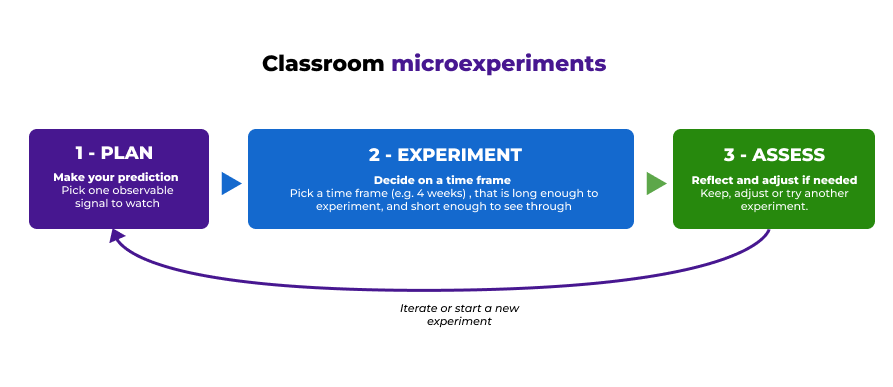
In the modern educational landscape, pedagogical innovation is too often associated with sweeping, disruptive overhauls. Teachers are routinely pressured to redesign entire curricula, adopt complex technological ecosystems, or completely abandon time-tested routines in pursuit of engagement. Yet, sustainable pedagogical growth rarely happens through radical revolution; instead, it is cultivated through intentional, incremental adaptation.
Enter the classroom micro-experiment—a low-stakes, high-impact framework designed to help educators test new methodologies without overwhelming themselves or their students. Defined as the smallest possible change that yields real, actionable data, a micro-experiment requires one tiny action, a short and fixed window of time, and one single metric or signal to monitor. Educators commit not to a predetermined outcome, but to the process of running the test, evaluating the empirical results, and making an informed decision: retain the change, iterate on a single variable, or pivot entirely.
Building upon Part 1 of this Back-to-School series—which explored the efficacy of weekly teacher-authored formative checks via interactive platforms like Kahoot—Part 2 investigates a profound pedagogical shift: transferring the creation of review materials directly to the students.
By tasking student cohorts with authoring their own weekly review games, educators leverage higher-order thinking skills as mapped out by Bloom’s Taxonomy. Rather than passively absorbing information or simply recalling memorized facts, students must analyze, evaluate, and synthesize curriculum material to construct challenging, fair, and engaging review questions for their peers. This dual-action approach transforms the reviewer into the teacher, unlocking unprecedented diagnostic insights into true student comprehension while fostering deep agency, collaboration, and accountability.
Detailed Chronology: The Evolution of Formative Assessment and the Micro-Experiment Framework
To understand the current shift toward student-led micro-experiments, it is vital to examine the chronological progression of formative assessment methodologies in contemporary classrooms.
Phase 1: The Traditional Review Paradigm
Historically, classroom review sessions followed a rigid, top-down trajectory. Following a week of direct instruction or project-based learning, the educator assumed the role of sole architect of assessment. Teachers spent precious prep hours sorting through notes, determining what mattered most, identifying common misconceptions, and carefully wording quiz questions designed to test retention. While this method ensured alignment with curriculum standards, it placed the cognitive burden entirely on the instructor. Students remained passive consumers of review—answering queries rather than formulating them.
Phase 2: The Digital Gamification Wave
As educational technology matured, traditional paper-and-pencil quizzes gave way to dynamic digital platforms. Gamified learning environments introduced real-time scoring, immersive audio-visual feedback, and competitive mechanics that dramatically boosted student engagement. Teachers could instantly gauge class comprehension through automated analytics dashboards. However, while engagement soared, the structural dynamic remained largely unchanged: the teacher authored the game, and the students played it.
Phase 3: The Micro-Experiment and Student-Authored Curricula
Recognizing the limitations of teacher-centric content generation, forward-thinking educators began experimenting with agile instructional design borrowed from software development and operational management. The concept of the "classroom micro-experiment" emerged as a structured way to test minor pedagogical tweaks over brief cycles—typically one to two weeks.
In this current phase, educators are closing the feedback loop by handing the pen to the learners. By structuring student groups to rotate weekly responsibilities for building the class review game, teachers transform assessment into an active, constructive exercise. The timeline of this micro-experiment unfolds over a predictable, manageable weekly cadence:
Monday to Wednesday: Designated student groups review prior coursework, distill core concepts, and draft targeted questions.
Thursday: The educator reviews the student-generated quiz for clarity and pedagogical appropriateness, making minor structural tweaks if necessary.
Friday: The entire classroom plays the student-built game, serving as a simultaneous formative assessment for the teacher and a rewarding celebration of peer collaboration for the creators.
Supporting Context & Metrics: Higher-Order Thinking and Bloom’s Taxonomy
The rationale behind student-authored assessments is deeply rooted in established cognitive science, most notably Bloom’s Taxonomy—a foundational framework that categorizes educational learning objectives into levels of complexity and specificity.
[ CREATING ]       <-- Formulating questions, designing review games (Highest Complexity)
[ EVALUATING ]     <-- Judging fairness, separating core ideas from trivia
[ ANALYZING ]      <-- Deconstructing topics, identifying common misconceptions
[ APPLYING ]       <-- Using information in new situations
[ UNDERSTANDING ]  <-- Explaining ideas or concepts
[ REMEMBERING ]    <-- Recalling facts and basic concepts (Lowest Complexity)
Deconstructing Cognitive Load
Traditional quizzes predominantly target the base tiers of Bloom’s Taxonomy: Remembering and Understanding. When students respond to multiple-choice questions, they retrieve stored data, recognize patterns, and match definitions. While essential for foundational literacy and numeracy, these lower-order tasks reveal little about a student’s ability to manipulate, critique, or synthesize knowledge.
Conversely, when students are tasked with writing review questions, they are forcibly elevated to the apex of the cognitive pyramid: Analyzing, Evaluating, and Creating.
Analyzing: To write an effective question, a student must deconstruct the week’s lessons, separate vital core concepts from trivial details, and determine what constitutes legitimate academic inquiry versus obscure trivia.
Evaluating: Students must construct plausible incorrect answers (distractors) that reflect genuine, common misconceptions held by their peers. This requires empathizing with the learner’s perspective and anticipating where confusion naturally arises.
Creating: The final synthesis results in an original assessment tool designed to teach and test simultaneously.
The Double Win: Active Teaching as Deep Learning
Educational researchers have long championed the "protégé effect"—the psychological phenomenon wherein individuals learn a concept more thoroughly when tasked with teaching it to someone else. Preparing to teach changes how a student studies. It instills intrinsic motivation, shifting the goal from merely passing an exam to ensuring genuine mastery so that peers can successfully navigate the review game.
This creates a powerful double win for the classroom ecosystem:
For the Creators: The act of building the assessment is the ultimate form of review. They interact with the source material on a meta-cognitive level.
For the Players: The resulting game provides the educator with an immediate, reliable formative signal, highlighting class-wide comprehension gaps and individual learning needs without the anxiety of high-stakes testing.
Official Statements and Pedagogical Insights
Educational leaders and curriculum specialists increasingly advocate for agile, low-overhead instructional strategies that empower learners while preserving teacher well-being.
Dr. Helena Vance, a cognitive developmental psychologist specializing in digital learning environments, notes:
"When we keep all the cognitive heavy lifting to ourselves as educators, we inadvertently rob our students of the struggle required to build durable neural pathways. Asking a student to write a fair, challenging multiple-choice question requires a level of conceptual mastery that answering that same question could never achieve. It forces them to look at the curriculum from the instructor’s vantage point."
Furthermore, instructional design advocates emphasize that micro-experiments eliminate the paralysis of perfectionism among educators. Rather than drafting exhaustive, semester-long action plans that often crumble under the unpredictable realities of daily classroom life, teachers can isolate a single variable.
Marcus Thorne, a veteran secondary school administrator and pedagogical consultant, explains the operational advantage of this framework:
"Teachers are constantly told to innovate, but burnout is real. The micro-experiment model succeeds because it asks for a tiny, bounded commitment. You aren’t rewriting your entire syllabus; you are handing question-writing to Group A for five days. You watch the single metric you agreed to track—whether student engagement rose, whether comprehension scores shifted—and you decide what to do next week. It brings scientific rigor and calm intentionality back to teaching."
A Practical Guide for Implementation
Executing this micro-experiment in your classroom does not require a complex administrative rollout. Educators can implement the strategy using a clear, four-step operational protocol:
Step 1: Establish the Rotation
Divide your class into small collaborative groups (3 to 4 students per group). Assign each group a specific week in the term to take ownership of the weekly review game. One group, one short quiz, once a week.
Step 2: Provide the Question-Writing Blueprint
Students cannot be expected to author effective assessment tools without guidance. Provide a concise, one-page template or run a short introductory game modeling what makes a high-quality review question:
Clarity: Is the prompt direct and unambiguous?
Relevance: Does the question focus on core conceptual takeaways rather than isolated, trivial facts?
Plausible Distractors: Are the incorrect answer options reflective of real misconceptions, rather than being obviously absurd?
Appropriate Difficulty: Does it challenge the peer group without inducing unnecessary frustration?
Step 3: Review and Refine
Before the game is deployed to the wider classroom, conduct a brief 5-minute review of the student-authored questions. This acts as a quality-assurance check, ensuring academic accuracy while validating the students’ hard work.
Step 4: Deploy and Evaluate
Launch the review game in class. Observe student engagement, note where peers struggle or excel, and gather your single chosen metric. Use this empirical data to guide your instructional focus for the following week.
Future Outlook: The Continuous Improvement Cycle
As classrooms continue to evolve in response to technological advancements, shifting demographic needs, and the demand for 21st-century skills—such as critical thinking, collaboration, and metacognition—the methods by which we assess learning must similarly adapt.
The micro-experiment framework proves that meaningful educational transformation does not require systemic disruption. By starting small—such as delegating the weekly review creation to student cohorts—teachers can cultivate an agile, evidence-based classroom culture where every week offers an opportunity to test, learn, and refine.
As this Back-to-School series progresses, the exploration of agile classroom interventions will expand beyond individual tasks into collaborative dynamics. In Part 3 of this series, we will investigate the impact of team-based competitive play:What happens when review games are played in collaborative teams rather than individual formats, and how does shifting the structure unlock participation among quiet or disengaged learners?
Until then, the path forward is clear: relinquish the pen, empower your students to build the assessment, and let the data guide your next instructional leap.