
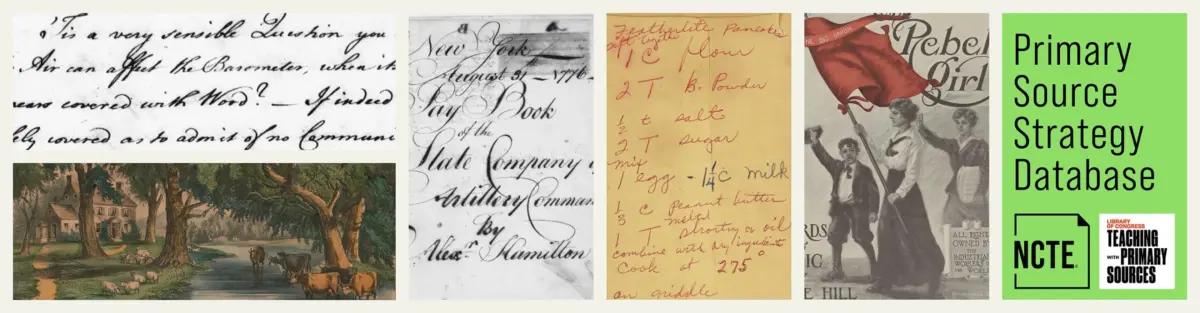
Executive Overview
In an era defined by an overabundance of digital information, helping students develop critical thinking, media literacy, and historical empathy has never been more urgent. At the forefront of this educational evolution is a powerful collaboration between the National Council of Teachers of English (NCTE) and the Library of Congress. Operating under the auspices of the prestigious Teaching with Primary Sources (TPS) Consortium, this nationwide initiative is actively expanding how primary source materials are integrated into the daily teaching and learning habits of literacy educators and their students.
At the heart of this partnership is a newly unveiled, highly specialized, and fully searchable database designed to revolutionize English language arts (ELA) and humanities classrooms. Developed by more than two dozen distinguished teachers and leaders in ELA education, the database features pedagogical strategies for more than 150 specific, digitized artifacts drawn directly from the Library of Congress’s vast archival holdings. Rather than treating history as a static set of dates and dead names, this initiative equips instructors to use authentic historical documents—ranging from turn-of-the-century African American newspapers to marginalized inventors’ blueprints—to teach rigorous literacy skills, structural analysis, and evidence-based argumentation.
By providing clear articulations of the literacy merit inherent in each document, along with alignment to state content standards, suggested thematic units, and searchable tags like "picturebook" and "argument," the NCTE-Library of Congress database bridges the gap between archival research and modern pedagogical practice. This comprehensive report explores the architecture of this initiative, the historical and instructional value of the primary sources it highlights, the specific academic frameworks it supports, and the profound future outlook for primary-source-driven literacy education in North American schools.
Detailed Chronology: Building the Bridge Between Archives and Classrooms
The integration of primary sources into K-12 education is not an entirely new concept, but historically, its application has been siloed within social studies and history classrooms. English language arts teachers, operating under distinct standards centered on narrative structure, rhetoric, and textual evidence, have traditionally relied on anthologies, fiction, and contemporary essays. The deliberate union of the Library of Congress and the NCTE represents a paradigm shift—a structural acknowledgement that historical artifacts are, in their own right, texts worthy of deep literary and rhetorical analysis.
The Genesis of the TPS Consortium Partnership
The collaborative framework traces its roots to the Library of Congress’s long-standing Teaching with Primary Sources program, which seeks to make the institution’s unprecedented digital collections accessible and usable for classroom teachers across the United States. Recognizing that literacy teachers hold the key to unlocking the language, nuance, and perspective embedded in historical texts, the Library of Congress forged a strategic partnership with the NCTE.
The NCTE, as the nation’s most prominent organization of English language arts educators, mobilized a cadre of over two dozen expert teachers, curriculum directors, and literacy leaders. This working group was tasked with a singular, ambitious mandate: to review items from the Library of Congress’s digitized collections and construct rigorous, classroom-ready instructional strategies that tie directly to ELA curriculum requirements.
Evolution of the Searchable Database
Over successive phases of development, the working group curated and cataloged strategies for more than 150 specific items. Recognizing that modern educators require immediate, targeted access to materials that fit their specific scope and sequence, the developers implemented a robust tagging architecture. Educators can now filter content through specialized tags, such as picturebook and argument, ensuring that a middle school language arts teacher looking to teach argumentative writing can effortlessly locate a primary source that serves as a model of persuasive rhetoric.
Furthermore, the database was engineered to dismantle traditional disciplinary boundaries. By infusing historical artifacts, journalistic archives, and STEM-related historical documents into ELA instruction, the initiative provides students with multidisciplinary entry points. A single archival document can simultaneously serve as a springboard for historical inquiry, an exercise in analyzing point of view, and a masterclass in structural argumentation.
Supporting Context & Metrics: Unlocking Hidden Histories and Diverse Innovators
To understand the transformative pedagogical value of the NCTE-Library of Congress database, one must examine the specific types of primary sources it highlights and the theoretical frameworks guiding their use. Two primary examples embedded within the initiative’s foundational framework illustrate how these resources reshape classroom dynamics: the re-centering of diverse inventors in STEM education and the historical analysis of early 20th-century African American print journalism.
Challenging Traditional Narratives: Diverse Innovators in STEM and Literacy
Historically, mainstream educational narratives surrounding inventors, technological progress, and scientific breakthroughs have suffered from a profound lack of representation, predominantly centering on white men. This historical narrowness perpetuates a subtle yet damaging message to students from marginalized backgrounds: that innovation is the exclusive domain of a privileged few.
The NCTE’s primary source integration framework directly confronts this systemic erasure. By introducing students to Black female innovators and inventors—such as Sarah E. Goode, Madam C. Walker, or Valerie Thomas—educators can effectively challenge traditionally limited perspectives. The instructional strategies tied to these figures emphasize several critical learning outcomes:
- Challenging Racial and Gender Injustice: Actively countering the historical erasure of women of color in STEM fields.
- Fostering Self-Reflection: Enabling diverse students to see themselves reflected in historical figures of achievement, thereby boosting academic identity and engagement.
- Redefining Innovation: Teaching students that innovation is fundamentally rooted in the desire to improve daily life and solve real-world problems. Many historical inventors, despite lacking formal education or elite institutional backing, engineered brilliant solutions to everyday challenges driven by necessity rather than the pursuit of fame or fortune.
The Power of the Press: Analyzing The Statesman
Another prime example of the archival depth housed within the database is the inclusion of historical periodicals, such as The Statesman. Founded in 1888 and published in Denver, Colorado, The Statesman was a pivotal weekly newspaper serving the African American communities across Colorado, Wyoming, Montana, Utah, and New Mexico.
Operating in the Mountain West during a period of intense legal and social segregation, the paper acted as an indispensable channel through which its readers could "voice their opinions, assert their rights, and demand their due recognition." A review of The Statesman (Chronicling America, Library of Congress) reveals a publication that reported local, church, and society news, alongside national stories of acute interest to African Americans in the region. Crucially, the paper featured bold op-eds addressing contentious and life-or-death issues of the era, including interracial marriage, Jim Crow laws, and institutional segregation.
When brought into the ELA or history classroom, a primary source like The Statesman allows students to:
- Examine how marginalized communities used journalism as an instrument of self-advocacy and civic resistance.
- Analyze rhetorical strategies, tone, and audience targeting in historical opinion pieces.
- Investigate the geographic and cultural realities of African Americans living in the Mountain West during the post-Reconstruction and Jim Crow eras—a region frequently omitted from standard national narratives of the period.
Standards Connections: Rigorous Academic Alignment
A primary reason for the rapid adoption of the NCTE-Library of Congress database among curriculum coordinators is its meticulous alignment with state content standards. Far from being an optional enrichment activity, the instructional strategies are mapped directly to core reading, history, social sciences, science, and technical subject standards.
To illustrate this rigorous alignment, consider the adoption framework provided by the New Mexico Public Education Department, which serves as a model for state-level integration:
| Curriculum Area | Standard Identifier | Standard Description & Pedagogical Application |
|---|---|---|
| Reading (Middle School) | RI.6.1 | Cite textual evidence to support analysis of what the text says explicitly as well as inferences drawn from the text. (Applied to analyze explicit claims and implicit cultural assumptions in historical documents and journalistic texts). |
| Reading (Middle School) | RI.7.2 | Determine two or more central ideas in a text and analyze their development over the course of the text; provide an objective summary of the text. (Applied to trace the evolution of arguments in historical editorials and pamphlets). |
| History/Social Sciences, Science, and Tech (Grades 9-10) | RH.9-10.1 | Cite specific textual evidence to support analysis of primary and secondary sources, attending to such features as the date and origin of the information. (Applied to contextualize archival artifacts, evaluating how the date of publication and the identity of the creator impact the meaning of the source). |
| History/Social Sciences, Science, and Tech (Grades 11-12) | RH.11-12.2 | Determine the central ideas or information of a primary or secondary source; provide an accurate summary that makes clear the relationships among the key details and ideas. (Applied to advanced synthesis of complex primary source bundles, requiring students to articulate how foundational details support overarching historical arguments). |
By anchoring primary source analysis to these rigorous anchor standards, the NCTE and the Library of Congress ensure that teachers do not have to sacrifice standards-based accountability to engage in transformative, inquiry-based learning.
Official Statements and Pedagogical Philosophy
Educational leaders and organizational stakeholders have lauded the partnership for its potential to reshape classroom discourse and foster a deeper appreciation for historical inquiry. While the initiative draws on the immense institutional weight of the Library of Congress, its daily execution relies on the grassroots expertise of classroom educators.
In professional development literature accompanying the TPS Consortium, NCTE leadership has consistently emphasized that literacy is fundamentally an act of inquiry. "Reading is not merely decoding words on a page; it is the active interrogation of perspective, context, and purpose," notes curricular guidance associated with the project. "When we place a primary source—be it an 1888 newspaper editorial from The Statesman or a patent diagram from a forgotten female inventor—into the hands of a student, we are inviting them into a conversation with history. We are asking them to weigh evidence, question authority, and construct independent interpretations based on verifiable artifacts."
Furthermore, educators who contributed to the database stress that the framework addresses a deep-seated pedagogical need: the scarcity of ready-to-use, standards-aligned materials that bridge historical artifacts with ELA skill sets. By providing structured focus questions, contextual backgrounds, and suggested teaching approaches for every single item in the database, the initiative lowers the barrier to entry for teachers who may feel intimidated by archival research.
Future Outlook: The Evolution of Primary Source Literacy
As educational technology advances and digital archives continue to expand exponentially, the NCTE and the Library of Congress are positioning their partnership at the vanguard of modern pedagogy. The future of literacy education relies heavily on the ability of students to navigate complex information ecosystems, evaluate source credibility, and synthesize disparate pieces of evidence into cohesive arguments.
Expanding the Database and Digital Reach
Looking ahead, the NCTE and the TPS Consortium plan to scale the database significantly. Future phases will likely incorporate an even broader array of digitized items from the Library of Congress, expanding into underrepresented linguistic archives, multimedia recordings, and visual arts. As artificial intelligence and semantic search tools mature, the database’s tagging system—currently encompassing tags like picturebook and argument—will evolve to offer hyper-personalized resource recommendations for teachers based on grade level, specific state standards, and thematic units.
Cultivating the Next Generation of Critical Thinkers
Ultimately, the longevity and impact of this initiative will be measured in the classrooms of tomorrow. By systematically dismantling the traditional boundaries between literature, history, and STEM, and by intentionally centering diverse voices that have long been marginalized in the historical record, the NCTE-Library of Congress partnership is helping to foster a more inclusive, critically minded generation of students.
As these primary source strategies become embedded in teacher preparation programs and professional development workshops nationwide, they promise to transform passive learners into active investigators—individuals equipped not only to read the world around them, but to question, analyze, and improve it.
Educators, curriculum directors, and researchers interested in accessing the searchable database, exploring the full repository of instructional strategies, and learning more about the NCTE’s ongoing work with the Library of Congress can visit the official NCTE Teaching with Primary Sources portal online.

