In the rapidly evolving landscape of artificial intelligence, the paradigm of deployment is undergoing a profound structural shift. For years, the industry’s focus has been fixed squarely on massive, monolithic "frontier" models—all-purpose answer engines designed to tackle everything from creative writing to complex coding challenges in a single, monolithic breath. However, as organizations transition from static prompt-and-response interactions to autonomous, long-running AI agents capable of executing hundreds of sequential operations, the limitations of these giant models have become glaringly apparent. They are often too slow, too expensive, and excessively heavyweight for the repetitive, granular labor required behind the scenes.
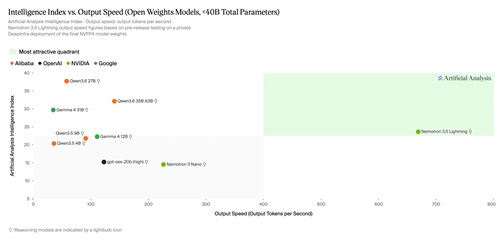
Addressing this critical bottleneck, Nvidia has officially introduced Nemotron 3.5 Lightning, a high-performance open AI model engineered specifically to serve as a fast workhorse within complex, multi-step agentic workflows. Released on August 11, Nemotron 3.5 Lightning is a 30 billion-parameter Mixture-of-Experts (MoE) model that activates a lean 3 billion parameters per token. Boasting support for a staggering 1-million-token context window and delivering up to four times the output speed of comparably sized models, Lightning represents a deliberate design philosophy: prioritizing raw inference speed, cost-efficiency, and specialized task execution over brute-force general intelligence.
Simultaneously, Nvidia is championing an architectural evolution known as the "system of models" or model ensembles. Rather than routing every micro-step of an AI agent’s plan through an expensive reasoning engine, Nvidia envisions a collaborative ecosystem where heavy-duty frontier models handle overarching strategic planning, while specialized, high-velocity models like Nemotron 3.5 Lightning shoulder the burden of repetitive tool calls, data formatting, syntax validation, and routine operations.
To operationalize this vision, Nvidia has also released NeMo Switchyard, an open-source routing library that dynamically directs individual requests to the most appropriate model at runtime based on latency, quality, and budgetary constraints. Together, these releases signal a watershed moment for enterprise AI development: model selection is no longer a static, one-time platform choice, but a dynamic, real-time optimization challenge.
Detailed Chronology: The Evolution Toward Specialized Agent Workflows
The Shift Beyond Single-Turn Prompts
To understand the significance of Nvidia’s Nemotron 3.5 Lightning release, one must examine how enterprise utilization of artificial intelligence has matured. In the early waves of the generative AI boom, applications were predominantly transactional. A user entered a prompt; a large language model (LLM) processed the request; an answer was returned. The entire computational weight rested on a single model executing a single pass.
As enterprises sought to automate more complex business processes, this single-turn paradigm proved insufficient. Organizations demanded systems capable of multi-step reasoning, interacting with external databases, executing code, verifying results, and correcting errors autonomously. This gave rise to the AI agent—software architectures that can break down high-level user directives into dozens, hundreds, or even thousands of individual sub-tasks, generating continuous streams of model calls along the way.
The Bottleneck of Monolithic Scaling
As AI agents grew more sophisticated, developers ran into a triad of persistent challenges:
Latency: Waiting for a 400-billion-parameter frontier model to generate a simple JSON formatting block or confirm a database schema variable introduces frustrating delays in user-facing applications.
Inference Cost: Constantly invoking massive models for low-level, routine operational tasks drains enterprise compute budgets at unsustainable rates.
Diminishing Returns on Reasoning: Routine data extraction and tool-invocation do not require the deep philosophical or creative reasoning capabilities of a premier frontier model; they require absolute speed, reliability, and syntactic precision.
Recognizing these compounding friction points, Nvidia’s engineering teams began developing models optimized not for universal supremacy, but for hyper-efficient execution within specialized functional niches. This trajectory culminated in the August 11 rollout of Nemotron 3.5 Lightning, a model explicitly built to operate as the engine room of a larger, multi-model agentic assembly line.
Supporting Context & Metrics: Under the Hood of Nemotron 3.5 Lightning
Architecture and Efficiency Breakthroughs
At its core, Nemotron 3.5 Lightning is a 30 billion-parameter Mixture-of-Experts (MoE) architecture. By routing input tokens through only a fraction of its total network parameters—specifically activating 3 billion parameters per token—the model achieves the computational footprint of a much smaller model while retaining the broad capacity of a 30B framework.
To maximize operational throughput, Nvidia integrated several advanced optimization techniques into Lightning’s framework:
Multi-Token Prediction: Allowing the model to forecast multiple future tokens simultaneously, drastically accelerating generation speeds.
Speculative Decoding: Employing a smaller draft model to propose token sequences that are then verified en masse by the target model, reducing latency bottlenecks.
NVFP4 Quantized Checkpoint: Utilizing advanced 4-bit floating-point quantization to minimize memory bandwidth consumption without sacrificing task accuracy.
Scale and Performance Metrics
Parameter Scale: 30 billion total parameters, with 3 billion active parameters per token.
Context Window: Full support for up to 1 million tokens, enabling the model to ingest massive codebases, extensive document libraries, or exhaustive conversation histories in a single pass.
Throughput Speed: Delivers up to four times the output speed of competing models in the same size category, transforming the responsiveness of automated agent pipelines.
Licensing Model: Offered under Nvidia’s permissive OpenMDW-1.1 license, providing developers with open weights, comprehensive training data transparency, and reproducible training recipes.
The Introduction of NeMo Switchyard
A high-speed specialized model is only as effective as the routing logic that feeds it work. Recognizing this, Nvidia simultaneously rolled out NeMo Switchyard, an open-source routing library designed to manage enterprise model fleets.
NeMo Switchyard acts as an intelligent traffic controller for AI applications. When an agent generates a sub-task, Switchyard analyzes the request against real-time parameters—such as required response quality, maximum acceptable latency, and operational cost thresholds—and dynamically routes the prompt to the optimal model. Crucially, Switchyard is designed to operate seamlessly across hybrid environments, allowing organizations to route workloads across a heterogeneous mix of proprietary models, open-source alternatives, and Nvidia’s proprietary hardware stacks without forcing developers to rewrite core application codebases.
Official Statements and Industry Implications
Nvidia’s framing of the Nemotron 3.5 Lightning release highlights a fundamental re-evaluation of how AI infrastructure should be deployed in production environments.
In its technical documentation and developer communications, the company emphasizes that modern enterprise agents are increasingly operating as model ensembles. Rather than relying on a single "jack-of-all-trades" intelligence, enterprise systems are shifting toward a division of labor reminiscent of human organizations:
"A larger reasoning model might plan a workflow or handle a difficult decision, while a faster specialized model performs the repeated tool calls, validations, formatting tasks, and other routine operations generated as an agent carries out that plan."
This division changes the calculus of AI procurement. For enterprise tech leads and Chief Technology Officers, the question is no longer simply "Which model is the smartest?" but rather "How do we optimize the total cost, speed, and accuracy of an entire multi-model workflow?"
By decoupling high-level reasoning from high-frequency execution, organizations can deploy expensive frontier models sparingly—reserving them strictly for complex logical hurdles—while offloading 80% to 90% of routine agentic chatter to hyper-fast, low-cost workhorses like Nemotron 3.5 Lightning.
Future Outlook: The Era of Runtime Model Selection
The launch of Nemotron 3.5 Lightning and NeMo Switchyard points toward a clear trajectory for the future of enterprise software engineering: model selection is transitioning from a static platform choice to a dynamic runtime decision.
As autonomous agents become deeply embedded in financial trading systems, healthcare diagnostics pipelines, automated software development lifecycles, and customer service infrastructure, the volume of model-to-model calls will dwarf human-to-model interactions. In this hyper-scaled environment, milliseconds of latency and fractions of a cent per inference will dictate the economic viability of AI applications.
Nvidia’s strategy positions the company not merely as a hardware vendor supplying GPUs, but as an indispensable architect of the software orchestration layer required to make multi-agent systems practical at scale. By providing open weights, transparent training recipes, and intelligent routing tools, Nvidia is empowering developers to build resilient, cost-effective, and lightning-fast AI ecosystems that can scale effortlessly to meet the demands of tomorrow’s enterprise.