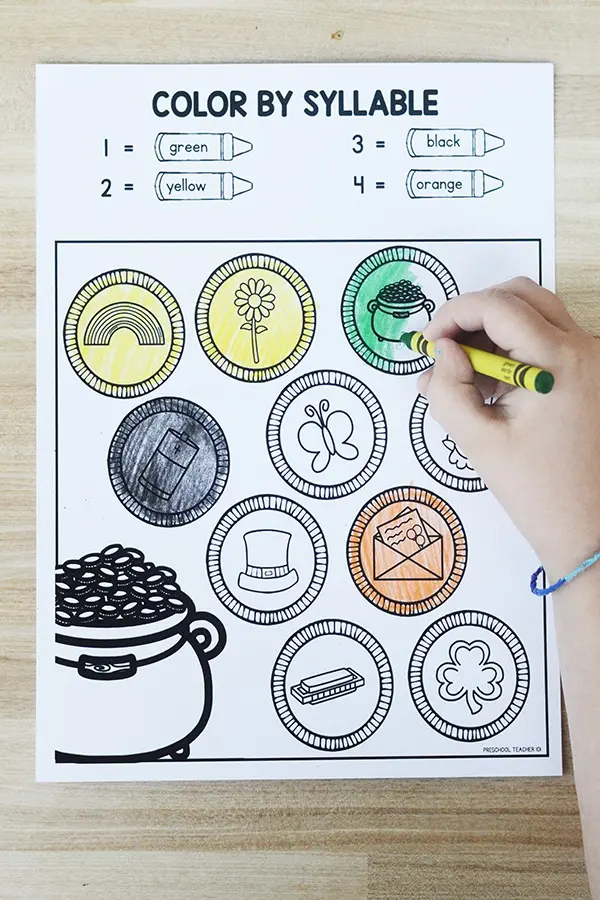
Early childhood education is currently undergoing a quiet yet profound transformation. As educational researchers and policymakers place increasing emphasis on foundational literacy—specifically phonological awareness—educators are constantly searching for innovative, engaging, and low-preparation tools to bridge the gap between abstract phonetic concepts and tangible student comprehension. Entering this dynamic educational landscape is the newly released St. Patrick’s Day Color by Syllable literacy resource, alongside its comprehensive companion, the Full-Year Color by Syllable Pack.
Designed specifically for preschool and kindergarten learners, these no-prep activities merge the time-tested engagement of color-by-code worksheets with critical pre-reading skill development. By breaking down holiday- and seasonal-themed vocabulary words into individual auditory units, young learners can physically segment syllables while developing crucial fine-motor and cognitive skills. This report offers an authoritative analysis of the pedagogical importance of these resources, examining how play-based phonics interventions are reshaping modern literacy centers, supporting diverse learner needs, and providing educators with scalable, stress-free instructional assets.
Detailed Chronology: The Evolution of Play-Based Phonological Tools
To understand the significance of the latest "Color by Syllable" release, one must examine the broader timeline of how early childhood literacy has evolved over the past decade.
Phase One: The Shift Toward Explicit Phonological Awareness (2015–2018)
For decades, early reading instruction often relied heavily on whole-language approaches or incidental exposure to books. However, a major paradigm shift occurred in the mid-2010s as cognitive scientists and reading researchers coalesced around the "Science of Reading." Educational institutions began mandating explicit, systematic instruction in phonological awareness—the ability to recognize and manipulate the spoken parts of sentences and words, including syllables, onsets, rimes, and phonemes.
During this period, teachers struggled to find materials that made abstract auditory concepts like "syllable counting" accessible to four- and five-year-olds without relying on tedious drill-and-kill worksheets.
Phase Two: The Rise of "No-Prep" Digital and Print Hybrid Models (2019–2022)
As classrooms became increasingly diverse and educators faced mounting administrative burdens, the demand for "no-prep" resources skyrocketed. Teachers needed materials that could be deployed instantly in literacy centers, morning tubs, or as take-home practice packets. Simultaneously, developers realized that gamified learning—such as color-by-number or color-by-code paradigms—could be cleverly adapted to linguistic tasks. Syllable segmentation was successfully mapped onto color-coding systems, allowing children to self-check their work visually while engaging their artistic senses.
Phase Three: Seasonal Integration and Comprehensive Year-Long Frameworks (2023–Present)
The release of specialized thematic packets—such as the St. Patrick’s Day Color by Syllable activities and the expansive 33-page year-long curriculum set—represents the current frontier of early literacy design. By anchoring phonological practice to culturally relevant holidays and seasonal shifts (ranging from winter and spring festivities to autumn milestones), educators can maintain high student engagement throughout the academic calendar. Today, these resources are distributed through dedicated early learning platforms, popular educator marketplaces like Teachers Pay Teachers, and specialized preschool curriculum hubs, marking a fully digitized yet tactile approach to foundational learning.
Supporting Context & Metrics: The Science Behind Syllable Segmentation
Phonological awareness is widely recognized as the single strongest predictor of early reading success. Within this domain, syllable segmentation serves as a crucial stepping stone.
Why Syllables Matter in Early Childhood
Before a child can decode written letters into distinct phonemes (the smallest units of sound), they must first be able to hear and isolate larger chunks of sound within spoken words. Syllables provide a natural, rhythmic entry point for young learners. Because syllables are naturally felt through jaw movements and claps, children can physically experience the structure of language.
According to developmental literacy metrics:
Cognitive Load Reduction: Breaking multi-syllable words down (e.g., sham-rock vs. le-pre-chaun) reduces the cognitive load on preschool and kindergarten students, allowing them to map sounds to letters more efficiently.
Classroom Efficiency: Studies show that early childhood educators lose up to 20% of instructional time during transitions and materials distribution. No-prep, print-and-go resources like color-by-syllable worksheets eliminate setup lag, maximizing active learning time.
Differentiation Needs: Modern classrooms often feature wide achievement gaps. A flexible resource that spans from single-syllable recognition up to five-syllable challenges allows teachers to seamlessly differentiate instruction for fast finishers, remedial learners, and advanced students alike.
Official Statements and Expert Perspectives
Early childhood specialists and literacy coaches have increasingly spoken out about the necessity of blending direct phonetic instruction with playful, low-stress reinforcement.
"When teaching foundational literacy to pre-K and kindergarten students, the primary challenge is maintaining engagement while delivering rigorous content," notes an early childhood curriculum developer behind the new series. "Children learn best when multiple senses are activated simultaneously. By combining auditory syllable counting with visual color recognition and fine-motor coloring, we are creating neural pathways that reinforce phonological awareness naturally."
Educators utilizing the color-by-code framework have reported notable shifts in student autonomy. Because the instructions are visually intuitive, children can work independently in literacy centers while the teacher pulls small groups for targeted intervention.
Furthermore, reading interventionists emphasize the importance of vocabulary front-loading:
"Before handing out a holiday-themed activity sheet, introducing and clapping out the vocabulary terms—such as ‘shamrock,’ ‘rainbow,’ or ‘horseshoe’—is vital. It bridges oral language comprehension with the mechanical task of syllable counting, ensuring that children understand the words they are analyzing."
Future Outlook: The Next Wave of Foundational Literacy Resources
Looking ahead, the market for targeted early childhood literacy tools is expected to expand rapidly. As schools continue to align their curricula with evidence-based reading practices, the demand for specialized, high-engagement supplementary materials will remain high.
Key Trends Shaping the Future of Literacy Centers:
Blended Tactile-Digital Learning: While physical printables remain essential for developing fine-motor control (pencil grip and coloring mechanics), future iterations of phonological tools will likely incorporate augmented reality (AR) or quick-response (QR) audio prompts, allowing children to hear words pronounced correctly by tapping the page with a tablet or smart device.
Modular Curriculums: Educators are moving away from rigid, one-size-fits-all textbooks in favor of modular, themed packets (such as the comprehensive year-long color-by-syllable sets) that can be easily plugged into existing thematic units.
Inclusive and Culturally Responsive Design: Future developmental printables will continue to diversify their themes, ensuring that seasonal and holiday activities reflect the rich multicultural fabric of modern classrooms, fostering inclusive learning environments from the earliest grades.
Conclusion
The introduction of specialized tools like the St. Patrick’s Day Color by Syllable printables and the extensive Full-Year Color by Syllable Pack highlights a positive evolution in early childhood education. By marrying the structural demands of the Science of Reading with the joyful, stress-free environment of color-by-code art, educators are equipped to foster foundational phonological awareness effortlessly. As classrooms continue to prioritize engaging, low-prep, and highly effective literacy interventions, these resources serve as a shining example of how learning can be both rigorously academic and genuinely fun.