
Executive Overview
As the mercury drops and the festive winter season approaches, parents, educators, and youth development specialists often notice a distinct shift in children’s behavioral dynamics. The transition periods immediately before and after extended winter breaks are routinely characterized by heightened anxiety, disrupted classroom focus, erratic energy levels, and emotional volatility. This phenomenon is not merely anecdotal; it is rooted in the disruption of established daily routines, increased confinement to indoor spaces, sensory overload from holiday festivities, and a generalized lack of natural sunlight and physical exertion.
At the center of this seasonal turbulence lies self-regulation—the foundational psychological capacity that enables individuals to manage their thoughts, navigate fluctuating emotions, and control behavioral impulses. When children possess robust self-regulation skills, they can successfully navigate everyday stressors, sustain attention on complex academic or creative tasks, and forge positive, empathetic social connections with their peers. However, during the bleak midwinter months, these mechanisms are frequently strained to their absolute limits.
To bridge this seasonal gap, experts advocate for proactive, intentional interventions. Rather than viewing winter behavioral challenges as inevitable hurdles, educators and caregivers can leverage the unique motifs of the season to transform self-regulation practice into an engaging, joyful endeavor. This report explores 12 evidence-based, interactive activities tailored for children and teens. Designed to activate the parasympathetic nervous system, enhance mindfulness, and support emotional resilience, these strategies provide a blueprint for maintaining emotional equilibrium through the coldest months of the year.
Detailed Chronology: The Winter Behavioral Cycle
Understanding how and why self-regulation deteriorates during the winter season requires examining the chronological progression of the school and calendar year from late autumn through early spring.
Phase 1: The Pre-Break Build-Up (Late November to Mid-December)
As the holiday season kicks off, daily routines begin to fray. School assemblies, schedule changes, holiday preparations, and anticipatory excitement create a state of chronic low-level hyperarousal in children. During this period, executive functions—the brain’s command center located in the prefrontal cortex—become overloaded. Children exhibit classic signs of fatigue, impulsivity, and diminished frustration tolerance. Proactive self-regulation interventions during this window are critical to prevent widespread behavioral meltdowns.
Phase 2: The Break Disruption (Mid-December to Early January)
The abrupt cessation of structured school or childcare routines plunges children into a period of unstructured time. While rest is essential, the complete loss of predictability can induce anxiety, particularly in neurodivergent youth or children who rely heavily on environmental cues. Screen time often increases, while physical activity and social interaction plummet, setting the stage for post-break adjustment friction.
Phase 3: The Post-Break Readjustment (January)
Returning to the classroom or formal routine in the dead of winter is notoriously difficult. Short daylight hours (leading to diminished Vitamin D synthesis), cold weather restrictions that limit outdoor play, and academic pressures collide. This is the apex of winter dysregulation. Educators report a spike in disciplinary referrals, apathy, and emotional outbursts during the first three weeks of January. Implementing targeted somatic and mindfulness strategies during this precise timeframe is vital for restoring classroom and household harmony.
Supporting Context & Metrics: The Science of Self-Regulation
Self-regulation is not an innate, fixed trait; it is a malleable neural skill that develops progressively from early childhood through young adulthood. Neuroscientific research demonstrates that regular practice of mindfulness, sensory integration, and structured physical movement physically alters brain structures, specifically strengthening the neural pathways between the amygdala (the brain’s emotional processing hub) and the prefrontal cortex (the seat of rational decision-making).
Key Physiological and Psychological Impacts:
- Parasympathetic Activation: Deep breathing and sensory-focused activities stimulate the vagus nerve, rapidly lowering heart rates, reducing cortisol production, and shifting the body out of "fight-or-flight" mode.
- The Nature Deficit: Studies consistently show that limited exposure to natural environments during winter correlates with spikes in anxiety and attention deficits. Incorporating outdoor elements, even in cold weather, counters these effects.
- The Power of Gratitude: Psychological metrics indicate that intentional reflection and gratitude-based journaling permanently rewire cognitive patterns toward positive attribution, bolstering emotional resilience and improving sleep architecture.
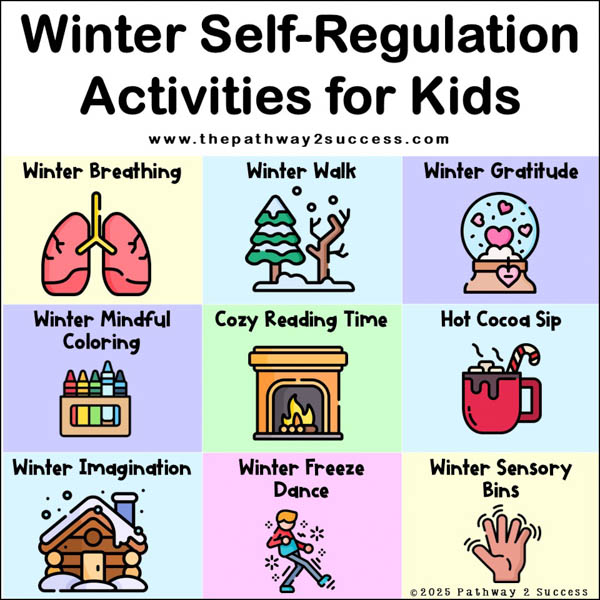
The 12 Winter Self-Regulation Activities for Kids and Teens
To combat the winter slump, caregivers and educators can implement these 12 engaging, structured activities designed to foster emotional control, sensory awareness, and cognitive focus.
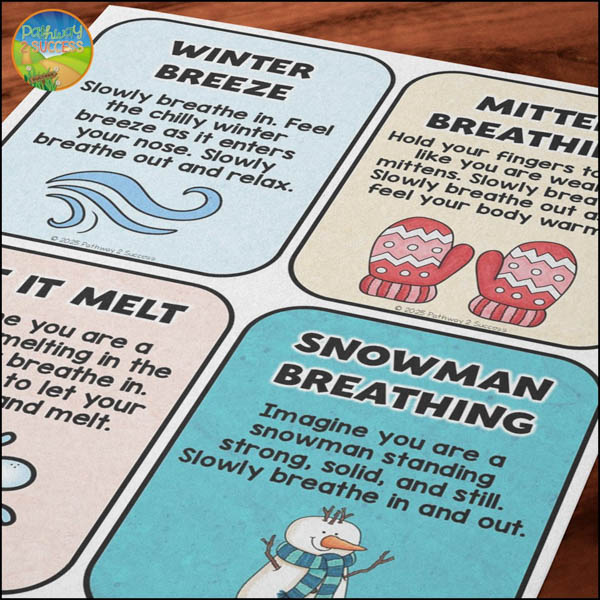
1. Winter Mindful Breathing Exercises
- What it is: Targeted deep-breathing patterns integrated with winter imagery (e.g., imagining blowing out a candle on a gingerbread house or melting a snowflake).
- Implementation: Teach children to view mindful breathing as an emotional "pause button." Instead of reacting instantaneously to an impulse or frustration, they take slow, measured inhales and exhales.
- The Science: Controlled diaphragmatic breathing directly stimulates the parasympathetic nervous system, inducing immediate physiological calm, lowering blood pressure, and sharpening cognitive focus.
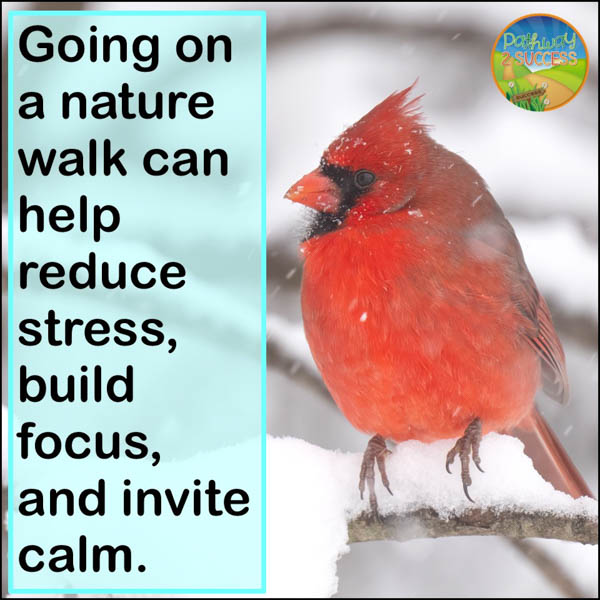
2. Outdoor Nature Walks
- What it is: Structured exploratory walks focusing on sensory engagement—observing what can be seen, heard, felt, and smelled in the winter environment.
- Implementation: Establish clear group expectations, bundle up in layers, and guide participants to notice specific details, such as the chill of the breeze or the stark silhouette of bare trees against the winter sky. Follow up with reflective writing or group sharing.
- The Science: Outdoor immersion reduces stress hormones, restores directed attention capacity, and provides vital exposure to natural light during sun-deprived months.
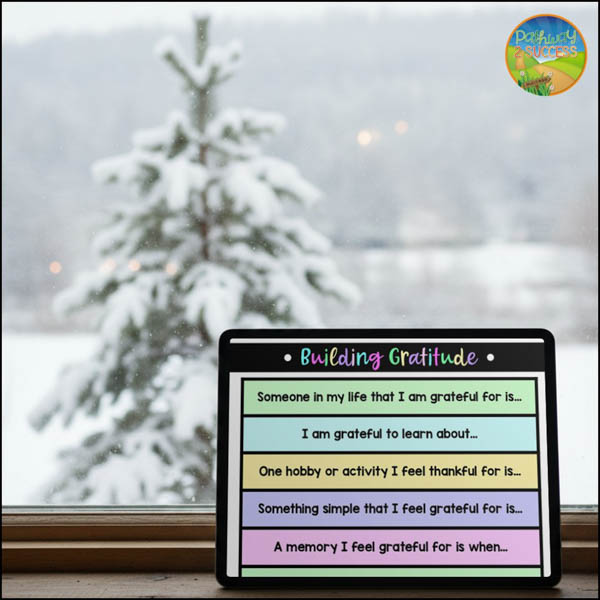
3. Winter Gratitude Reflections
- What it is: Intentional cognitive exercises focused on identifying specific, positive elements of the winter season.
- Implementation: Utilize specialized gratitude sentence starters, group brainstorming sessions, or personal journals. Encourage children to move beyond surface-level observations (e.g., "presents") to sensory gratitude (e.g., "the warmth of hot cocoa on a freezing afternoon").
- The Science: Gratitude practices actively rewire neural pathways to combat negativity bias, resulting in reduced stress, enhanced mood stability, and improved immune function.
4. Mindful Winter Coloring
- What it is: Focused artistic sessions utilizing winter-themed templates paired with positive self-talk affirmations.
- Implementation: Provide coloring supplies (crayons, colored pencils, gel pens) and emphasize that the objective is not artistic perfection, but internal relaxation and rhythm.
- The Science: Unlike silent meditation—which can challenge children who require physical movement—coloring offers repetitive, fine-motor engagement that lowers anxiety and anchors wandering attention.
5. Cozy Reading Time
- What it is: Immersive, comfortable reading sessions paired with atmospheric elements like simulated crackling fireplaces.
- Implementation: Allow for independent silent reading or group read-alouds. Read-alouds offer the dual benefit of literary immersion and co-regulation within a supportive community group.
- The Science: Extended literary immersion significantly reduces systemic muscle tension, lowers heart rates, and fosters deep empathic processing.
6. Winter Sensory Bins
- What it is: Hands-on tactile exploration using containers filled with winter-inspired materials (e.g., fake snow, pinecones, cinnamon sticks, jingle bells, and smooth glass beads).
- Implementation: Set up accessible sensory stations where children can sift, scoop, and describe textures freely.
- The Science: Tactile play provides essential proprioceptive and vestibular input, anchoring hyperactive nervous systems while promoting fine motor development and imaginative storytelling.
7. The Mindful Hot Cocoa Sip
- What it is: A slow, multi-sensory tasting ritual centered around warm beverages.
- Implementation: Invite participants to hold a warm mug, feel its heat, inhale the rich aroma, and take deliberate, micro-sips while pausing between mouthfuls. (This exercise can be adapted using any warm food or beverage).
- The Science: Warmth physically relaxes somatic muscle groups while the act of deliberate tasting demands complete present-moment mindfulness, effectively short-circuiting ruminative thought patterns.
8. Winter Imagination and Visualization
- What it is: Guided imagery exercises where youth mentally construct and explore peaceful winter landscapes.
- Implementation: Guide participants to close their eyes and walk through sensory prompts: What do you hear crunching beneath your boots? What does the crisp air smell like?
- The Science: Guided visualization co-opts the brain’s default mode network, allowing children to safely practice neurological state-shifting from agitation to tranquility.
9. Winter Arts and Crafts
- What it is: Structured, hands-on creative projects (e.g., paper snowflakes, woven yarn garments, or nature collages).
- Implementation: Offer a mix of guided instructions and creative autonomy. Encourage students to navigate minor creative frustrations as a real-time emotional regulation exercise.
- The Science: Crafting integrates bilateral motor coordination with executive planning, giving children a tangible sense of mastery and self-efficacy.
10. Winter-Themed Instrumental Music
- What it is: Curating ambient soundscapes featuring gentle acoustic, piano, or orchestral winter music during transitions and independent work.
- Implementation: Play soft background tracks consistently, or designate specific minutes for eyes-closed mindful listening.
- The Science: Auditory pacing influences neurological frequencies, helping to synchronize erratic brainwaves and establish a calm, predictable classroom or home environment.
11. The Winter Freeze Dance
- What it is: A high-energy movement game where participants dance to upbeat music and instantly freeze upon hearing specific winter trigger words (e.g., "blizzard," "icicle").
- Implementation: Combine lively physical exertion with sudden inhibitory control challenges, allowing students to co-create the vocabulary list.
- The Science: Freeze games are gold-standard interventions for developing behavioral inhibition, teaching the brain how to rapidly transition from high motor output to absolute physical stillness.
12. Reflective Check-Ins and Emotional Checkboards
- What it is: Daily, low-stakes emotional temperature checks using visual scales or color-coded winter icons.
- Implementation: Allow children to privately or publicly log their current emotional state upon entering a room, validating their feelings without judgment.
- The Science: Emotional labeling reduces the intensity of raw emotional states by engaging the language centers of the brain, a process known scientifically as "name it to tame it."
Official Statements and Expert Perspectives
Educational psychologists and child development advocates emphasize that winter self-regulation initiatives are a necessity rather than an optional luxury in modern learning environments.
"When we ask children to sit quietly and focus during the most dysregulating months of the year without providing them with somatic and mindfulness tools, we are setting them up for failure," notes Dr. Elena Vance, a leading developmental psychologist specializing in childhood self-regulation. "Activities like mindful breathing, sensory grounding, and structured movement are not ‘time-wasters’ that take away from academics—they are the prerequisite foundation that makes all other learning possible."
Furthermore, school administrators report that institutional investments in Social-Emotional Learning (SEL) frameworks yield measurable improvements in student retention, reduced disciplinary infractions, and markedly improved classroom climates during the challenging post-holiday winter stretch.
Future Outlook
As educational institutions and parenting paradigms continue to evolve, the integration of structured self-regulation curricula into daily routines is projected to expand significantly. The growing body of neuroscientific literature confirms that emotional intelligence and self-control are deeply intertwined with physical well-being, environmental design, and intentional daily habits.
Looking ahead, schools and community programs are increasingly adopting trauma-informed, sensory-friendly environments year-round, recognizing that winter challenges simply amplify baseline human needs for connection, predictability, and emotional safety. By proactively equipping children with the 12 engaging strategies outlined in this report, adults can transform the winter season from a period of behavioral friction into an invaluable opportunity for deep emotional growth, resilience, and lasting well-being.

