
Executive Overview
In the rapidly evolving landscape of modern education and digital publishing, the ability to distinguish between human-authored prose and artificial intelligence has become the modern academic Holy Grail. Educational institutions, publishers, and platforms invest heavily in automated invigilation products and AI-detection software, all promising infallible gatekeeping against uninvited machine intelligence. Yet, a ground-breaking May 2026 Snap Survey conducted by the Online Learning Consortium (OLC) reveals a stark, unsettling reality: human intuition regarding text origin is no better than a coin toss, and AI-detection tools remain profoundly flawed.
Analyzing the responses of 52 participants tasked with identifying the authorship of three distinct passages on qualitative research methods, the OLC investigation uncovered counter-intuitive findings. Respondents misclassified authentic human writing as machine-generated, while enthusiastically accepting an AI-generated text as the genuine work of a human academic. Overall respondent accuracy hovered stubbornly around 50%—rendering human judgment statistically indistinguishable from random chance.
These revelations strike at the heart of contemporary academic integrity policies. As generative pre-trained transformers (GPTs) mature, the physical and linguistic markers traditionally used to spot AI—such as em dashes, uniform sentence structures, and an overabundance of buzzwords like "delve" or "tapestry"—are rapidly evaporating. More importantly, this study forces a fundamental philosophical pivot across the educational sector. The pressing question for educators, administrators, and instructional designers is no longer whether we can accurately detect AI-generated drafts, but whether our obsession with detection is missing the pedagogical forest for the trees.
Detailed Chronology: Inside the OLC May 2026 Snap Experiment
The methodology behind the OLC’s May 2026 Snap Survey was structured to isolate text origin while neutralizing potential confounding variables such as subject matter bias, vocabulary complexity, and document length. To achieve this, the investigation team designed a controlled comparative test utilizing three passages centered uniformly on the core academic theme of "qualitative research methods."
Phase 1: Curating the Baseline Passages
The investigation began with an exhaustive search of open-access academic literature published shortly after the public launch of generative AI platforms in late 2022 and 2023. The goal was to secure authentic, peer-reviewed or openly licensed educational resources that reflected genuine human academic composition without the retroactive influence of modern prompting techniques.
- Passage 1 (Human-Authored): Sourced from a 2023 open educational resource by A. Hurst, this text introduced undergraduates and graduates to qualitative research by contrasting it cleanly with quantitative statistics, utilizing relatable analogies (such as the "mother love" example).
- Passage 2 (AI-Generated): Prompted directly by researchers using ChatGPT, this text was explicitly synthesized to address the same academic definitions, focusing on the nuances of social world interpretation, contextual meaning, and variable avoidance, maintaining a length and tone comparable to the human baselines.
- Passage 3 (Human-Authored): Drawn from a 2023 practical guide for health and social care researchers by D. Ayton, T. Tsindos, and D. Berkovic, this passage rigorously outlined the subjective, inductive, and exploratory properties of qualitative frameworks versus deductive quantitative models.
Phase 2: Preliminary Automated Screening
Prior to public deployment in the Snap Survey, all three passages were submitted to Turnitin to establish baseline consistency. In this small-scale demonstration, the detection software performed as expected, flagging the AI text and clearing the human contributions. However, the researchers noted that this localized success ran contrary to broader, peer-reviewed empirical studies highlighting the systemic vulnerabilities of automated checkers.
Phase 3: Community Deployment and Blind Testing
In May 2026, the OLC distributed the survey to its community of digital learning professionals, educators, and instructional designers ($n=52$). Participants were asked to review each passage independently and cast a binary vote: Is it AI? The resulting data shattered preconceived notions regarding stylistic discernment and academic fingerprinting.
Supporting Context & Metrics: Breaking Down the Survey Data
The statistical breakdown of the May 2026 Snap Survey provides a fascinating window into the psychology of text perception and the shifting markers of digital literacy.
Passage 1: The Human Control That Felt Artificial
- Source: Human-authored (Hurst, 2023)
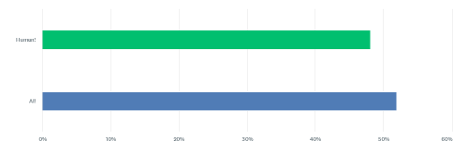
- Community Verdict: Split down the middle. Slightly more participants classified this human-written text as artificial than those who correctly identified it as human.
- Analysis: Passage 1 featured an approachable, conversational pedagogical tone designed to comfort students intimidated by statistics. Yet, because modern AI models can easily replicate accessible, conversational explanations, respondents projected machine authorship onto authentic human prose. The informal clarity that made the text effective for undergraduates also stripped away traditional elitist markers of human authorship in the minds of the evaluators.
Passage 2: The Machine Masterpiece That Fooled the Majority
- Source: AI-generated (ChatGPT)
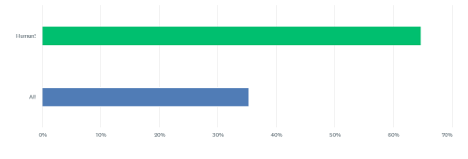
- Community Verdict: Nearly 65% of respondents misclassified this machine-generated text as human-authored.
- Analysis: This represents the psychological high-water mark of the experiment. The ChatGPT-authored passage successfully threaded the needle of academic prose, adopting an objective, balanced rhythm that avoided the hyper-definitive stylistic traps often associated with early generative AI. By mirroring the cadence of standard academic literature, the machine output sailed past the intuitive radar of two-thirds of professional educators and instructional designers.
Passage 3: The Traditional Academic Standard
- Source: Human-authored (Ayton et al., 2023)
- Community Verdict: Approximately two-thirds of respondents correctly identified this passage as human-written.
- Analysis: Featuring dense structural elements, traditional academic citations, and nuanced categorization frameworks typical of health and social care literature, this passage retained enough formal complexity to be recognized as authentic scholarship by the majority of the panel. Nevertheless, a full third of participants still misattributed this rigorous clinical writing to an algorithm.
Summary of Respondent Accuracy:
[Passage 1 (Human)]: ~50% Accuracy (Coin Flip - Leaned AI)
[Passage 2 (AI)]    : ~35% Accuracy (65% Fooled into thinking it was Human)
[Passage 3 (Human)]: ~66% Accuracy (Correctly identified)
Overall Accuracy   : ~50% (No better than random chance)
Official Statements and Academic Insights
The implications of these empirical findings reach far beyond a simple parlor game of spot-the-bot. They highlight a growing disconnect between institutional policies and technological realities.
The Fallibility of Automated Detectors
Contextualizing their findings within the broader academic literature, the OLC report points to recent comprehensive studies, such as the 2025 evaluation by Erol et al. Assessing the efficacy of commercial and open-source AI-output detectors, Erol and colleagues concluded that while these tools may serve as supplementary screening devices during peer review or abstract evaluation, “they often misclassify texts and require improvement.” None are 100% reliable, and their propensity for false positives poses an active threat to academic equity.
The Evolution of Linguistic Markers
For years, faculty members have relied on intuitive checklists to flag suspected AI submissions. Physical markers—such as excessive em dashes, uniform bulleted lists, and single-sentence paragraphs—alongside linguistic tropes like "delve," "tapestry," "testament," and "pivotal," became the informal rubric of academic suspicion.
However, as generative models undergo recursive training and prompt engineering practices become mainstream among students, the structural hallmarks of machine text are mutating. AI-generated writing has become cleaner, more stylistically diverse, and structurally indistinguishable from human composition.
Carrie’s Perspective: Rethinking Educational Strategy
Reflecting on the study, Carrie, Senior Researcher at the Online Learning Consortium—holding a PhD in Educational Technology from Arizona State University with over 15 years of experience as an online educator and instructional designer—emphasizes the urgent need for a pedagogical paradigm shift.
"Many faculty members believe they can recognize AI-generated work based on writing style alone, yet our respondents performed at approximately chance levels," notes Carrie. "This suggests that suspicion based solely on perceived writing characteristics may be misplaced. Rather than attempting to identify AI use after the fact, educators may be better served by designing learning activities that emphasize process, reflection, application, and demonstration of learning."
Future Outlook: Moving Beyond the Detection Trap
As the higher education sector looks toward the remainder of the decade, the OLC May 2026 Snap Survey serves as a crucial reality check. The data proves conclusively that both automated software and human intuition are failing to reliably unmask machine-written text. This realization forces institutions to confront a profound strategic fork in the road.
1. The Obsolescence of Post-Hoc Policing
Chasing the ghosts of generative AI through increasingly sophisticated arms races of detection software is a losing battle. As large language models absorb more linguistic variance, the margin for error in detection tools will continue to alienate innocent students while failing to catch sophisticated users. The fundamental question must evolve from "Can we detect AI?" to "Does it matter who or what drafted the preliminary text if the final educational product is accurate, ethical, and deeply understood?"
2. Redesigning for Authentic Process Over Product
The most viable path forward lies in assessment redesign. Educators are encouraged to move away from static, terminal essay submissions that can be easily outsourced to digital assistants. Instead, modern course design should prioritize:
- Iterative Process Documentation: Evaluating student progress through rough drafts, revision histories, and reflective journals.
- Personalized Contextual Application: Requiring learners to connect theoretical frameworks directly to unique local datasets, personal professional experiences, or synchronous cohort discussions.
- Oral Defenses and Interactive Demonstrations: Supplementing written assignments with multi-modal presentations where students verbally defend their analytical frameworks.
3. Cultivating True AI Literacy
Ultimately, AI literacy must transcend the memorization of superficial machine "tells." Just as calculators fundamentally transformed the teaching of mathematics without destroying quantitative reasoning, generative AI requires educators to elevate their pedagogical expectations. By shifting focus toward critical evaluation, content accuracy, ethical synthesis, and deep intellectual engagement, the academic community can turn the disruption of artificial intelligence into an opportunity for transformative educational renewal.
To participate in future investigative initiatives and stay informed on emerging trends in digital and online learning, education professionals are encouraged to subscribe to OLC Today, the official weekly newsletter of the Online Learning Consortium.

