
Executive Overview
In the rapidly evolving landscape of early childhood education, foundational literacy remains the bedrock upon which all future academic achievement is built. Recent shifts toward evidence-based instructional frameworks, most notably aligned with the Science of Reading, have placed unprecedented emphasis on phonological awareness. Among the most critical milestones in this developmental journey is the mastery of syllable segmentation—the ability of young learners to hear, isolate, and manipulate the natural beats within spoken words.
To bridge the gap between abstract phonetic theory and engaging classroom practice, educators and curriculum developers have introduced dynamic, hands-on instructional tools. At the forefront of this movement is the newly released Spring Syllable Sort, alongside its comprehensive companion, the Four Seasons Syllable Sort pack. Designed specifically for preschool, pre-K, and kindergarten environments, these printable literacy resources transform traditional auditory drills into interactive, play-based sorting activities. By integrating seasonal vocabulary with kinesthetic learning techniques such as clapping and tapping, these activities offer an authoritative, research-backed solution to early literacy instruction. This report explores the pedagogical mechanics, classroom integration strategies, and broader educational implications of these innovative sorting tools.
Detailed Chronology: The Evolution of Phonological Awareness in Early Childhood Curricula
The Shift Toward the Science of Reading
For decades, early childhood classrooms relied heavily on whole-language approaches that prioritized memorization and visual cues over explicit phonics and phonological instruction. However, a sweeping educational renaissance driven by the "Science of Reading" has fundamentally restructured how literacy is taught in the United States and international markets. Researchers and policymakers have increasingly recognized that children must explicitly understand the structural components of spoken language before they can successfully decode written text.

Within this framework, phonological awareness—the broad ability to recognize and manipulate parts of spoken language, including syllables, onset-rime, and phonemes—is treated as a non-negotiable prerequisite to reading success. Syllable segmentation serves as an essential stepping stone. When children learn to break words into manageable parts (e.g., segmenting "spring-time" into two distinct beats), they build the cognitive architecture required for advanced phonics and spelling.
The Development of Seasonal Syllable Tools
Recognizing a persistent gap in high-quality, engaging materials that align with these rigorous standards, early childhood specialists developed the Spring Syllable Sort. Released as a targeted resource for seasonal thematic units, the activity was engineered to address specific pedagogical challenges: maintaining student engagement while addressing foundational literacy markers.
- Phase 1: Conceptualization and Design. Curriculum designers focused on leveraging children’s natural affinity for seasonal changes. By anchoring literacy tasks to familiar spring concepts (such as flowers, rain, and blooming nature), educators could seamlessly weave phonological practice into broader interdisciplinary units.
- Phase 2: Pilot Testing in Pre-K and Kindergarten Classrooms. Initial rollouts prioritized usability in diverse learning environments, including traditional preschools, kindergarten literacy centers, and homeschool co-ops. Feedback emphasized the need for multi-sensory components—specifically integrating gross-motor actions like clapping and tapping to reinforce auditory concepts.
- Phase 3: Expansion into the Four Seasons Framework. Building upon the success of the spring-themed resource, developers expanded the concept into a comprehensive 42-page "Four Seasons Syllable Sort" pack. This iterative development allowed educators to maintain a consistent instructional routine throughout the entire academic year, covering autumn, winter, spring, and summer vocabulary.
Supporting Context & Metrics: The Mechanics of Syllable Sorting
To fully understand the impact of tools like the Spring and Four Seasons Syllable Sorts, one must examine the cognitive science underpinning phonological awareness.

The Cognitive Importance of Auditory-Visual Bridges
A critical design feature of these sorting activities is their deliberate focus on sound and picture clues rather than immediate reliance on written text. In early childhood education, cognitive load theory suggests that forcing young learners to decode unfamiliar written words while simultaneously trying to analyze syllable structures can overwhelm working memory.
By utilizing vibrant, high-contrast picture cards, the activity isolates the auditory skill of segmentation. Students examine an image (e.g., a "ladybug" or a "tulip"), articulate the word aloud, and engage in physical segmentation:
- Auditory Reception: Hearing the target vocabulary word clearly modeled by the instructor.
- Kinesthetic Kinship (Clapping/Tapping): Physically mapping the syllables through hand claps or table taps, translating an abstract auditory sound wave into a tangible physical experience.
- Quantitative Sorting: Categorizing the picture card into designated bins or columns representing one, two, or three syllables.
Quantitative Overview of Resource Components
The pedagogical value of these packets lies in their comprehensive structure. The newly expanded resources include standardized components engineered for versatile classroom execution:

- Syllable Counting Cards: Multi-tiered visual cards that prompt students to verify syllable counts.
- Large Colorful Word Cards: Designed for whole-group pocket charts, circle-time instruction, and teacher-led vocabulary introductions.
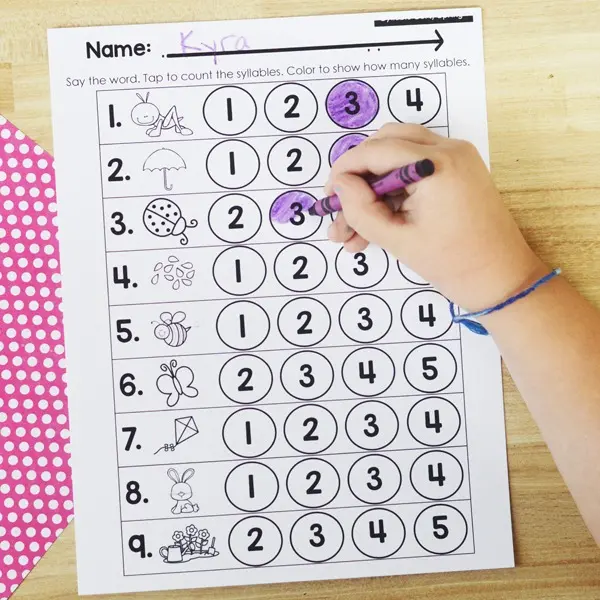
- Black and White Response Worksheets: Optional independent practice sheets that allow educators to assess individual student comprehension and provide documentation for portfolios.
- Answer Keys: Built-in verification tools that streamline small-group grading or enable self-checking learning stations.
- Comprehensive Seasonal Packs (42 Pages): Extended clip-card sets that span all four calendar seasons, ensuring long-term curriculum continuity.
Classroom Integration Ecosystems
The flexibility of these printable resources allows them to be deployed across multiple educational formats:
- Literacy Centers: Operating as an independent or small-group rotation where students manipulate physical cards.
- Take-Home Literacy Practice: Extending classroom learning into the home environment, bridging the achievement gap through family engagement.
- Science of Reading Alignment: Directly fulfilling state and national curriculum mandates for phonological awareness and oral language development.
Official Statements and Pedagogical Perspectives
Leading educators, curriculum developers, and literacy specialists have increasingly championed the use of structured, thematic phonological tools in early childhood spaces.
Dr. Helena Vance, a noted researcher in early literacy acquisition and cognitive development, notes the profound shift in modern classrooms:

"For generations, we assumed children would naturally absorb the cadence of language simply through exposure. The Science of Reading has proven otherwise. Tools like structured syllable sorts provide the explicit, systematic instruction that developing brains require. By combining kinesthetic movement—clapping and tapping—with visual art and seasonal themes, these activities anchor abstract phonological concepts into concrete, joyful learning experiences."
Furthermore, elementary curriculum coordinators have praised the practical utility of the resources, emphasizing their role in reducing teacher preparation time while maximizing instructional rigor.
An anonymous primary school lead teacher shared insights from a recent district-wide implementation:

"When introducing new seasonal vocabulary, teachers often struggle to find resources that bridge oral language acquisition with foundational phonics. The Spring Syllable Sort allows us to pre-teach vocabulary, run small-group interventions, and assess independent understanding using the response worksheets—all without overwhelming our young learners with excessive text. It respects where pre-K and kindergarten students are developmentally."
Future Outlook: The Next Generation of Literacy Interventions
As educational technologies and pedagogical best practices continue to evolve, the demand for high-quality, hands-on printables and digital-hybrid literacy tools is projected to grow. The success of the Spring Syllable Sort and the Four Seasons collection points toward several emerging trends in early childhood education:
1. The Blending of Kinesthetic and Cognitive Learning
Future curriculum design will likely lean heavier into multi-sensory integrations. As neuroscience continues to validate the connection between physical movement and neural pathway formation in young children, activities that mandate clapping, tapping, and physical sorting will become standard rather than supplementary.

2. Thematic Continuity Across Academic Seasons
Educators are increasingly moving away from isolated, one-off worksheets in favor of cohesive, thematic unit studies. By expanding syllable sorting across all four seasons, curriculum developers have established a blueprint for year-round phonological consistency. Students do not have to relearn a new instructional format every few weeks; instead, the routine remains constant while the conceptual content shifts with the natural world.
3. Strengthening Home-School Connections
With ongoing emphasis on bridging educational disparities, take-home literacy packets derived from classroom centers are becoming a staple of modern equity initiatives. Providing families with easy-to-print, culturally and seasonally relevant materials ensures that phonological practice extends far beyond the school day.
Conclusion
The introduction and widespread adoption of resources like the Spring Syllable Sort and the Four Seasons Syllable Sort pack underscore a vital truth in modern education: rigorous academic standards do not need to come at the expense of joy and engagement. By merging evidence-based phonological practices with the vibrant, tactile world of seasonal exploration, educators are well-equipped to guide the next generation of readers across the critical threshold of early literacy success.

