
Executive Overview
The modern educational landscape demands an extraordinary level of cognitive agility, emotional resilience, and executive functioning from its workforce. Teachers are expected to orchestrate dynamic lessons, navigate intricate administrative workflows, manage compliance timelines, and maintain a vibrant, supportive classroom environment. However, a significant portion of the teaching demographic operates within these rigid frameworks while managing conditions such as Attention-Deficit/Hyperactivity Disorder (ADHD), autism, dyslexia, and other forms of cognitive diversity.
For decades, discussions surrounding neurodiversity in education have focused almost exclusively on students. Adults in the classroom—particularly the "lost generation" of teachers in their 30s, 40s, and 50s who grew up before widespread diagnostic criteria existed for girls, high achievers, and non-hyperactive profiles—have largely been left to fend for themselves. Navigating career burnout, sensory overload, and chronic executive dysfunction in silence, these educators frequently internalize systemic friction as personal failure.
Recent discourse, highlighted by expert insights from voices like Emily Kircher-Morris, is beginning to change that narrative. Rather than framing neurodivergence as a deficit that needs fixing, a progressive movement within educational leadership is advocating for structural evolution. By examining the unique intersection of cognitive diversity and institutional expectations, schools can transition from punitive conformity to sustainable, inclusive environments that benefit teachers and students alike.

Detailed Chronology: The Evolution of Awareness and the Modern Awakening
To understand the current paradigm shift surrounding neurodivergent teachers, it is necessary to trace how awareness has evolved over the past several decades, moving from strict behavioral medicalization to a modern, identity-affirming framework.
The Era of Medicalization and the "Invisible" Generation
In the 1980s and 1990s, diagnostic criteria for neurodivergent conditions were heavily skewed. ADHD was widely understood as a behavioral issue predominantly affecting hyperactive young boys. Autism was diagnosed almost exclusively in early childhood based on profound developmental differences.
- The Overlooked Demographic: High-achieving students, girls, and individuals with internalizing symptoms were routinely missed. Many of today’s veteran and mid-career educators belonged to this invisible population.
- The Coping Mechanism: These individuals developed elaborate, exhausting coping mechanisms—often referred to as "masking"—to survive academic and early professional environments. They learned to over-prepare, work late into the night, and suppress sensory distress, all while believing that their internal exhaustion was simply a personal flaw in time management or character.
The Turning Point: Parenthood and Digital Connectivity
The widespread realization of adult neurodivergence over the last ten years did not happen in academic isolation. It was catalyzed by two primary cultural shifts:
- Generational Diagnosis: Many educators first recognized their own neurodivergence after their children underwent formal evaluations for ADHD or autism. Seeing familiar patterns mirrored in their offspring prompted teachers to reevaluate their own lifelong struggles with overwhelm, executive dysfunction, and emotional regulation.
- Accessible Discourse: The proliferation of podcasts, social media communities, and independent advocacy networks provided a shared vocabulary for adult neurodivergence. For the first time, educators had access to a collective narrative that reframed their struggles not as personal incompetence, but as a mismatch between their brain wiring and institutional environments.
The Present Day: The Stigma of Professionalism
Despite growing cultural awareness, the modern educational environment still struggles to accommodate neurodivergent adults safely. The traditional definition of "professionalism" in schools often equates neatness, quiet compliance, and seamless multitasking with competence. Consequently, many teachers remain apprehensive about disclosing their neurodivergence, fearing that admitting to executive dysfunction, sensory sensitivities, or burnout could jeopardize their employment or standing within the school community.
Supporting Context & Metrics: Strengths Versus Systemic Friction
Neurodivergent educators possess a unique set of cognitive attributes that enrich school communities, yet they frequently collide with the rigid operational norms of traditional school systems.
The Strengths of Cognitive Diversity
When neurodivergent educators are supported rather than forced to mask their identities, their traits become powerful assets within the school ecosystem:
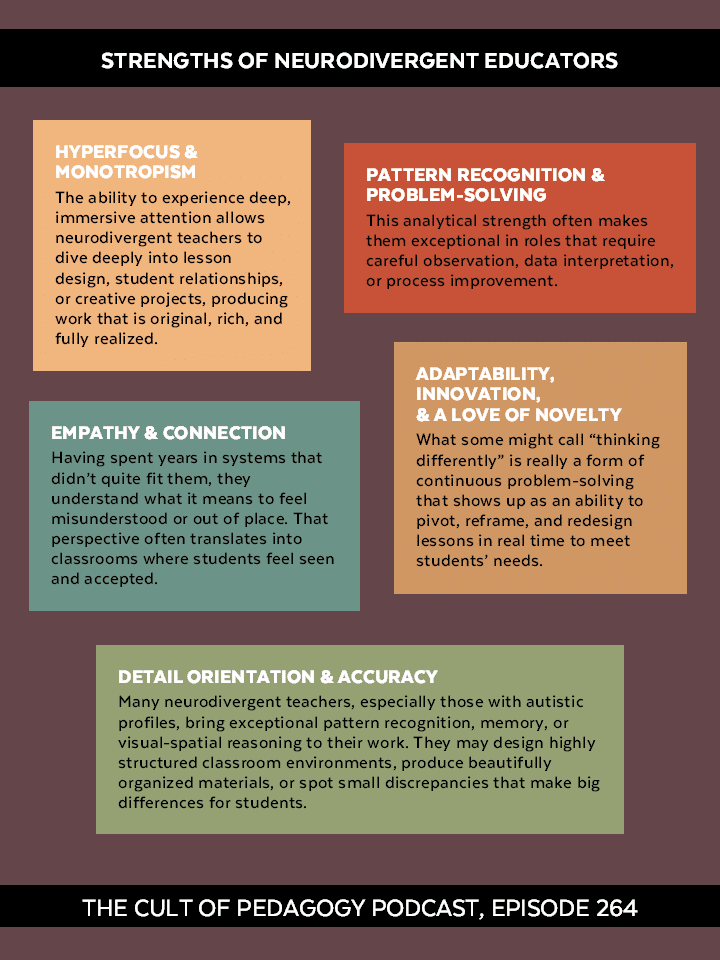
- Deep Empathy and Intuition: Educators with ADHD or autism often possess an acute awareness of emotional undercurrents in a room. They can easily identify the student who is quietly struggling, offering profound validation and psychological safety.
- Hyperfocus and Passion-Driven Innovation: When engaged in curriculum design or creative problem-solving, neurodivergent brains can enter states of hyperfocus, yielding highly engaging, unconventional, and memorable learning experiences for students.
- Authenticity as Modeling: By being transparent about their learning styles—such as utilizing visual schedules, taking mindful breaks, or openly discussing attention patterns—neurodivergent teachers normalize neurodiversity for their students. This demonstrates that there is no single "correct" way to think or learn.
The Systemic Friction Points
Conversely, the daily realities of school life often run counter to the needs of neurodivergent nervous systems. The primary challenges include:
- Constant Context-Switching: Teachers are forced to transition rapidly between administrative tasks, emotional counseling, disciplinary oversight, and instructional delivery. For executive-functioning systems taxed by neurodivergence, this rapid gear-shifting causes profound cognitive fatigue.
- Sensory Overload: Bright fluorescent lighting, echoing hallways, unpredictable cafeteria noise, and relentless social interaction drain sensory reserves. Without adequate recovery windows, this leads directly to chronic burnout.
- Rigid Compliance Deadlines: Traditional school cultures often penalize non-linear productivity. Educators who thrive in dynamic, non-traditional workflows struggle under mountains of bureaucratic paperwork and rigid administrative timelines.
Official Perspectives and Practical Strategies
Addressing these systemic challenges requires a dual approach: actionable self-care and workflow preservation strategies for the educator, coupled with systemic policy adjustments from school administrators.
Practical Tools and Strategies for Educators
While systemic reform remains the ultimate goal, neurodivergent educators can implement several evidence-based strategies to protect their cognitive energy:
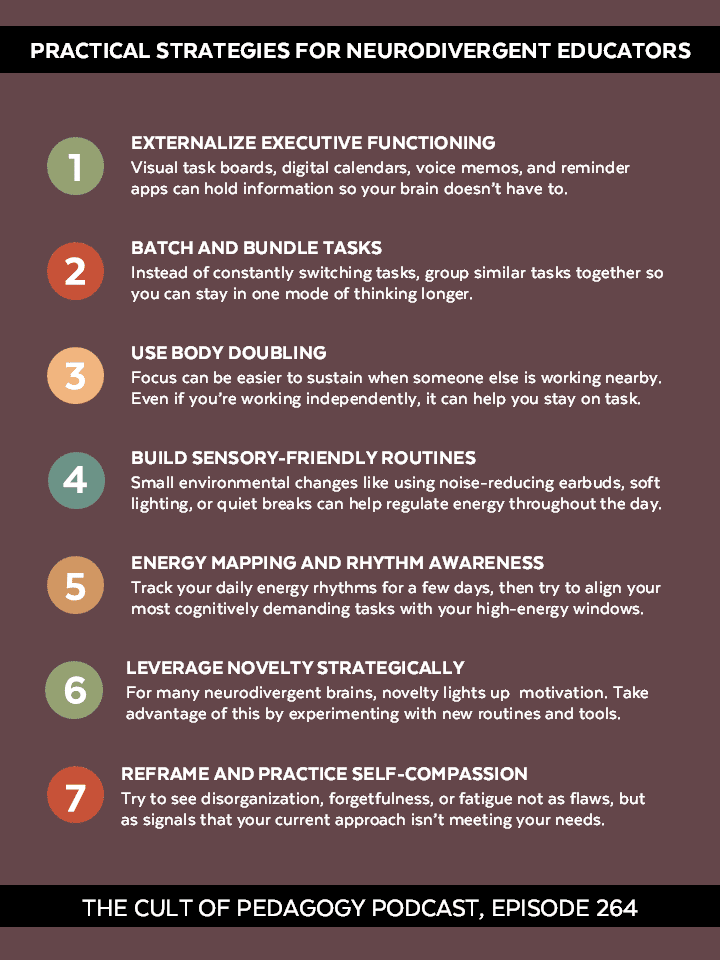
- Externalizing Executive Functioning: Stop relying on working memory. Utilize visual task boards, digital calendars, automated workflow tools (like IFTTT), and voice memos to capture ideas on the go, reducing mental clutter.
- Task Batching and Bundling: Minimize cognitive "gear-shifting" by grouping similar tasks. Dedicate specific blocks of time exclusively to grading, emailing, or lesson planning to stay within a single cognitive mode for longer periods.
- Utilizing Body Doubling: Leverage the accountability of another person’s presence. Partner with a colleague during planning periods or participate in virtual co-working sessions to maintain momentum through challenging administrative tasks.
- Building Sensory-Friendly Routines: Mitigate environmental stressors by incorporating noise-reducing earbuds, utilizing natural light or lamps instead of harsh fluorescents, and building intentional micro-breaks into daily transitions.
- Energy Mapping and Rhythm Awareness: Track daily energy fluctuations for two weeks. Align cognitively demanding tasks (such as detailed feedback or lesson design) with natural high-energy windows, reserving low-energy times for routine tasks.
- Leveraging Strategic Novelty: Introduce small variations—such as rearranging the classroom layout or experimenting with a new digital tool—to spark motivation when focus wanes.
- Practishing Radical Self-Compassion: Reframe disorganization or fatigue not as personal failure, but as objective feedback indicating that a current workflow requires adjustment.
Institutional Recommendations for School Administrators
Support for neurodivergent teachers must move beyond superficial awareness to tangible operational adjustments. Administrators can foster thriving environments by adopting the following practices:
- Differentiated Professional Support: Just as educators differentiate instruction for diverse learners, administrators must offer flexible support structures for staff, avoiding a one-size-fits-all approach to productivity and evaluation.
- Streamlining Bureaucratic Noise: Reduce unnecessary administrative burdens and redundant paperwork to allow teachers to focus their limited cognitive reserves on instruction and student connection.
- Fostering Psychological Safety: Create cultures where educators feel safe discussing their accommodation needs without fear of professional penalty or stigma.
- Designing Sensory-Considerate Workspaces: Provide quiet breakout rooms, adjustable lighting options in staff lounges, and flexible planning environments to help teachers regulate sensory input throughout the day.
Future Outlook: A Sustainable Paradigm for Education
The conversation surrounding neurodivergent educators represents a vital turning point in modern schooling. As more professionals reclaim their narratives, the education sector is being forced to confront an uncomfortable truth: systems that exhaust their teachers ultimately fail their students.
True reform requires moving away from an institutional obsession with outward perfection and compliance, toward a culture centered on sustainability, authenticity, and human well-being. When schools embrace cognitive diversity at every level of the organization, they model the exact values they wish to instill in the next generation. By fixing the system rather than trying to "fix" the neurodivergent individual, school communities can retain their most passionate, creative educators and build an academic future where everyone can thrive just as they are.

