In the modern educational landscape, the quest for pedagogical efficiency often stalls under the weight of sweeping, macro-level overhauls. School districts continuously search for the silver bullet—a comprehensive curriculum redesign or a total technological integration—that promises to elevate student engagement and academic mastery. Yet, these massive initiatives frequently collapse under their own logistical weight, leaving educators overwhelmed and skeptical.
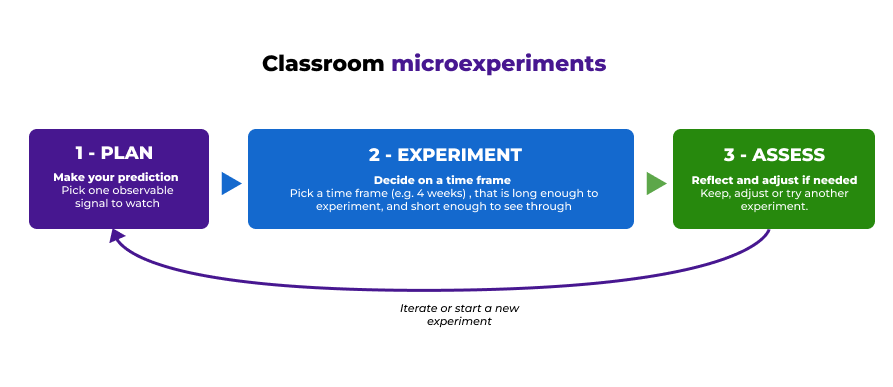
Enter the classroom micro-experiment: a low-risk, high-reward strategy that redefines how teachers approach instructional innovation. In this second installment of an ongoing Back-to-School series on micro-experimental learning, educators are invited to shift their perspective on formative assessment. Instead of the teacher orchestrating every detail of weekly reviews, the locus of control is handed directly to the students.
By tasking student groups with creating their own weekly review games using interactive platforms like Kahoot!, educators catalyze a powerful cognitive transformation. This approach moves students out of the passive passenger seat of rote memorization and places them firmly behind the wheel of higher-order thinking, as defined by Bloom’s Taxonomy. Formulating questions requires analysis, evaluation, and synthesis—skills far more complex than merely selecting the correct multiple-choice option.
This article explores the mechanics of classroom micro-experiments, analyzes the cognitive dividends of student-led question design, provides a comprehensive look at the implementation framework, and outlines the broader implications for the future of interactive learning environments.
Detailed Chronology: The Evolution of Formative Assessment
To understand the necessity and power of student-led micro-experiments, one must trace the evolution of formative assessment in the 21st-century classroom.
The Traditional Paradigm: Teacher-Centric Review
For decades, the standard weekly review followed a predictable chronological arc:
Instruction: The teacher delivers content over four to five days via lectures, readings, and guided practice.
Curation: On Friday, the teacher spends precious planning time synthesizing the week’s lessons into a quiz or review game.
Execution: Students log in or take out paper to answer the teacher-crafted questions.
Evaluation: The teacher grades the assessment, diagnosing gaps in comprehension after the instructional window has closed.
While functional, this model places the heavy lifting of cognitive processing entirely on the educator. The teacher must decide what matters, anticipate misconceptions, and design distractor questions. Consequently, students remain consumers of information rather than architects of understanding.
Part 1: The Weekly Formative Check
In Part 1 of this series, the focus rested on a small-scale intervention: the weekly formative check via a short teacher-written review game. While this reduced the friction of traditional testing and provided immediate feedback, it maintained the teacher as the sole creator of academic content.
Part 2: The Shift to Student-Led Design
The current micro-experiment marks a radical chronological departure. Instead of introducing a new tool, it repurposes an existing one by rotating the authorship of the review.
Phase 1 (The Setup): The educator establishes a micro-experiment window—typically a fixed, short-term trial of three to four weeks—designating rotating student groups as the week’s "Question Architects."
Phase 2 (The Synthesis): During designated study periods, these students review the week’s curriculum, filter essential concepts from trivial details, and draft targeted quiz questions.
Phase 3 (The Deployment): The peer-created game is played by the entire class, serving simultaneously as a rich formative assessment for the teacher and a rewarding collaborative experience for the student creators.
Supporting Context & Metrics: The Cognitive Science Behind the Experiment
Why does writing a question yield superior learning outcomes compared to simply answering one? The answer lies at the intersection of cognitive psychology and educational taxonomy.
Bloom’s Taxonomy in Action
Benjamin Bloom’s taxonomy of educational objectives provides a vital metric for understanding student engagement. The framework categorizes cognitive skills into a hierarchical pyramid:
Base (Lower-Order Thinking Skills – LOTS): Remembering and Understanding. This is the domain of traditional quiz-taking. Students recognize terms, recall facts, and comprehend basic narratives.
Apex (Higher-Order Thinking Skills – Hots):** Analyzing, Evaluating, and Creating. This is the domain of question-authoring.
When a student sits down to write a fair, challenging Kahoot! question about a complex scientific process or historical event, they cannot rely on superficial recognition. They must:
Analyze the source material to determine the core learning objective.
Evaluate various facets of the topic to decide what constitutes a valid, non-ambiguous question.
Create plausible, tempting incorrect answers (distractors) that expose common misconceptions without being confusing or unfair.
Educational metrics consistently show that the most effective way to master a subject is to teach it. When students prepare questions for their peers, they undergo a psychological shift. They transition from passive grade-seekers to active stakeholders in the classroom culture.
Metrics from collaborative learning environments indicate that student-authored assessments foster:
Deeper Retention: Information processed through the lens of creation is encoded more securely in long-term memory.
Metacognitive Awareness: Students develop a better understanding of their own learning gaps when they try to design questions that stump their peers.
Intrinsic Motivation: The social dynamic of stumping or teaching classmates introduces a healthy, gamified incentive structure that transcends extrinsic grading pressure.
Official Statements and Pedagogical Insights
Educational leaders and curriculum designers increasingly emphasize the value of micro-experiments as a bridge between theoretical pedagogy and daily classroom realities.
"A classroom micro-experiment is the smallest change you can make that still tells you something real," notes lead instructional designer Dr. Elena Vance. "You are not committing to a permanent curriculum overhaul. You commit to running a tiny test for a fixed window, watching one clear signal, and letting the data dictate your next step."
This philosophy strips away the intimidation factor of educational innovation. Teachers are frequently inundated with mandates to transform their teaching methods overnight. Micro-experiments offer an antidote to this burnout. By isolating a single variable—in this case, who writes the review questions—educators can test the waters of constructivist learning without risking classroom stability.
Furthermore, pedagogical experts highlight the structural benefits of intentionality. Many teachers occasionally let students write review questions on an ad-hoc basis when a lesson ends early. However, without a structured micro-experiment framework, these instances remain isolated novelties. By framing student question-authoring as a structured, rotating weekly protocol with clear objectives, teachers turn a random activity into a reliable, measurable diagnostic tool.
Future Outlook: The Horizon of Interactive, Student-Driven Classrooms
As we look toward the future of education, the integration of student-led content creation points toward a more decentralized, collaborative classroom ecosystem.
What’s Next: Team Play and Quiet Voices
Following the success of student-authored question micro-experiments, Part 3 of this Back-to-School series will explore the dynamics of collaborative gameplay. Specifically, researchers will examine whether shifting from individual competition to team-based play bridges the participation gap, drawing quiet and hesitant students into the active learning process.
The Long-Term Impact on Student Agency
Empowering students to co-create their assessment materials lays the groundwork for 21st-century competencies such as critical thinking, digital literacy, and peer collaboration. As educational technology platforms evolve, the barrier to entry for content creation continues to drop, allowing learners of all ages to take charge of their educational journeys.
By embracing micro-experiments, teachers can incrementally build more dynamic, responsive, and engaging learning environments. The journey of a thousand miles begins with a single step—or, in the case of the modern classroom, a single student-written question.
Ready to transform your weekly review? Set up a student group, share a simple question-writing guide, and let your students take the lead on next week’s Kahoot!.