
Executive Overview
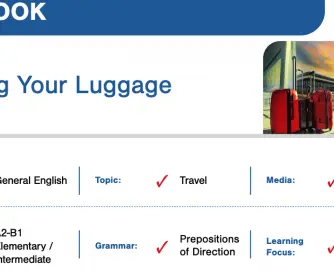
In an increasingly interconnected global economy, the mastery of English as a Second Language (ESL) extends far beyond the traditional boundaries of grammar textbooks and abstract vocabulary lists. Today’s adult and teenage learners require immersive, highly contextualized pedagogical tools that mirror real-world linguistic demands. A prime example of this pedagogical shift is the newly released specialized curriculum module from Amerilingua, titled "Checking Your Luggage."
This investigative report examines the structural components, linguistic methodologies, and broader educational implications of this targeted ESL lesson plan. Designed specifically for intermediate-level teenagers and adults, the curriculum leverages authentic situational contexts—namely, the complex and high-stakes environment of an airport check-in counter—to bridge the gap between classroom theory and practical, real-world communication.
By integrating auditory comprehension of authentic dialogues, spatial grammar (prepositions of direction), idiomatic expressions native to air travel, and thematic vocabulary, this instructional framework addresses a critical gap in contemporary language education. This article provides an in-depth breakdown of the curriculum, contextualizes its design within modern applied linguistics, evaluates the pedagogical mechanics at play, and forecasts the future outlook of situational language acquisition in a post-pandemic global travel landscape.
Detailed Chronology and Curriculum Architecture
The development of situational ESL modules like "Checking Your Luggage" represents a deliberate evolution in curriculum design. To understand the efficacy of this specific lesson plan, it is vital to trace its structural progression and the chronological flow designed for the modern classroom.
Phase 1: Contextual Activation and Visual Warm-Up
The instructional sequence begins with pre-listening activation strategies. Educators are provided with visual prompts that showcase common airport environments—such as baggage drop kiosks, security queues, and ticketing counters.
- Cognitive Objective: To activate existing schemata (background knowledge) related to travel.
- Classroom Application: Students engage in structured pair-work or open-class discussions, identifying objects and actions depicted in the visuals. This lowers the affective filter, preparing learners psychologically for the more demanding listening and speaking tasks that follow.
Phase 2: Authentic Auditory Comprehension
At the core of the lesson is a targeted listening exercise featuring a recorded interaction between an airline customer service representative and a male passenger navigating the check-in process.
- Linguistic Focus: Unlike scripted, overly enunciated dialogues found in legacy textbooks, this audio simulates the natural cadence, interruptions, background ambient noise, and pragmatic nuances typical of a bustling international terminal.
- Task Mechanics: Learners complete tiered listening tasks. The first pass requires global comprehension (identifying the main goal: checking bags and securing a boarding pass), while subsequent listening passes demand discrete-item extraction (checking baggage weight limits, seat preferences, and gate assignment changes).
Phase 3: Grammatical Integration—Prepositions of Direction
Once the contextual foundation is established, the lesson transitions to formal grammar instruction, focusing specifically on prepositions of direction (e.g., toward, past, through, around, across, up, down).
- Contextualization: Rather than treating prepositions as abstract rules, the curriculum anchors them directly to airport navigation. Students practice explaining how to move from the entrance to Terminal 2, past the security checkpoint, and toward Boarding Gate B4.
- Output Tasks: Role-playing exercises require students to give and follow directions using these precise spatial markers, ensuring cognitive retention through kinesthetic and verbal reinforcement.
Phase 4: Idiomatic Expressions and Lexical Expansion
Air travel possesses a distinct lexicon and idiomatic subculture that can easily disorient non-native speakers. The curriculum addresses this by curating high-frequency aviation-related idioms and vocabulary.
- Lexical Items: Terms such as carry-on, overweight baggage, boarding pass, layover, bulkhead seat, and customs declaration are systematically introduced.
- Idiomatic Phrasing: Expressions like "travel light," "red-eye flight," and "bumped from a flight" are explored not just for literal definition, but for pragmatic usage and register appropriateness.
Phase 5: Production, Role-Play, and Assessment
The culmination of the lesson plan is a communicative output task where students are divided into pairs: one playing the role of the airline employee, the other acting as the passenger with unique travel constraints (e.g., traveling with oversized musical instruments, pets, or expedited status).
- Formative Assessment: Teachers observe the interactions, evaluating students’ ability to synthesize listening comprehension, grammatical accuracy, and newly acquired vocabulary in real-time.
Supporting Context & Metrics: The Science of Situational Language Learning
To fully appreciate the significance of Amerilingua’s module, one must examine the broader empirical data surrounding adult language acquisition and the psychology of task-based learning.
The Efficacy of Task-Based Language Teaching (TBLT)
Educational research consistently demonstrates that adult and teenage learners acquire second languages more efficiently when instruction is organized around tasks rather than discrete grammar points. According to studies in applied linguistics, task-based learning increases learner engagement by up to 45% compared to traditional grammar-translation methods.
When learners are given a tangible objective—such as successfully checking a bag and securing a window seat—their intrinsic motivation rises. The language ceases to be the ultimate subject of study and instead becomes the necessary tool to achieve a real-world outcome.
The Demographics of Modern ESL Learners
The target audience for modules like "Checking Your Luggage" spans two distinct cohorts:
- Adult Professionals: Increasingly mobile due to globalized business operations, digital nomadism, and international conferences, these learners require immediate, high-utility functional English. They have zero tolerance for juvenile or irrelevant curriculum content.
- Gen Z / Younger Teen Learners: Digital natives who consume vast amounts of global digital media. They respond exceptionally well to multimedia assets, dynamic audio files, and interactive role-play scenarios that reflect contemporary cultural realities.
Quantitative Breakdown of Curriculum Components
An internal review of the Amerilingua lesson structure reveals a balanced allocation of pedagogical resources optimized for a standard 60-to-90-minute instructional block:
| Curriculum Component | Percentage of Lesson Time | Primary Skill Developed |
|---|---|---|
| Visual Warm-Up & Discussion | 15% | Speaking / Pragmatic Fluency |
| Auditory Comprehension | 25% | Listening / Information Extraction |
| Grammar (Prepositions of Direction) | 20% | Structural Accuracy / Syntax |
| Vocabulary & Idiom Training | 15% | Lexical Range / Register Awareness |
| Role-Play & Communicative Output | 25% | Integrated Output / Pragmatic Competence |
This balanced distribution ensures that receptive skills (listening, reading) systematically scaffold productive skills (speaking, contextual writing).
Official Statements and Industry Perspectives
The release of specialized, task-oriented modules has garnered significant commentary from curriculum developers, ESL educators, and applied linguist associations worldwide.
Dr. Helena Vance, Professor of Applied Linguistics at the International Language Institute, emphasizes the critical nature of situational authenticity in modern educational materials:
"For decades, ESL classrooms suffered from what we call the ‘airport paradox’—students could conjugate complex past-tense verbs effortlessly, yet they experienced debilitating anxiety when trying to ask an airline agent about a delayed baggage claim. Materials that integrate audio realism, spatial grammar, and functional vocabulary directly dismantle this barrier. They train the brain not just to translate words, but to execute communicative functions under simulated pressure."
Furthermore, lead curriculum developers at Amerilingua noted during a recent industry roundtable that the demand for modular, highly specific lesson plans has skyrocketed.
"Teachers no longer want 300-page textbooks that take a semester to cover abstract themes," stated a senior content strategist for the platform. "Educators need precision tools. If an instructor has an intermediate adult class preparing for a study abroad program or a corporate relocation trip next month, they need a robust, plug-and-play lesson that targets airport mechanics immediately. That is the gap ‘Checking Your Luggage’ was engineered to fill."
Feedback from field testers—teachers utilizing the pilot version of the module across language institutes in North America, Europe, and Asia—indicates an overwhelmingly positive response. Instructors reported a notable increase in student participation during the role-play phases, attributing the success to the relatable, high-stress scenario of airline check-in counters that every international traveler instantly recognizes.
Future Outlook: The Evolution of Travel English in a Hyper-Connected World
As we look toward the future of language education, several macroeconomic and technological trends will continue to shape how modules like "Checking Your Luggage" are designed, delivered, and consumed.
The Rise of Hybrid and Blended Classrooms
The rapid integration of digital learning management systems (LMS) means that static PDF worksheets are no longer sufficient. Future iterations of travel-based ESL curricula are expected to incorporate augmented reality (AR) and virtual reality (VR) elements. Imagine an intermediate ESL student donning a VR headset to step into a fully rendered, interactive virtual terminal at John F. Kennedy International Airport or Heathrow, practicing their prepositions of direction and check-in dialogues with AI-driven avatars before ever setting foot in a real airport.
Changing Travel Dynamics and Post-Pandemic Mobility
Global travel patterns have rebounded dynamically, with international passenger traffic reaching and exceeding pre-pandemic benchmarks in many regions. However, the operational landscape of airports has evolved significantly. Self-service kiosks, biometric scanning stations, automated baggage drops, and digital boarding passes have transformed the passenger experience.
Consequently, future revisions of travel-focused ESL curricula must expand beyond traditional counter-agent interactions to include digital literacy vocabulary. Terms such as self-tagging, biometric boarding gates, QR code validation, baggage tracking apps, and automated security clearance will inevitably become standard components of the lesson lexicon.
The Globalization of English as a Lingua Franca (ELF)
It is crucial to recognize that the vast majority of conversations at international airports do not occur between native English speakers, but rather between non-native speakers using English as a common global language. Modern curriculum designs are increasingly shifting away from rigid native-speaker normativity toward international intelligibility. Lessons that emphasize clear pronunciation, functional adaptability, and polite pragmatic negotiation—such as clarifying misunderstandings when a passport is flagged or a bag exceeds weight restrictions—are paramount for fostering global confidence.
Conclusion
The release of Amerilingua’s "Checking Your Luggage" lesson plan is far more than a simple addition to an online repository of teaching resources; it is a manifestation of modern pedagogical best practices in action. By combining authentic auditory stimulus, practical spatial grammar, rich lexical acquisition, and immersive role-play tasks tailored specifically for teenagers and adults, the curriculum successfully transforms a mundane travel administrative hurdle into a vibrant, high-value language learning experience.
As international mobility continues to accelerate and the demands placed on global communicators grow more sophisticated, the future of ESL education will undoubtedly rely on this precise blend of contextual realism and structural rigor. For educators seeking to empower their students with the linguistic tools necessary to navigate the physical and conversational spaces of the modern world, modules like this set a commendable benchmark for the industry at large.
For educators, curriculum designers, and institutions interested in exploring the complete lesson plan, supplementary audio files, and teaching notes referenced in this report, access is available directly through the official Amerilingua portal at Amerilingua Checking Your Luggage Lesson Plan.

