
Executive Overview
For generations, the pedagogical metric of a successful lesson has been immediate feedback in the classroom: hands raised, questions answered correctly, and a general hum of productivity before the bell rings. Yet, educators have long wrestled with a silent, persistent challenge in education: How much of that newly acquired knowledge actually survives the transition from the classroom to the long-term memory of the student?
Too often, instruction functions as a temporary vessel. Information is absorbed for the duration of a single class period, only to dissolve by the time homework is assigned or exams roll around.
A landmark study published by researchers Boulahnane, Ismaili, and Haddi (2026) offers a compelling look at this educational dilemma. Conducted within a Moroccan middle school setting, the study moves beyond traditional achievement measures to examine the long-term impact of game-based learning platforms—specifically Kahoot!—on student retention, academic performance, and classroom engagement.
By comparing two ninth-grade classes over a rigorous three-week intervention, the researchers sought to uncover whether gamifying the learning experience could fundamentally alter how students process and retain complex academic concepts. The subjects of focus were critical foundational pillars: English grammar, English vocabulary, and Life and Earth Sciences.
The findings are striking. Students instructed using Kahoot! not only achieved roughly twice the learning gains of their peers during immediate post-instruction assessments, but they also demonstrated a profound ability to retain that knowledge over time. When tested two weeks later without intervening study sessions, the Kahoot! cohort maintained a commanding lead, sustaining a 3.3 to 3.7-point advantage over the control group across all three subjects. Furthermore, self-reported engagement metrics revealed a dramatic gulf between the two instructional styles, with game-based learners reporting an average engagement score of 23.6 out of 25, compared to just 17.0 for the conventional instruction group.
This investigative report examines the architecture of the Boulahnane, Ismaili, and Haddi study, breaks down its quantitative metrics, explores the underlying cognitive mechanisms of game-based learning, and provides actionable insights for educators looking to reshape their instructional frameworks.
Detailed Chronology of the 2026 Study
To understand the weight of the Boulahnane, Ismaili, and Haddi (2026) findings, one must examine the meticulous methodology and chronological progression of the research design.
The study took place over a tightly controlled three-week window in a Moroccan middle school. The sample population comprised two distinct ninth-grade classes, totaling 60 students aged 14 to 15 (30 students per class). To ensure empirical validity, both cohorts shared comparable academic baselines, identical curriculum requirements, and the exact same volume of instructional time. Both groups were taught the same core modules: English grammar, English vocabulary, and Life and Earth Sciences.
Phase 1: Pre-Instructional Baseline (Week 0)
Before a single lesson was delivered, researchers established a quantitative baseline. Every student across both classes completed a standardized, 20-item diagnostic test tailored to each of the three subject areas. The results confirmed that both cohorts possessed statistically equivalent baseline knowledge, neutralizing prior academic achievement as a confounding variable.
Phase 2: The Instructional Intervention (Weeks 1 to 3)
During the active teaching phase, the two classes diverged into entirely different pedagogical environments:
- The Control Group (Conventional Instruction): This cohort experienced traditional teacher-led instruction. Lessons relied heavily on direct teacher explanations, textbook exercises, and conventional pair-work drills. Formative assessment consisted of traditional questioning and answering, where teachers called on individual students.
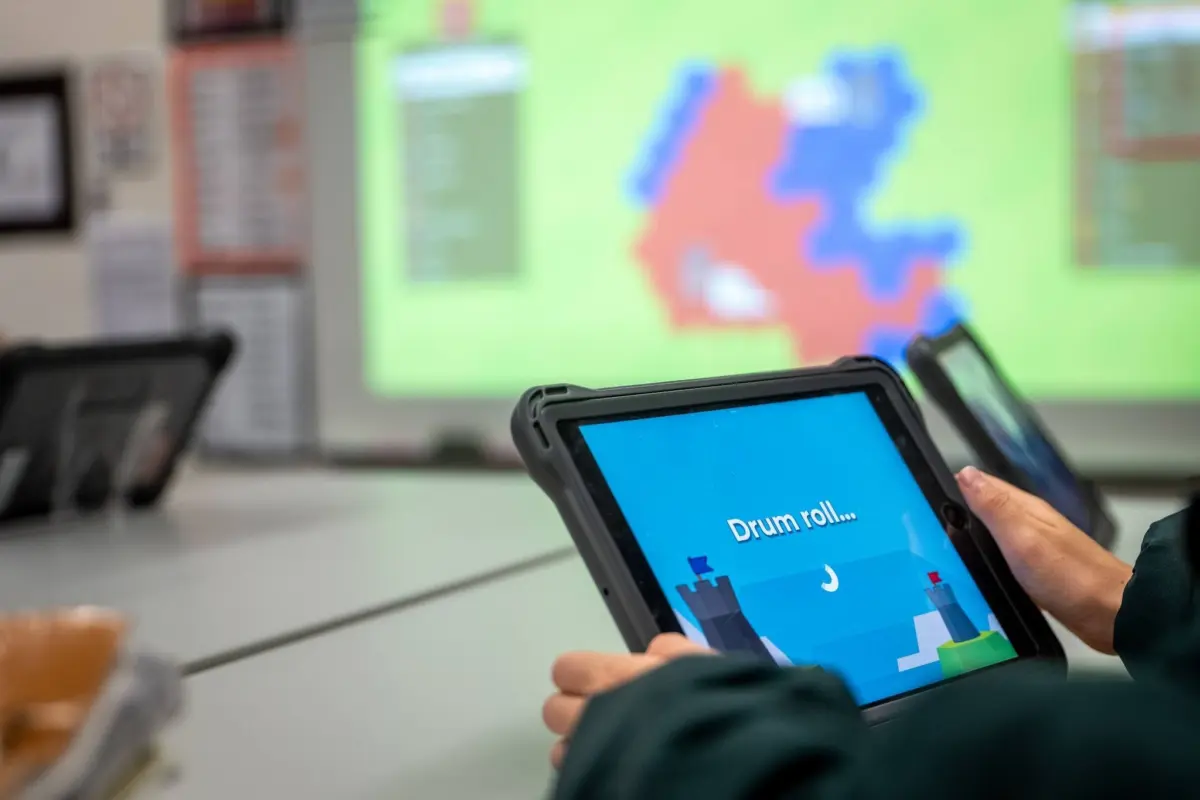
- The Experimental Group (Kahoot! Integration): This cohort experienced the same core content delivered through the integration of the Kahoot! platform. During these sessions, teachers projected quiz questions onto a shared central screen. Students used personal smartphones or shared classroom tablets to log in and submit their responses in real-time.
Crucially, the pedagogical application of Kahoot! went beyond mere gamification or racing against a timer. The platform served as a dynamic feedback loop. Immediately following each question, the shared screen displayed the correct answer alongside a visual distribution of how the entire class had responded. Whenever a significant portion of the class answered incorrectly, the teacher paused the game, reviewed the specific misconception, provided targeted explanations, and facilitated a brief class discussion before advancing to the next prompt.
Phase 3: Immediate Post-Instruction Assessment
The moment the instructional unit concluded at the end of week three, both groups were subjected to the same 20-item achievement tests administered at the baseline phase. This phase measured the immediate cognitive acquisition of the students, capturing the short-term impact of both teaching methodologies.
Phase 4: The Two-Week Retention Check
Perhaps the most critical phase of the chronological design occurred fourteen days later. Without any advance warning, study preparation, or interim review sessions covering the tested material, both classes were administered the identical 20-item test for a third time. This longitudinal follow-up was designed to pierce through the illusion of short-term mastery and evaluate true cognitive retention—measuring how deeply the concepts had integrated into the students’ long-term memory structures.
Supporting Context & Metrics: Unpacking the Data
The quantitative data yielded by Boulahnane, Ismaili, and Haddi (2026) provides a clear look at the cognitive benefits of interactive, game-based learning environments. The metrics span three primary dimensions: immediate academic gains, long-term memory retention, and psychological engagement.
Academic Gains: Immediate Post-Test Results
While both classes exhibited positive learning curves from the pre-test to the immediate post-test, the velocity and magnitude of growth differed dramatically. Across all three subject domains—English grammar, English vocabulary, and Life and Earth Sciences—students utilizing Kahoot! achieved roughly twice the learning gains of their peers in the conventional instruction group.
This immediate leap suggests that the gamified format served as an intensive cognitive accelerator. By transforming formative assessment into a high-involvement, low-stakes competitive environment, students were prompted to rapidly process information, evaluate options under time constraints, and encode data more efficiently than they did through passive listening or textbook drills.
Long-Term Retention: The Two-Week Follow-Up
Educational research is replete with interventions that produce stellar immediate results, only for those gains to evaporate weeks later due to the well-documented "forgetting curve." To test whether Kahoot! suffered from this same limitation, the researchers analyzed the data from the unannounced two-week follow-up assessment.
While both groups experienced a slight decline in scores over the fourteen-day hiatus—underscoring the absolute necessity of spaced repetition in education—the Kahoot! cohort maintained a commanding statistical advantage. Students in the game-based learning group sustained a persistent edge, maintaining an average score advantage of 3.3 to 3.7 points higher (out of a 20-point scale) than the control group across grammar, vocabulary, and science.
[Mean Test Scores Over Time (Out of 20)]

English Grammar:
- Pre-Test:        Similar Baselines (Control ≈ Kahoot!)
- Immediate Post:  Kahoot! shows ~2x greater gains
- 2-Week Follow:   Kahoot! retains a 3.3 - 3.7 point advantage

English Vocabulary:
- Pre-Test:        Similar Baselines (Control ≈ Kahoot!)
- Immediate Post:  Kahoot! shows ~2x greater gains
- 2-Week Follow:   Kahoot! retains a 3.3 - 3.7 point advantage

Life & Earth Sciences:
- Pre-Test:        Similar Baselines (Control ≈ Kahoot!)
- Immediate Post:  Kahoot! shows ~2x greater gains
- 2-Week Follow:   Kahoot! retains a 3.3 - 3.7 point advantage
Psychological Engagement Metrics
Cognitive engagement is widely recognized as a primary precursor to deep learning. To evaluate students’ subjective experiences during the instructional units, researchers administered a validated engagement survey following the completion of the study.
The contrast in student sentiment was stark:
- Kahoot! Cohort Average Engagement Score: 23.6 out of 25
- Conventional Instruction Cohort Average Engagement Score: 17.0 out of 25
This 6.6-point differential highlights a profound shift in classroom climate. Students operating within the game-based learning framework did not simply memorize facts more effectively; they experienced the learning process as fundamentally more stimulating, immersive, and rewarding. This heightened affective state likely fueled the attention and effort required to encode complex linguistic and scientific principles into long-term memory.
Official Insights & Theoretical Implications
While the study’s quantitative outputs are undeniable, educational researchers must unpack the underlying mechanics driving these results. Boulahnane, Ismaili, and Haddi point toward several cognitive phenomena that likely collaborated to produce the observed outcomes, though they note that future research will be needed to isolate individual variables.
The Power of Active Recall and Immediate Feedback
Traditional classrooms often suffer from a feedback delay. A teacher assigns homework, collects it, grades it over the weekend, and returns it days or weeks later. By the time the student reviews their mistakes, the cognitive window for error correction has largely closed.
In contrast, digital game-based learning platforms like Kahoot! operate on instant feedback loops. The moment a student submits an answer, the platform flashes correct or incorrect, reinforced by a visual breakdown of how the rest of the class performed. This immediate alignment between action and consequence prevents the consolidation of misconceptions.
Furthermore, the instructional design observed in the study leveraged active recall. Rather than passively reviewing notes or reading a textbook chapter, students were forced to retrieve information from memory under active conditions, strengthening neural pathways and making the data far easier to access during subsequent evaluations.
The Pedagogical Bridge: Technology Plus Teacher Mediation
A critical nuance of the Boulahnane, Ismaili, and Haddi (2026) study is that Kahoot! was not deployed as an isolated, standalone digital babysitter. The platform was leveraged as an active diagnostic instrument by the classroom instructor.
When the aggregate data revealed a widespread misunderstanding—signaled by a cluster of incorrect responses on the shared screen—the instructor intervened. They stopped the game, addressed the specific cognitive stumbling block, explained the underlying rules of grammar or biological processes, and facilitated an open class discussion.
This synergy between digital data collection and human pedagogical intervention transforms quiz games from mere entertainment into precision teaching instruments. Teachers were empowered to direct their instructional energy precisely where student comprehension was fracturing, maximizing the efficiency of class time.
Future Outlook & Practical Takeaways for Educators
As educational institutions navigate the integration of digital tools into modern classrooms, studies like the one conducted by Boulahnane, Ismaili, and Haddi provide rigorous, evidence-based direction. While the study was intentionally bounded—focusing on two classes within a single school and tracking retention over a two-week span—it contributes an important data point to the growing body of literature supporting game-based learning.
Actionable Strategies for Middle School Classrooms
For educators teaching language arts, sciences, or humanities, the practical applications derived from this research are both accessible and immediately actionable:
- Formative Assessment as a Diagnostic Compass: Stop using quizzes solely as terminal evaluation tools. Deploy platforms like Kahoot! at the midpoint or conclusion of a foundational teaching block to rapidly scan the classroom’s collective comprehension.
- Embrace the "Pause and Pivot": Resist the urge to rush through a digital quiz just to finish the game. When data reveals a high rate of incorrect answers, pause immediately. Turn the missed question into a focal point for class discussion, encouraging peer-to-peer explanations and direct teacher clarification.
- Leverage Spaced Repetition: Recognizing that even high-performing students experience some degree of knowledge decay over time, integrate recurring review kahoots. Re-visiting core vocabulary, grammar rules, and scientific concepts a week or two after initial instruction helps reinforce neural pathways and combat the forgetting curve.
- Prioritize Affective Engagement: Acknowledge that student engagement is not a luxury; it is a cognitive necessity. By integrating structured play into rigorous academic content, educators can dramatically elevate student participation levels, transforming passive listeners into active, invested learners.
The Horizon of Educational Technology Research
As the academic community looks toward the future, research into digital pedagogies must continue to evolve. Subsequent studies would benefit from expanding sample sizes across diverse demographic landscapes, lengthening the longitudinal tracking window from two weeks to months or even semesters, and isolating specific mechanics—such as the exact impact of time pressure versus immediate feedback loops.
Nevertheless, the 2026 findings by Boulahnane, Ismaili, and Haddi offer an encouraging message for the modern classroom. When thoughtfully integrated into a well-structured curriculum, game-based learning platforms do more than simply entertain students—they help build lasting knowledge that endures long after the game has ended.

