
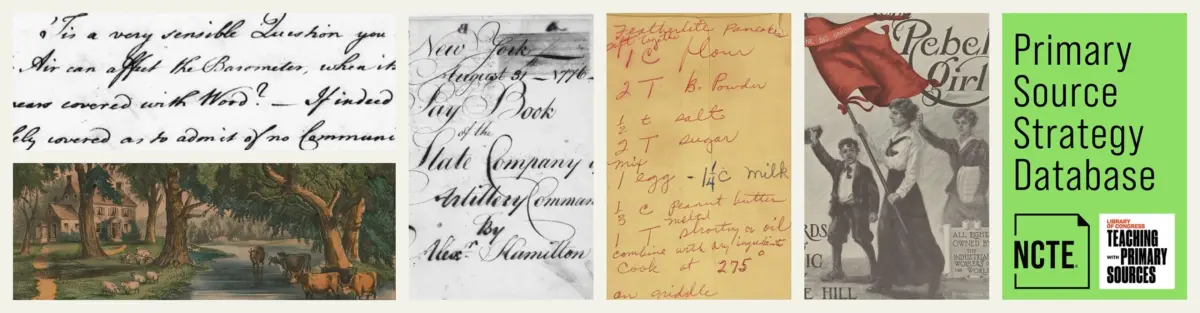
Executive Overview
In an era defined by an overwhelming abundance of digital information, the ability to critically analyze historical documents, historical media, and archival records has never been more vital. Recognizing this pedagogical imperative, the National Council of Teachers of English (NCTE) has forged a dynamic partnership with the Library of Congress as an active participant in the Teaching with Primary Sources (TPS) Consortium.
This ambitious multi-year collaboration is designed to fundamentally shift how literacy teachers and students interact with historical artifacts, moving beyond passive textbook learning into active historical inquiry. At the heart of this initiative is a newly expanded, highly searchable digital database featuring pedagogical strategies for more than 150 specific items culled directly from the Library of Congress’s vast, digitized primary source collections.
Developed by a collaborative task force comprising more than two dozen distinguished educators and leaders in English Language Arts (ELA) education, these curriculum resources provide concrete pathways for integrating authentic historical texts into modern classrooms. By aligning primary source analysis with rigorous academic standards, thematic units, and specific literacy frameworks—such as picture book evaluation and argument construction—the NCTE and the Library of Congress are equipping the next generation of students with the critical media literacy skills required to navigate a complex world.
Detailed Chronology: Bridging Archives and Classrooms
The integration of primary sources into modern ELA and humanities curricula did not happen overnight; it represents the culmination of decades of archival digitization and educational advocacy.
- The Foundation of Access (Late 20th Century – Early 2000s): For generations, primary source documents—ranging from foundational government legislation to regional abolitionist newspapers—were locked away in physical archives, accessible primarily to academic researchers and professional historians. The advent of the digital age initiated a paradigm shift, spearheaded by the Library of Congress through initiatives like American Memory and later, Chronicling America, which systematically brought millions of historical pages into the public digital sphere.
- Establishment of the TPS Consortium: Recognizing that raw access to digitized archives was insufficient without pedagogical scaffolding, the Library of Congress launched the Teaching with Primary Sources program. By partnering with universities and educational organizations across the nation, the TPS Consortium began training educators on how to help students construct knowledge from original artifacts.
- The NCTE Partnership Integration: Building upon the foundational success of the TPS model, the NCTE integrated its deep expertise in literacy education into the consortium. Recognizing that reading comprehension extends far beyond standard literary fiction to encompass historical arguments, visual media, and periodical journalism, the NCTE mobilized ELA leaders to draft practical classroom strategies.
- Launch of the Curricular Database: The culmination of this ongoing partnership is the deployment of a robust, searchable digital repository. Designed with intuitive filtering tags such as "picturebook," "argument," "STEM," and "history," the database allows educators to pinpoint exact historical items and immediately access peer-reviewed instructional frameworks. Today, this repository supports over 150 curated items, serving as an evolving bridge between archival history and contemporary literacy instruction.
Supporting Context & Metrics: Representation, Pedagogy, and Archival Power
To fully appreciate the impact of the NCTE-Library of Congress initiative, one must examine the specific pedagogical theories and historical frameworks guiding the database’s design. The instructional value of these primary sources extends across multiple dimensions, focusing heavily on inclusive representation, critical thinking, and civic engagement.
Challenging Traditional Narratives in STEM and History
A cornerstone of the instructional strategies embedded within the database is the deliberate dismantling of historically exclusionary narratives. For decades, popular historical discourse surrounding innovation, invention, and scientific discovery has disproportionately centered on white men. This systemic bias has inadvertently reinforced the false notion that innovation is the exclusive domain of a specific demographic, leading to the cultural erasure of countless Black, Indigenous, and female innovators.
The NCTE-backed curriculum directly counters this historical injustice. By spotlighting pioneering historical figures—such as inventors like Sarah E. Goode, Madam C. Walker, or lesser-known female innovators like the historically marginalized historical figures often studied in tandem with early American industry—educators can guide students to see themselves reflected in the annals of history.
Crucially, the instructional materials emphasize that real-world innovation does not always require formal institutional education or a pursuit of fame and fortune. Many historic breakthroughs emerged organically from an individual’s desire to solve practical, daily challenges within their communities. By examining these primary sources, students learn to appreciate ingenuity in all its diverse forms, fostering a more inclusive and accurate understanding of human progress.
Archival Spotlight: The Statesman and the Mountain West
A prime example of the rich archival material featured within the initiative’s scope is The Statesman, a historical weekly newspaper founded in 1888 and published in Denver, Colorado. Serving the vibrant African American communities across Colorado, Wyoming, Montana, Utah, and New Mexico, The Statesman acted as a vital communal lifeline.
Operating during an era of profound institutional oppression, the newspaper provided a crucial public forum where its readers could voice opinions, assert their constitutional rights, and demand due recognition. Its pages chronicled local community events, church gatherings, and society news, alongside hard-hitting national reporting tailored specifically to the interests of African Americans residing in the Mountain West. Furthermore, the publication featured bold op-eds dissecting the realities of Jim Crow laws, legal segregation, and interracial marriage.
When integrated into modern classrooms, periodicals like The Statesman offer students an unfiltered lens into the past, allowing them to study historical journalism not merely as passive text, but as active tools of advocacy and community resilience.
+-----------------------------------------------------------------------------------+
|                        THE NCTE-LOC INITIATIVE AT A GLANCE                        |
+---------------------------+-------------------------------------------------------+
| Core Partners             | National Council of Teachers of English (NCTE) &      |
|                           | Library of Congress (TPS Consortium)                  |
+---------------------------+-------------------------------------------------------+
| Primary Objective         | Expanding primary source utilization in literacy      |
|                           | instruction and historical inquiry                    |
+---------------------------+-------------------------------------------------------+
| Database Scale            | Over 150 specific, digitized items with customized    |
|                           | instructional strategies                              |
+---------------------------+-------------------------------------------------------+
| Contributor Network       | Developed by more than two dozen ELA teachers and     |
|                           | educational leaders                                   |
+---------------------------+-------------------------------------------------------+
| Key Searchable Tags       | Picturebook, Argument, History, News, STEM            |
+---------------------------+-------------------------------------------------------+
Standards Alignment and Rigorous Academic Frameworks
To ensure that educators can seamlessly integrate these archival resources into existing school districts without sacrificing standardized testing requirements, the database provides explicit alignments with state content standards. For instance, the strategies are mapped directly to rigorous literacy frameworks such as the New Mexico Adopted Content Standards, demonstrating clear applications across multiple grade bands:
- Middle School Reading (RI.6.1 & RI.7.2): Students learn to cite explicit textual evidence to support deep analytical conclusions, determine multiple central ideas within a complex text, trace their developmental trajectory, and craft objective summaries.
- High School History/Social Sciences & Technical Subjects (RH.9-10.1 & RH.11-12.2): Students engage in advanced source evaluation, citing specific evidence from primary and secondary documents while rigorously attending to contextual features such as the date, geographical origin, and historical context of the information. They are taught to synthesize key details and map out the conceptual relationships linking historical ideas.
Official Statements and Pedagogical Philosophy
Educational leaders and organizational stakeholders have continuously emphasized the transformative power of connecting raw archives with young minds. While traditional instruction often relies on sanitized secondary summaries, the philosophy driving the Teaching with Primary Sources Consortium places faith in the student’s ability to act as an independent historian.
"When students handle primary sources—whether it is a handwritten letter from an abolitionist, a photograph from the industrial revolution, or an editorial from a turn-of-the-century Black-owned newspaper—they are doing the authentic work of historians," notes pedagogical literature produced through the TPS Consortium. "They are forced to grapple with bias, context, and conflicting perspectives. This is the absolute bedrock of media literacy."
Furthermore, NCTE leadership highlights the unique intersection of literacy and content-area learning. Reading is not a mechanical skill isolated to English class; it is an active, cross-disciplinary practice. By utilizing database tags such as argument and STEM, the initiative bridges the artificial divide between humanities and sciences. Students reading historical patent descriptions or scientific treatises learn to evaluate the rhetorical structures of technical writing, while science students studying historical lab notes engage with the narrative and societal implications of technological advancement.
Future Outlook: Expanding the Digital Classroom
As educational landscapes continue to evolve in the wake of rapid technological advancements and shifting curricular demands, the NCTE and the Library of Congress remain firmly committed to scaling their collaborative efforts.
Looking forward, the partners aim to expand the database well beyond its current threshold of 150 items. Plans are underway to invite contributions from an even broader coalition of educators, encompassing international perspectives, specialized vocational frameworks, and expanded digital media formats. By continuously updating the repository with fresh instructional strategies, the initiative ensures that teachers remain equipped to address contemporary educational challenges, including the rise of digital misinformation and the necessity for culturally responsive pedagogy.
Ultimately, the goal of the NCTE-Library of Congress partnership is to foster a culture of inquiry that outlasts standardized testing cycles. By demystifying the archives and providing educators with the practical, standards-aligned tools needed to bring history to life, the initiative empowers students to question, analyze, and ultimately shape the world around them. Educators interested in exploring the searchable database, accessing implementation guides, and joining the broader community of practice can find comprehensive resources directly through the NCTE’s official teaching portals.

