
Executive Overview
In the landscape of early childhood education and foundational literacy, few concepts present as consistent a hurdle for developing readers as the phonetic variability of the English language. Among these orthographic complexities, the rules governing "hard" and "soft" consonant sounds—specifically the letters c and g—stand out as critical milestones. When young learners encounter these letters, they quickly realize that a single grapheme can map to multiple phonemes. For instance, the letter c produces a hard /k/ sound in words like cat, but shifts to a soft /s/ sound in city. Similarly, g ranges from the hard /g/ in goat to the soft /j/ (often represented as /dʒ/) in giraffe.
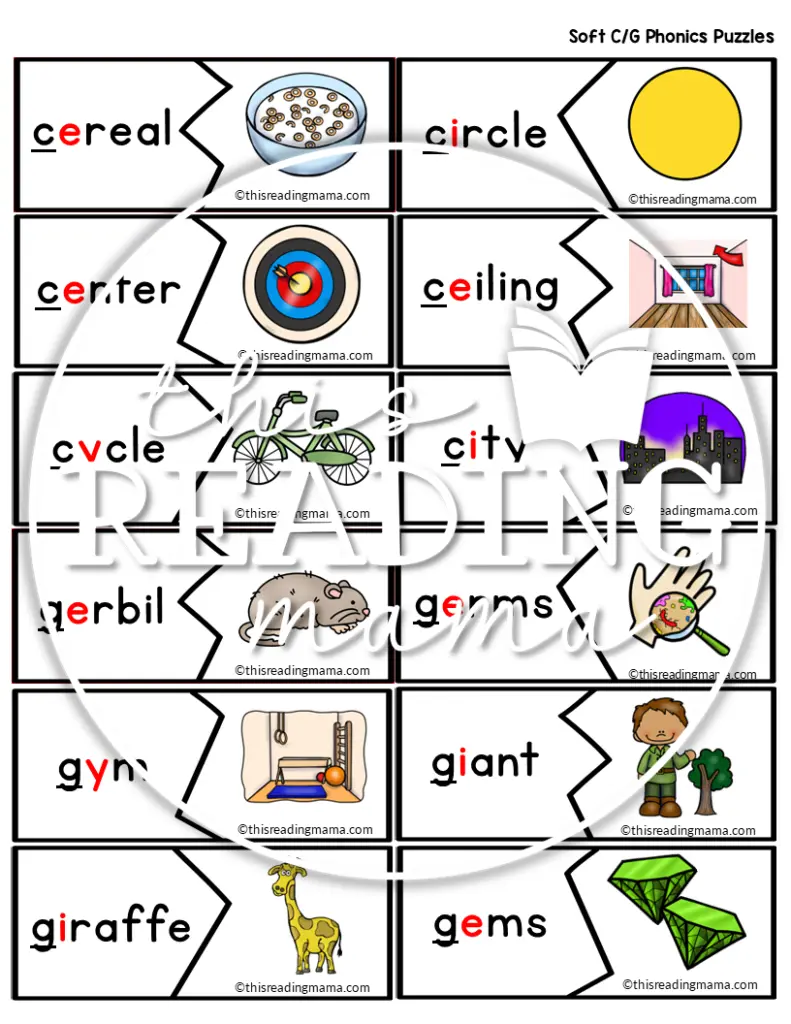
Mastering these distinctions is not merely a matter of memorization; it requires a firm grasp of underlying phonics generalizations and cognitive mapping. To assist educators, reading specialists, and parents in navigating these instructional waters, a new pedagogical resource has been introduced: free, downloadable Soft C and G Phonics Puzzles. Created by literacy advocate Becky of This Reading Mama, these interactive materials are designed to transform abstract phonics rules into tactile, engaging learning experiences.
This report provides an in-depth examination of the linguistic science behind soft c and g sounds, analyzes the pedagogical framework supporting puzzle-based learning, details the mechanics of the new resource, and explores how modern educators can integrate these tools to foster confident, fluent readers.
Detailed Chronology: The Evolution of Phonics Instruction and the Soft C/G Rule
The teaching of reading has undergone significant transformation over the past century, oscillating between whole-language approaches and systematic, explicit phonics instruction. Contemporary consensus, heavily backed by the "Science of Reading" movement, emphasizes that explicit instruction in phoneme-grapheme correspondence is essential for long-term reading success.

Historical Context of English Orthography
To understand why we teach children about soft c and g, one must look at the historical evolution of the English language. English is a Germanic base language heavily influenced by Old Norse, Norman French, Latin, and Greek. As words from Romance languages entered the English lexicon, they brought along spelling conventions that disrupted purely phonetic Germanic patterns.
In Old English, the letters c and g were pronounced softly only in specific environments, but the Norman Conquest of 1066 introduced French scribal habits that permanently altered English spelling. Consequently, students today must learn historical generalizations to decode words accurately.
The Emergence of Interactive Phonics Tools
As educational research shifted toward multisensory learning in the late 20th and early 21st centuries, static worksheets gave way to dynamic, hands-on learning tools. Puzzles, manipulative tiles, and sorting games emerged as vital methodologies for teaching complex phonics generalizations.
The release of the Soft C and G Phonics Puzzles represents the latest milestone in this chronological progression. Designed for digital accessibility and printable convenience, these puzzles bridge the gap between theoretical linguistic rules and practical classroom application. By isolating the soft c and g phonemes through targeted puzzle pieces, educators can introduce the concept systematically, reinforcing the core rule: When c or g is followed by e, i, or y, they typically make their soft sounds.

Supporting Context & Metrics: The Science of Soft Sounds
Navigating phonics instruction requires an understanding of statistical patterns in the English language and cognitive processing metrics in young learners.
Linguistic Generalizations and Exceptions
Phonics generalizations provide learners with cognitive shortcuts for decoding unfamiliar words. For hard and soft c and g, the rule is remarkably reliable, though exceptions inevitably exist.
- Hard C /k/: Appears before back vowels (a, o, u) and consonants, as in cat, cot, cut, and clap.
- Soft C /s/: Appears before e, i, and y, as in cent, city, and cycle.
- Hard G /g/: Appears before back vowels and consonants, as in gate, got, gum, and glad.
- Soft G /j/: Appears before e, i, and y, as in gem, ginger, and gym.
While this rule covers the vast majority of instances, educators must explicitly address common exceptions to prevent learner confusion. Notable high-frequency exceptions include words of Germanic origin where the hard sound is retained despite being followed by e or i, such as gift, girl, get, give, and kin (though k follows a different rule, words like tiger or begin demonstrate hard g before i).
Cognitive Metrics in Phonics Acquisition
Research in cognitive psychology indicates that multisensory engagement—such as manipulating physical puzzle pieces while simultaneously vocalizing phonemes—significantly enhances memory retention. According to reading literacy metrics:

- Phonemic Awareness: Accounts for up to 20% of the variance in reading comprehension success in early elementary students.
- Explicit Decoding: Students instructed using systematic phonics frameworks achieve decoding proficiency up to 30% faster than those taught exclusively through whole-word memorization.
- Engagement Multipliers: Interactive, game-based learning tools increase student time-on-task by an estimated 40%, reducing cognitive fatigue during challenging morphological studies.
Official Statements & Pedagogical Insights
Educational leaders and curriculum developers continue to emphasize the importance of blending structural phonics with engaging, low-stress practice activities.
Insights from Literacy Specialists
Becky, creator of This Reading Mama and designer of the new phonics puzzles, emphasizes the necessity of breaking down abstract rules into manageable pieces. In her pedagogical notes accompanying the release, she highlights the frequent confusion students experience when first encountering these sounds:
"It doesn’t take long for learners to notice that when they happen upon the letter c or the letter g, these letters can represent more than one sound. C doesn’t always represent /k/ as in cat, and g doesn’t always represent /g/ as in goat. The /k/ and /g/ sounds are the hard sounds of c and g. Sometimes, c represents its soft sound, /s/. We hear this in the words city and nice. And sometimes g represents its soft sound, /j/. We hear this in the words giraffe and age. So how are learners to know which sound to make? I’m so glad you asked!"
The core pedagogical philosophy behind these puzzles is rooted in self-discovery and guided practice. Rather than requiring rote memorization of long word lists, the puzzle format allows students to physically match sounds, letters, and visual cues, reinforcing the e, i, y rule through active participation.
Complementary Instructional Frameworks
To maximize the effectiveness of the Soft C and G Phonics Puzzles, educational specialists recommend pairing them with no-prep supplementary pages, such as dedicated hard-and-soft sorting exercises. When learners can contrast a hard sound (cat) directly against a soft sound (city) within the same instructional session, neural pathways for orthographic mapping are significantly strengthened.
Future Outlook: The Direction of Foundational Literacy Resources
As classrooms become increasingly digitized while still valuing tactile, hands-on experiences, the future of phonics instruction lies in hybrid, adaptable resources.
Trends in Early Reading Material Development
- Accessibility and Equity: Free, high-quality digital downloads—such as the PDF-based puzzles provided by literacy advocates—ensure that underfunded schools, homeschoolers, and title-one programs have equitable access to evidence-based teaching tools.
- Integration with The Science of Reading: Future curriculum enhancements will likely place even greater emphasis on spelling patterns (orthography) alongside phonology, ensuring children understand why words are spelled the way they are, rather than merely memorizing sight words.
- Expanded Multisensory Implementations: The success of tactile phonics puzzles points toward a broader industry trend where learning aids are designed for multiple iterations—laminating, cutting, sorting, and interactive digital matching.
Conclusion and Next Steps for Educators
The introduction of targeted tools like the Soft C and G Phonics Puzzles provides educators with a vital asset in the ongoing mission to foster fluent, literate children. By demystifying the rules governing hard and soft consonant sounds—and anchoring them in engaging, hands-on activities—teachers can turn a notoriously tricky spelling hurdle into an enjoyable learning milestone.
For educators, reading specialists, and parents looking to enrich their literacy toolkits, these free puzzles, alongside complementary no-prep curriculum pages and exclusive membership libraries (such as The Library by This Reading Mama), offer an immediate, research-backed pathway to instructional success. By embracing systematic phonics instruction paired with creative play, the next generation of readers will be well-equipped to decode the complexities of the English language with confidence and ease.

