

Executive Overview
In the ongoing national and global debates surrounding literacy education, educators and policymakers have focused overwhelmingly on phonics, reading fluency, and comprehension. While these components are undeniably foundational, a critical companion has been systematically left out of the conversation: writing instruction. Despite the deep, inextricable interdependence of reading and writing, the latter is frequently relegated to an afterthought in standard curricula.
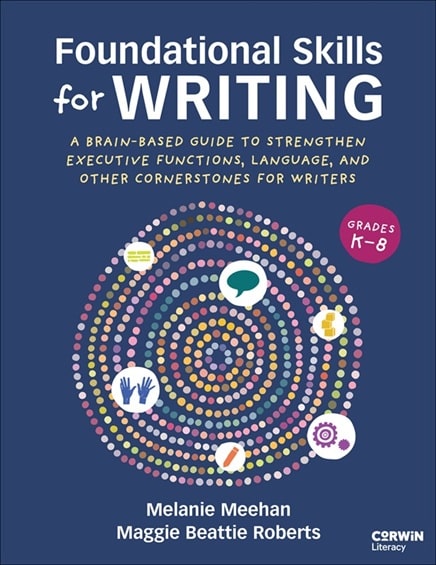
To confront this glaring omission, literacy experts and former educators Melanie Meehan and Maggie Roberts have published a definitive guide: Foundational Skills for Writing: A Brain-Based Guide to Strengthen Executive Functions, Language, and Other Cornerstones for Writers. Bridging decades of classroom experience, curriculum design, and literacy consulting, Meehan and Roberts argue that writing is not merely a mechanism for assessing knowledge, but a complex, neurologically demanding cognitive act.
When students struggle with writing, the root cause is rarely a lack of ideas or imagination. Instead, it is often a cognitive bottleneck caused by underdeveloped foundational skills. By breaking writing down into its core components—transcription skills, oral language, and executive functioning—the authors offer educators practical, low-barrier tools to transform writing instruction. Among their most actionable contributions are “Minute Moves”: micro-interventions designed to automatize foundational skills in just a few minutes a day, freeing up the cognitive energy students need to become confident, proficient writers.

Detailed Chronology & Origins of the Literacy Oversight
The modern crisis in literacy instruction is well-documented. Over the past decade, a concerted push toward the "Science of Reading" has reshaped classrooms across the globe. School districts have reallocated budgets, retrained teachers, and overhauled reading programs to emphasize explicit phonics instruction and cognitive decoding strategies. Yet, this localized focus on reading has inadvertently marginalized writing.
Historically, writing has been taught as a byproduct of reading—an assumption that if students consume enough text, they will naturally learn how to produce it. However, cognitive science tells a very different story. Writing places vastly different and heavier demands on the brain than reading. While reading involves decoding existing symbols, writing requires simultaneous generation, transcription, organization, and self-monitoring.
Recognizing this systemic blind spot, Melanie Meehan—a former curriculum coordinator and founder of an in-person writing center—and Maggie Roberts—a literacy consultant and veteran middle school teacher with nearly two decades of classroom support experience—began investigating the cognitive architecture of writing. Their collaborative efforts culminated earlier this month with the release of Foundational Skills for Writing.
By mapping out what the brain must accomplish during the writing process, Meehan and Roberts have mapped a new trajectory for literacy education. Their work shifts the paradigm from simply grading finished essays to actively building the cognitive, linguistic, and motor pathways required before the pen ever touches the paper.
Supporting Context & Core Mechanics: The Brain-Based Framework
To understand why writing is so difficult for many students, educators must look inside the brain. Meehan and Roberts categorize the foundational pillars of writing into three essential domains:
- Transcription Skills: The mechanical acts of writing, including handwriting, keyboarding, spelling, and gross/fine motor development. When these skills require conscious thought, they consume vital working memory.
- Oral Language: The speaking and listening precursors to written text, encompassing vocabulary, sentence construction, and narrative structures.
- Executive Functioning: The cognitive control center encompassing working memory, cognitive flexibility, and inhibitory control.
When these skills are underdeveloped, students experience cognitive overload. They become so bogged down trying to remember how to spell a word or form a sentence that they lose track of their overarching argument or creative narrative.

To combat this, the authors introduced "Minute Moves"—rapid, flexible learning routines lasting just 60 to 90 seconds. These micro-lessons can be seamlessly woven into classroom transitions, utilized as warm-ups, or practiced during hallway movements.
Spelling Minute Moves: Making Words "Cool"
Spelling is often taught through rote memorization and weekly tests, a method that yields fragile retention. Meehan and Roberts advocate for morphological awareness—teaching students to see the logic and relationships within words.
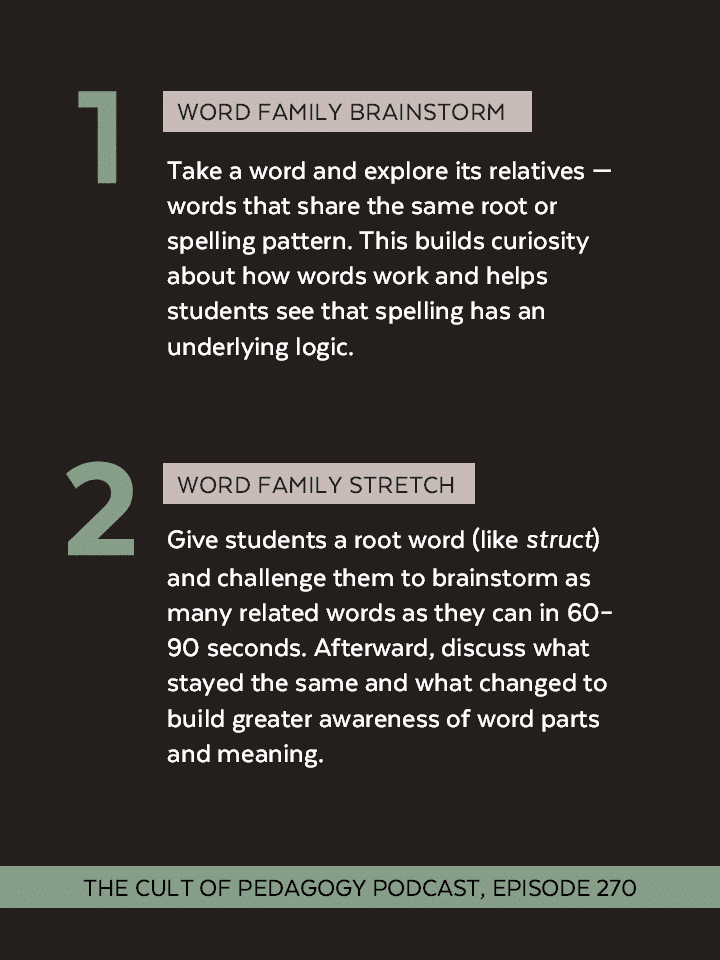
- Word Family Brainstorm: Instead of grouping homophones like two, to, and too in isolation, educators connect two to relatives like twin, twine, and twenty, revealing a shared concept of "twoness." Similarly, tracing decision back through decide, incision, concise, and scissors uncovers a Latin root meaning "to cut." This builds an intuitive, pattern-based spelling framework.
- Word Family Stretch: Utilizing a 60-to-90-second timer, students take a root like struct (to build) and race to generate related words (structure, destruction, construct, instruct). A brief debrief examines how prefixes and suffixes alter meaning, distinguishing between bound roots (which cannot stand alone) and free roots.
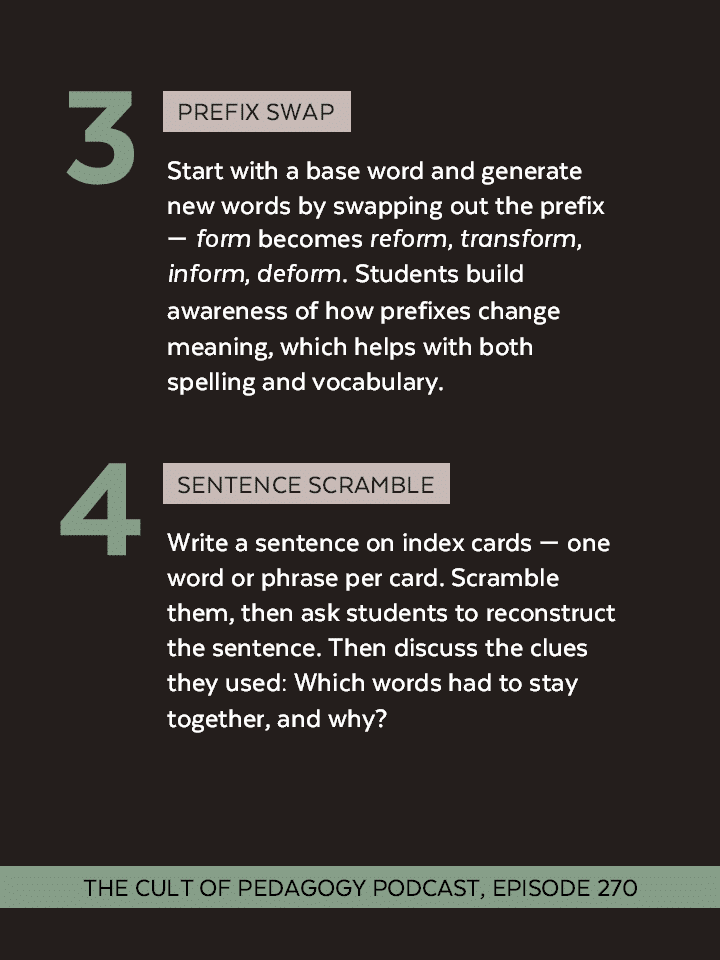
- Prefix Swap: Students manipulate base words by swapping prefixes—transforming form into reform, transform, inform, and deform. This method is particularly transformative for multilingual learners, who can leverage cognates from their native languages to instantly decode complex academic vocabulary.
Sentence Construction Minute Moves: Building Syntax
Syntax provides the scaffolding of written thought. When students rely solely on simple, choppy sentences, their writing lacks nuance and flow.

- Sentence Scramble: Dissecting a sentence into individual words written on physical index cards allows students to physically manipulate syntax. Through guided questions—such as Which words must stay together and why?—students internalize structural patterns.
- Sentence Expander: Moving away from abstract grammatical terms like "subject" and "predicate," Meehan uses terms like "doer" and "doing." Starting with a kernel sentence like The cat purrs, students answer guiding questions (Which cat? What color? Where? When? Why?) to build rich, complex sentences like The orange cat is sleeping on the couch in the afternoon because he is tired.
- Sentence Combining: A high-impact strategy where students merge bare-bones sentences (e.g., My cat is orange and My cat is big into My big orange cat…). By experimenting with conjunctions like because, and, and but, students naturally transition toward sophisticated syntactic variety.
Executive Functioning Minute Moves: Cultivating Cognitive Flexibility
Cognitive flexibility is the cornerstone of revision and advanced composition. It requires students to step back from their own work and consider alternative approaches.
- What’s Another Way?: Students take an existing sentence and manipulate it—starting with a dependent clause, replacing a noun with a pronoun, or intentionally shortening it. Meehan emphasizes that mastering the art of the short, impactful sentence is just as important as crafting complex prose. Giving students the vocabulary to recognize this as cognitive flexibility empowers them deeply.
- New Angle: Zooming out from the sentence to the narrative level, students retell familiar scenes from alternative characters’ perspectives. Whether analyzing a ninth-grade cafeteria food fight from an exasperated teacher’s viewpoint or writing responses to Pixar shorts like Snack Attack, students exercise perspective-taking—a vital skill for writing and civic life alike.
Official Statements & Expert Insights
The philosophy underpinning Foundational Skills for Writing challenges traditional assumptions about literacy education.
"Literacy has always been a hot topic in education, and the intensity surrounding it has really ramped up in the last few years," Meehan and Roberts note in their joint interviews. Yet, the persistent oversight of writing instruction remains a critical vulnerability in modern pedagogy.
Reflecting on the psychological impact of spelling instruction, Meehan emphasizes curiosity: "The more that you can get kids curious and thinking words are cool, the better." By framing spelling and morphology as an investigation into word families rather than a compliance task, student engagement shifts dramatically.
On the power of syntactic mastery, Maggie Roberts highlights the efficiency of micro-interventions: "Sentence combining is a really high-impact, quick way for kids to graduate from writing a series of simple sentences to ones that are more syntactically complex, interesting, and precise."
Furthermore, Meehan highlights the broader, societal implications of executive functioning exercises like perspective-taking:
"It’s not just about writing and it’s not just about watching this show, but it’s also about democracy and thinking about how other people think and what their perspectives are."
By teaching students to inhabit different viewpoints through narrative exercises, writing classrooms become laboratories for empathy and critical thinking.
Future Outlook: Reintegrating Writing into the Literacy Equation
As school districts nationwide evaluate their literacy frameworks, the release of Foundational Skills for Writing arrives at a pivotal moment. The artificial divide between reading and writing must be dismantled. Educational leaders can no longer afford to treat writing as an optional assessment tool deployed only after reading comprehension has been secured.
The future of literacy instruction lies in a truly balanced, brain-based approach that acknowledges the heavy cognitive loads placed upon young writers. By implementing low-burden, high-frequency interventions like "Minute Moves," educators can bridge the gap between spoken language, mechanical transcription, and executive functioning.
Ultimately, empowering students to write fluently is not merely about improving standardized test scores or producing academic essays. It is about equipping them with the cognitive tools to organize their thoughts, articulate their worldview, and participate meaningfully in society. When writing is taught through the lens of brain-based foundations, students stop viewing the blank page as an obstacle—and begin seeing it as an opportunity.

