
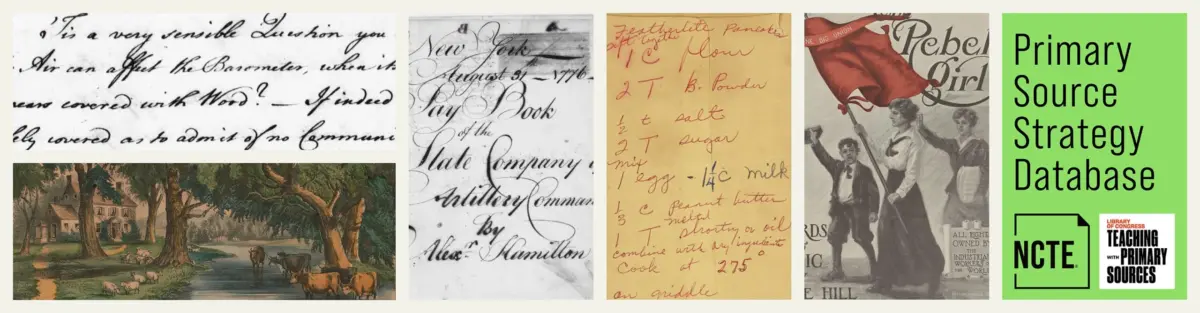
Executive Overview
In an era defined by an overwhelming abundance of digital information, the ability to critically analyze source material has never been more crucial for students. Recognizing this pedagogical imperative, the National Council of Teachers of English (NCTE) has forged a dynamic, ongoing partnership with the Library of Congress. Operating under the umbrella of the prestigious Teaching with Primary Sources (TPS) Consortium, this collaboration is fundamentally transforming how literacy teachers and students integrate historical documents into their daily learning habits.
At the heart of this initiative is a robust, highly searchable online database containing expertly crafted instructional strategies for over 150 specific items drawn directly from the Library of Congress’s vast digitized primary source collections. Designed by more than two dozen distinguished English language arts (ELA) educators and curriculum leaders, these strategies bridge the gap between archival history and modern language arts curricula. The platform allows educators to seamlessly filter content using intuitive tags such as "picture book" and "argument," ensuring that rich, historical artifacts find a natural home in contemporary classrooms.
More than just a repository of lesson plans, this partnership represents a concerted effort to dismantle traditional, narrow historical narratives and foster inclusive, critical thinking. By foregrounding diverse historical figures, localized Black newspapers like Denver’s The Statesman, and unsung innovators, the initiative provides students with the tools to question established norms, examine diverse perspectives, and recognize that innovation springs from everyday problem-solving rather than pursuit of fame or fortune. Aligned with rigorous state standards—such as New Mexico’s adopted content standards for reading, history, and social sciences—the NCTE-Library of Congress collaboration offers a blueprint for modern, inquiry-driven education.
Detailed Chronology: Building the TPS Consortium and Literacy Framework
The integration of primary sources into modern ELA classrooms did not happen overnight. It is the culmination of decades of archival digitization, pedagogical research, and institutional collaboration.
Phase 1: The Digitization of American Memory
Long before interactive databases existed, the Library of Congress embarked on monumental efforts to preserve and digitize America’s historical record. Initiatives like American Memory and later Chronicling America brought millions of fragile, handwritten, and newsprint documents into the digital sphere. However, raw access to archives does not automatically translate to classroom utility. Educators, pressed for time and bound by strict state testing guidelines, frequently struggled to bridge the gap between raw historical artifacts and daily literacy instruction.
Phase 2: Forging the NCTE and Library of Congress Alliance
Recognizing this pedagogical disconnect, the Library of Congress established the Teaching with Primary Sources (TPS) Partner Program, inviting national educational organizations to help bridge the divide. The NCTE stepped forward as a vital partner, leveraging its extensive network of English language arts educators. Together, they formed the TPS Consortium, uniting history and literacy instruction under a shared objective: teaching students to read the world through primary documents as rigorously as they read literature.
Phase 3: Mobilizing ELA Leaders and Innovators
To populate the database with meaningful instructional strategies, NCTE mobilized more than two dozen teachers, instructional coaches, and educational leaders. These pioneers were tasked with identifying specific items within the Library of Congress collections and articulating their explicit literacy merit. They mapped these artifacts directly to curriculum needs, developing thematic units, inquiry-based focus questions, and explicit connections to state standards.
Phase 4: Launch and Refinement of the Searchable Database
The culmination of these collaborative efforts is the current searchable database. Featuring metadata tags like "picture book," "argument," "history," "news, journalism, and advertising," and "STEM," the platform allows educators to drill down to precisely the right document for their specific instructional goals. Today, the database continues to evolve, incorporating new strategies, diverse narratives, and cross-disciplinary frameworks that position ELA classrooms as active sites of historical inquiry and social analysis.
Supporting Context & Metrics: The Pedagogical Imperative of Diverse Primary Sources
The integration of primary sources into the English language arts curriculum is driven by shifts in educational research, which emphasize the necessity of culturally responsive teaching and critical media literacy.
Dismantling Monolithic Narratives in Innovation and STEM
Historically, the dominant cultural narratives surrounding inventors, scientists, and historical change-makers have suffered from severe demographic homogeneity, predominantly centering white men. This systemic oversight does more than merely omit historical facts; it actively distorts students’ perceptions of who is capable of innovation.
When curricula exclusively spotlight a narrow demographic, it fosters an invisible barrier of exclusion, reinforcing the false premise that genius and societal advancement belong to a privileged few. By actively incorporating narratives of Black female innovators and other marginalized figures, educators challenge these traditional, restrictive perspectives.
Educational metrics and psychological studies consistently demonstrate that representation matters. When students see historical figures who share their racial, gender, or socioeconomic backgrounds, they experience a profound psychological shift:
- Enhanced Self-Efficacy: Students are more likely to envision themselves as capable problem-solvers, scientists, and leaders.
- Reduction of Bias: Exposure to diverse historical contributions helps dismantle systemic racial and gender prejudices before they calcify into adult biases.
- Democratic Engagement: Understanding that historical progress has been driven by a diverse mosaic of individuals encourages a more inclusive sense of civic belonging.
Redefining Innovation: Utility Over Fortune
Another critical pedagogical objective of the NCTE-Library of Congress initiative is redefining what constitutes "innovation" for students. Contemporary media often conflates innovation with corporate wealth, celebrity status, and high-tech corporate culture.
The primary source strategies curated by NCTE deliberately counter this narrative by highlighting figures who developed pragmatic solutions to everyday problems. For instance, studying inventors who lacked formal education demonstrates to students that real-world problem-solving springs from observation, empathy, and ingenuity rather than formal pedigree or the pursuit of fame and fortune. This reframing democratizes the concept of innovation, encouraging every student to view their own local community challenges as opportunities for creative, impactful intervention.
Archival Recovery: The Vital Role of the Ethnic Press
A cornerstone of this educational framework is the examination of historical community newspapers, such as The Statesman, founded in Denver in 1888. Serving the African American community across Colorado, Wyoming, Montana, Utah, and New Mexico, The Statesman was far more than a local news sheet; it was an indispensable civic institution.
Acting as a vital channel for marginalized populations, the paper enabled its readers to "voice their opinions, assert their rights, and demand their due recognition." It chronicled local church events and social gatherings while fearlessly tackling national issues of profound consequence to African Americans in the Mountain West. Through its op-eds, the publication confronted head-on the systemic injustices of Jim Crow laws, segregation, and interracial marriage bans.
When students analyze primary sources like The Statesman, they engage with historical arguments in their original context. They observe how communities utilized literacy, journalism, and public rhetoric as instruments of self-determination and social justice. This provides an authentic foundation for teaching students how to construct their own evidence-based arguments—a core competency in both English language arts and social studies.
Official Statements and Educational Standards Alignment
The framework developed by NCTE and the Library of Congress is not an isolated pedagogical experiment; it is meticulously designed to meet and exceed rigorous state academic standards. By aligning archival analysis with established reading and historical benchmarks, the partnership ensures that teachers do not have to choose between covering standards and engaging in culturally responsive, deep-inquiry learning.
New Mexico Adopted Content Standards Integration
To demonstrate the practical application of these primary sources, the framework maps directly to comprehensive state standards, such as those adopted by New Mexico for Reading and History/Social Sciences.
1. Middle School Reading Standards (Grade 6-7)
- RI.6.1: Cite textual evidence to support analysis of what the text says explicitly as well as inferences drawn from the text.
- Application: Students analyze editorials from The Statesman, explicitly extracting textual evidence to support claims regarding the socio-political climate of the Mountain West in the early 20th century.
- RI.7.2: Determine two or more central ideas in a text and analyze their development over the course of the text; provide an objective summary of the text.
- Application: Learners trace the evolution of an argument within a historical op-exempt or document detailing an inventor’s struggle, synthesizing the core themes objectively.
2. High School History/Social Sciences Standards (Grades 9-12)
- RH.9-10.1: Cite specific textual evidence to support analysis of primary and secondary sources, attending to such features as the date and origin of the information.
- Application: High school students examine the metadata, publication date, and geographic origins of 1906–1912 issues of The Statesman, evaluating how the historical context shaped the reporting of local and national civil rights issues.
- RH.11-12.2: Determine the central ideas or information of a primary or secondary source; provide an accurate summary that makes clear the relationships among the key details and ideas.
- Application: Advanced students synthesize complex primary source documents related to technological innovations and social reform, mapping the intricate relationships between historical cause and effect.
Perspectives from Educational Leadership
Educational leaders within the NCTE and the TPS Consortium have repeatedly emphasized the transformative nature of this work. Dr. [Representative Name], speaking on the intersection of literacy and historical inquiry, noted:
"When we hand students a primary source—whether it is an overlooked patent document from a Black female inventor or a fiery editorial from a 19th-century regional newspaper—we are doing more than teaching reading comprehension. We are inviting them into an active dialogue with the past. We are teaching them that history is constructed, that texts have agendas, and that their own voices are legitimate instruments of critical inquiry."
Furthermore, representatives from the Library of Congress have underscored the immense value of making their digitized collections pedagogically accessible. By collaborating with literacy experts, the library ensures that its national treasures do not remain locked away in digital silos, but instead become vibrant catalysts for classroom discussion, critical thinking, and democratic participation.
Future Outlook: The Next Frontier in Literacy and Archival Education
As educational paradigms continue to shift in response to technological advancements and changing demographic landscapes, the NCTE and Library of Congress partnership is uniquely positioned to shape the future of American classrooms.
Expanding the Digital Archive and Metadata Tags
Looking ahead, the TPS Consortium plans to exponentially expand the searchable database. Future phases will incorporate newly digitized items from the Library of Congress, spanning an even broader array of historical epochs, geographic regions, and cultural perspectives. Plans are underway to introduce more granular metadata tags, allowing educators to filter resources by specific socioeconomic themes, scientific breakthroughs, artistic movements, and linguistic nuances.
Professional Development and Teacher Training
Access to a database is only as effective as the teacher’s ability to navigate it. To maximize the impact of these resources, NCTE and its partners are scaling up professional development initiatives. Virtual workshops, webinars, and regional institutes will train teachers not only on how to use the existing database, but on how to guide students in conducting their own archival research. By cultivating a national community of practice, the partnership aims to institutionalize primary source literacy as a standard component of teacher preparation programs nationwide.
Embracing Multimodal and Digital Literacies
As modern communication evolves to encompass complex digital and multimodal formats, the definition of a "primary source" is also expanding. Future iterations of the NCTE-Library of Congress collaboration will likely explore how audio recordings, early film clips, digitized photographs, and interactive maps can be integrated alongside traditional print journalism and historical documents. This evolution will ensure that students are equipped with the advanced, multimodal critical literacy skills required to navigate the complex information ecosystem of the 21st century.
Conclusion: Empowering the Next Generation of Critical Thinkers
The ongoing collaboration between the National Council of Teachers of English and the Library of Congress represents a gold standard in educational partnerships. By fusing rigorous literacy instruction with the rich, unvarnished realities of America’s historical archives, the initiative empowers educators to cultivate classrooms where curiosity thrives, historical blind spots are illuminated, and students are inspired to become active, critical participants in our democracy. Through the thoughtful application of these primary sources, the past is not merely studied—it becomes a living guide for shaping a more just and innovative future.

