In an era defined by constant digital stimulation, fragmented attention spans, and mounting academic and social pressures, children and teenagers face unprecedented hurdles in navigating their daily lives. Educators, parents, and developmental psychologists are increasingly noticing a deficit in the foundational brain-based capacities required for children to plan, execute tasks, regulate emotions, and solve complex problems. These vital cognitive mechanisms are collectively known as executive functioning skills.
While traditional educational frameworks have focused heavily on academic instruction, a growing body of evidence suggests that the key to unlocking academic success and emotional resilience lies in a deceptively simple practice: mindfulness. Far from being merely a tool for relaxation or stress relief, mindfulness acts as a powerful cognitive conditioner. By teaching young minds how to turn their attention inward and anchor themselves in the present moment, mindfulness physically and functionally strengthens the prefrontal cortex—the command center of the brain.
This comprehensive report examines the symbiotic relationship between mindfulness and executive functioning. We will explore how evidence-based mindful practices directly enhance attention, self-control, emotional regulation, working memory, flexible thinking, and perseverance in kids and teens. Furthermore, we will outline actionable, practical strategies that educators and caregivers can seamlessly integrate into daily routines to foster these critical lifelong skills.
Detailed Chronology: The Evolution of Mindfulness in Modern Education
To understand how mindfulness became a cornerstone of modern youth development, it is necessary to trace its journey from ancient contemplative traditions to a recognized, evidence-based cognitive intervention in contemporary schools.
Ancient Roots to Early Adaptations (Pre-2000s): For millennia, mindfulness practices were largely confined to Eastern philosophical and meditative traditions. Toward the late 20th century, pioneers like Jon Kabat-Zinn introduced secular mindfulness-based stress reduction (MBSR) to clinical settings, proving its efficacy in reducing adult stress and chronic pain.
The Early 2000s—Entering the Classroom: As neuroscientists began mapping the brain using advanced functional magnetic resonance imaging (fMRI), researchers discovered neuroplasticity—the brain’s ability to reorganize itself by forming new neural connections. Visionary educators and psychologists began asking a crucial question: If mindfulness reshapes the adult brain, what effect does it have on developing young minds? Early pilot programs in select school districts began introducing basic breathing exercises and quiet time.
The 2010s—The Evidence-Based Boom: Over the last decade, empirical research accelerated. Longitudinal studies demonstrated that children who engaged in regular mindfulness practices exhibited measurable improvements in behavioral self-regulation and academic performance. Schools began moving away from punitive discipline models, replacing them with "mindfulness rooms" and social-emotional learning (SEL) curricula.
Present Day (2025 and Beyond): Today, mindfulness is no longer viewed as an alternative or fringe educational fad. It is recognized as a vital, evidence-based strategy for nurturing executive functioning. With mounting technological distractions facing Gen Z and Generation Alpha, the integration of mindfulness into daily curricula has evolved from an optional luxury into an urgent developmental necessity.
Executive functioning (EF) skills are often compared to the air traffic control system of the brain. Managed primarily by the prefrontal cortex, these cognitive processes allow us to juggle multiple tasks, remember instructions, prioritize, regulate our emotional outbursts, and think before we act.
When these skills are strong, individuals navigate daily life smoothly and achieve their goals almost effortlessly. However, when executive functioning is impaired or underdeveloped—which is common in children and adolescents whose brains are still maturing—the results manifest as chronic disorganization, impulsivity, emotional volatility, and academic underachievement.
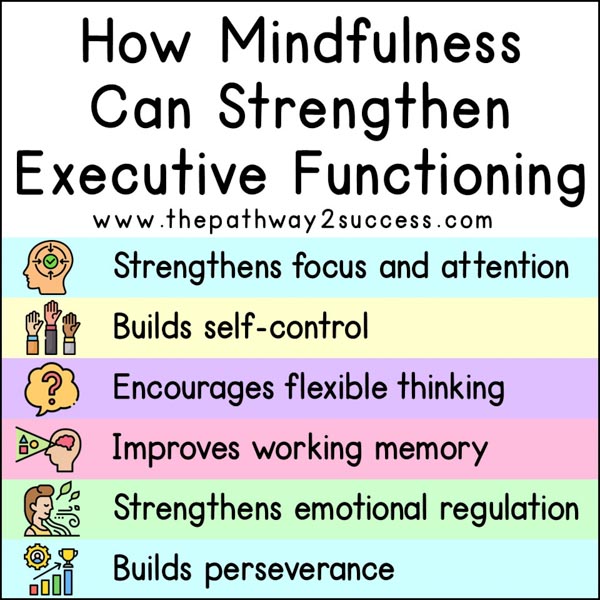
The Six Pillars of Executive Functioning and Their Mindfulness Connection
1. Focus and Attention
The Challenge: Attention is the capacity to sustain focus on a person, task, or concept over time. Students require attention for everything from listening to a multi-step classroom lecture to completing complex math equations.
The Mindfulness Solution: Mindfulness exercises serve as direct calisthenics for attention. When a child focuses solely on the sensation of their breathing, they are training their mind to anchor in the "here and now." When the mind inevitably wanders, the act of noticing that drift and gently returning focus to the breath builds neural pathways for sustained concentration.
2. Self-Control
The Challenge: Self-control is the behavioral brake system of the mind. It prevents impulsive reactions, allowing children and teens to stop, think, and weigh consequences before making a decision.
The Mindfulness Solution: Mindfulness creates a vital pause between stimulus and response. Regular practice strengthens inhibitory control. For example, rather than reacting aggressively or impulsively to a minor social slight in the hallway, a mindful student learns to take a breath, short-circuit the automatic emotional surge, and select a constructive path forward.
3. Emotional Regulation
The Challenge: Emotional regulation dictates an individual’s ability to monitor, understand, and manage their daily affective states without becoming entirely hijacked by them.
The Mindfulness Solution: Mindfulness fosters non-judgmental self-awareness. Instead of viewing intense emotions like anger, anxiety, or frustration as existential threats, mindful youth learn to observe these feelings as transient weather patterns passing through the sky. This emotional distance prevents meltdowns and clears the path for rational problem-solving.
4. Working Memory
The Challenge: Working memory is our mental scratchpad—the ability to hold, manipulate, and update information over short intervals. It is essential for reading comprehension, multi-step problem solving, and following directions.
The Mindfulness Solution: Cognitive overload is a primary enemy of working memory. Mindfulness helps sweep away mental clutter and extraneous worrisome thoughts. By emptying excess cognitive noise, mindfulness provides students with a clean slate, optimizing mental bandwidth for incoming instructions and academic tasks.
5. Flexible Thinking
The Challenge: Cognitive flexibility allows individuals to adapt to changing environments, view situations from multiple perspectives, and accept critical feedback without taking it personally.
The Mindfulness Solution: Mindfulness encourages radical acceptance of present-moment experiences, even unfavorable ones. By practicing non-judgmental observation, young adults learn to detach their self-worth from external outcomes. When receiving critical feedback on an essay, a mindful student can process the critique objectively, utilizing it as a stepping stone for growth rather than a personal attack.
6. Perseverance
The Challenge: Perseverance, or grit, is the determination to stick with difficult tasks until completion, resisting the urge to quit when faced with frustration.
The Mindfulness Solution: Sitting quietly and focusing on the breath can actually be uncomfortable or frustrating for a wandering mind. By sticking with the mindfulness practice despite the urge to quit, children actively build perseverance. They learn firsthand that discomfort is temporary and that endurance yields results.
Official Statements and Expert Perspectives
Developmental psychologists and educators worldwide emphasize the transformative impact of integrating contemplative practices into youth development frameworks:
"Mindfulness is not about stopping thoughts; it is about changing our relationship to them. When we teach a child how to pause and observe their internal state rather than reacting blindly, we are fundamentally altering their cognitive architecture for the better."
— Dr. Elizabeth Vance, Child Neuropsychologist
"In modern classrooms, we ask students to focus, remember instructions, and regulate their behavior for hours on end, yet we rarely teach them how to do those things. Mindfulness bridges that gap. It gives kids the biological tools—the executive functioning skills—they need to access deep learning."
— Marcus Sterling, Educational Consultant and SEL Director
Research institutions studying school-based mindfulness programs consistently report statistically significant gains in standardized measures of cognitive control, emotional self-regulation, and classroom behavioral conduct among participating student cohorts.
Actionable Strategies: Implementing Mindfulness with Kids and Teens
Before introducing mindfulness interventions, educators and parents must demystify the practice. Transparency is vital: explain to learners that mindfulness is a practical brain-training tool. Frame it as a secret weapon to find calm before public speaking, sharpen focus before an athletic competition, or reset energy levels during a stressful academic day.
1. Structured Lessons and SEL Curricula
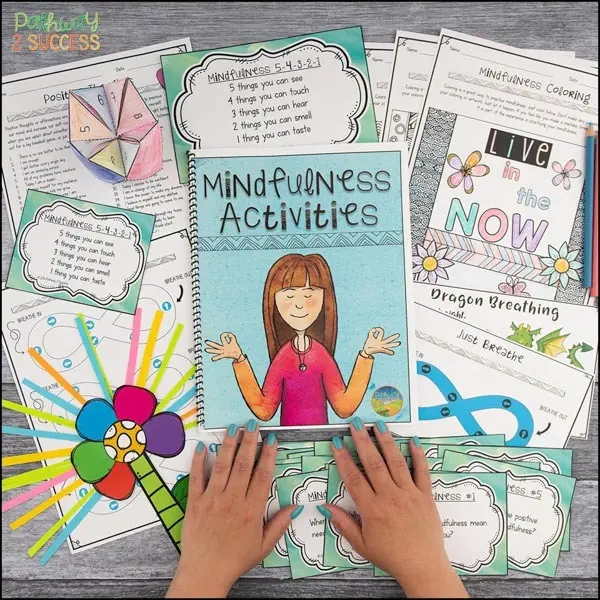
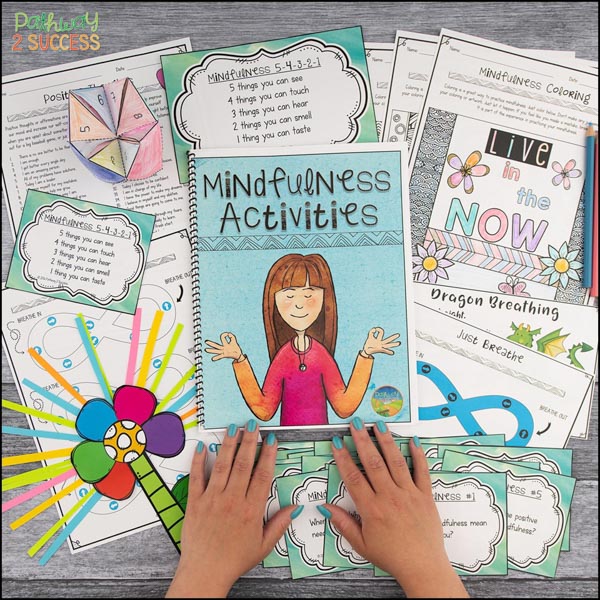
Incorporate comprehensive mindfulness and Social-Emotional Learning (SEL) lesson plans into the weekly schedule. Utilizing structured sets that include hands-on activities, discussion cards, reflective coloring sheets, and informative posters ensures that mindfulness remains engaging and varied. These resources can be revisited throughout the academic year to reinforce core concepts.
2. Literature and Storytelling
Incorporate picture books and young adult literature that explicitly explore themes of calm, awareness, and emotional regulation. Even older children and teens benefit profoundly from narrative-driven discussions that normalize the human experience of stress and mental distraction.
3. Intentional Mindful Breathing
Breathing is the portable anchor of mindfulness. Teach children foundational belly-breathing techniques, emphasizing the physical sensations of air entering the nostrils and filling the lungs. Once students grasp basic breathing, introduce creative variations such as "Cool Off the Pizza" or "Shape Breathing." These function simultaneously as mindfulness exercises and highly effective classroom brain breaks.
4. Mindful Coloring
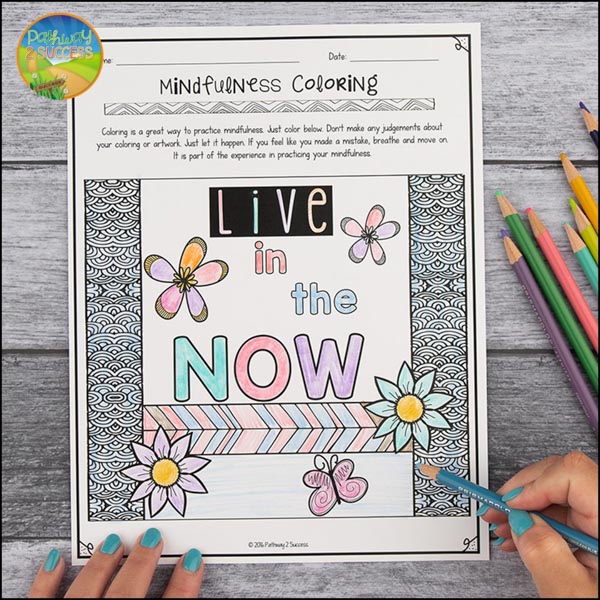
For kinesthetic and visual learners, mindful coloring offers a powerful avenue to concentration. Instruct students to immerse themselves entirely in the physical act of coloring—letting go of perfectionism and aesthetic anxieties. The goal is purely to breathe, color, and exist in the present moment using dedicated mindfulness coloring sheets.
5. Yoga and Somatic Stretching
Physical movement combined with intentional breathwork helps bridge the gap between body and mind. Gentle yoga flows and somatic stretches teach children how physical tension manifests and how intentional movement paired with breathing can release that stress.
6. Mindful Journal Writing
Kick off the morning routine with reflective writing prompts. Journaling provides a safe, private space for students to empty mental clutter, process complex emotions, and practice self-awareness through free-writing or guided prompts.
7. Outdoor Mindfulness Encounters
Nature is naturally therapeutic and provides endless sensory anchors. Take learning outdoors with activities such as mindful nature walks, gardening, cloud-watching, wildlife observation, or blowing bubbles. The multifaceted sensory input of the natural world naturally guides wandering attention back to the present moment.
8. Mindful Affirmations
Combat negative self-talk by introducing positive, grounding affirmations. Students can repeat these phrases silently while regulating their breath, or keep a printed list in their desks, lockers, or binders. Morning affirmations set a proactive, resilient tone for the rest of the day.
9. Mindful Observance of Everyday Objects
Train the brain’s focus muscle by handing students a mundane everyday object—such as a pen, a smooth stone, or a water bottle. Ask them to study the object intently, noting its textures, colors, weight, and temperature while maintaining steady breathing. This simple exercise powerfully reinforces concentrated attention.
Future Outlook
As society continues to accelerate technologically and socially, the demands placed upon the developing human brain will only intensify. The traditional academic focus on rote memorization and standardized testing is increasingly insufficient for preparing youth for a complex, dynamic future.
The integration of mindfulness into educational and parenting paradigms represents a paradigm shift toward holistic cognitive health. By systematically strengthening executive functioning skills through accessible practices like mindful breathing, journaling, and intentional observation, we are equipping the next generation with the psychological armor they need.
Ultimately, mindfulness is not an educational trend or a temporary fix; it is an invaluable cognitive foundation. By teaching children how to master their attention, regulate their emotions, and persevere through adversity, we empower them not only to succeed academically, but to navigate the intricate journey of life with clarity, resilience, and unshakeable inner calm.