
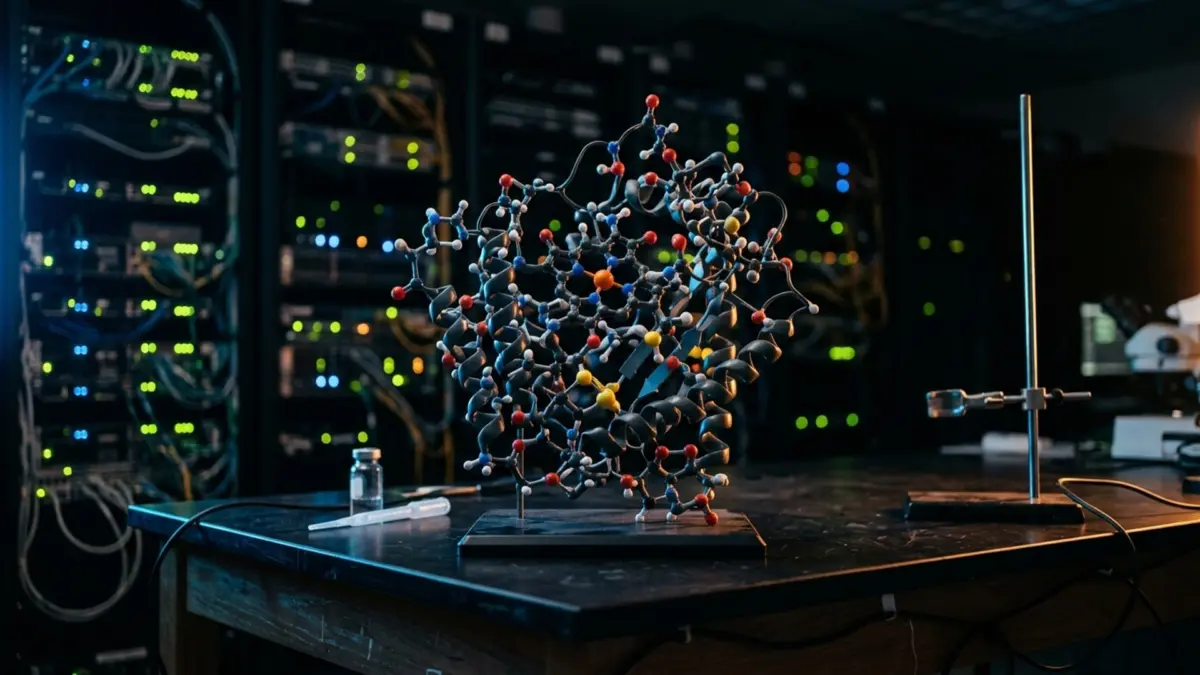
TOKYO & YOKOHAMA — In what marks a profound leap forward for national technological self-reliance and computational biology, infrastructure firm ai& and high-performance processor pioneer Tenstorrent officially launched JapanFold on September 3, 2026. Designed exclusively for Japan’s vibrant research community, JapanFold is an advanced, fully localized drug discovery platform that serves open-source structural biology models on homegrown sovereign infrastructure.
Crucially, the platform operates entirely within Japanese borders. Every single floating-point computation, protein fold simulation, and de novo drug design candidate generated by the service executes on domestic hardware powered by Tenstorrent Galaxy superclusters. By absorbing the costs of inference, ai& has made the platform entirely free of charge for Japanese researchers, academic institutions, universities, and biotech startups.
This historic initiative effectively removes the twin hurdles of prohibitive cloud compute expenses and cross-border data sovereignty concerns, ushering in a new era for Japan’s pharmaceutical and life sciences industries.
Executive Overview: A Paradigm Shift for Japanese Life Sciences
The launch of JapanFold on September 3, 2026, arrives at a critical juncture for global and regional science. For years, Japanese pharmaceutical giants, biotech startups, and academic laboratories have faced a structural dilemma: how to leverage state-of-the-art artificial intelligence for protein folding and drug discovery without routing sensitive, proprietary biomedical data through overseas hyper-scaler clouds. Furthermore, the sheer cost of commercial cloud inference has historically priced smaller academic groups out of cutting-edge computational experiments.
JapanFold resolves this friction entirely. Built upon ai&’s vertically integrated sovereign infrastructure and accelerated by Tenstorrent’s revolutionary RISC-V and AI hardware architectures, the platform provides unhindered access to a comprehensive suite of structural biology models.
By shouldering the entire financial burden of inference, ai& has democratized high-performance computational biology across the archipelago. Whether a researcher is operating out of a major pharmaceutical headquarters in Tokyo or an academic lab at a regional university, they now possess direct access to world-class AI infrastructure. As ai&’s inaugural flagship initiative under its "AI for Science" banner, JapanFold is more than just a software portal—it is a bold statement on the necessity of technological sovereignty in an increasingly data-sensitive global economy.
Detailed Architecture, Models, and Developer Access
JapanFold is engineered to cover the entire spectrum of modern computational structural biology, spanning sequence embedding, structure prediction, binding affinity analysis, and de novo molecular design.
Model Categories and Architecture
The platform serves models categorized into three distinct functional groups:
- Structure and Binding Affinity Prediction: To decipher how proteins fold and interact with other molecules, JapanFold hosts an impressive roster of state-of-the-art models, including Boltz-2, OpenFold3, ESMFold-2, OpenDDE, Protenix-v2, RoseTTAFold3, OpenBind-0, and Nesso-1. These models enable scientists to model complex macromolecular assemblies with unprecedented precision.
- De Novo Drug Design: Moving beyond mere prediction, the platform offers generative engines such as BoltzGen, RFdiffusion 3, and PXDesign. These tools allow researchers to engineer entirely new protein structures from scratch, streamlining the pipeline from initial protein folding simulations to the generation of viable drug candidates.
- Protein Embeddings: For downstream machine learning and bioinformatics tasks, the platform integrates ESMC and SaProt, providing robust vector representations of protein sequences.
Flexible Access Vectors
Recognizing the diverse workflows of modern computational biologists, ai& has engineered three distinct access vectors for JapanFold:
- The Browser-Based Workbench: A sleek, intuitive graphical interface requiring zero local installation, configuration, or user registration, allowing researchers to visualize and analyze structures instantly.
- A Unified HTTP API Endpoint: A single, standardized API endpoint shared across every model on the platform. The API is asynchronous—users submit jobs, poll their status, and download results upon completion—and operates keyless by default, with an optional Bearer key available to scope jobs to individual callers.
- Agent Skills for Modern IDEs: Built-in agent integrations for popular development and coding environments, including Claude Code, Cursor, and Codex, allowing bioinformaticians to query structural models directly from their development workflows.
Operational Limits of the Public Demo
Because the public iteration of JapanFold functions as a free demonstration service running on shared compute resources, certain safeguards and technical caps are enforced. The platform enforces per-model residue ceilings—such as 1,024 residues for Boltz-2 and 576 residues for OpenFold3—alongside strict rate limits and results budgeting.
Additionally, results storage on the public tier is transient. The service retains only the 1,000 most recent jobs, automatically evicting the busiest caller’s oldest job once storage or volume caps are reached. However, enterprise users and institutional partners requiring durable storage and unbounded concurrency can access the unthrottled version of the platform.
Supporting Context: Hardware Economics and Accuracy Parity
The underlying engineering triumph of JapanFold lies in the symbiotic pairing of ai&’s sovereign infrastructure vision with Tenstorrent’s disruptive processor architecture.
The Compute Economics of Structural Biology
In a companion launch post, ai& co-founders Shimpei Hara and David Bennett detailed the fundamental compute economics that made JapanFold possible. Unlike large language models (LLMs), which are heavily bound by memory bandwidth, protein folding and structural biology workloads are predominantly compute-bound. Consequently, these workloads thrive on hardware architectures specifically optimized for dense arithmetic operations and high-speed on-chip SRAM.
Leveraging Tenstorrent’s hardware, ai& achieved staggering efficiency gains. According to the project’s published benchmark measurements, a single Tenstorrent Blackhole Galaxy supercluster matches the raw throughput of an NVIDIA DGX B200 when executing a 512-residue protein folding workload. Remarkably, it achieves this parity at roughly one-fifth of the purchase price—yielding a staggering fivefold increase in throughput per dollar, holding workload complexity and accuracy constant.
Hardware Specifications: The Tenstorrent Galaxy Blackhole
The physical backbone of JapanFold is anchored by the Tenstorrent Galaxy Blackhole server architecture:
- ASIC Density: 32 Blackhole ASICs delivering a combined 23 petaFLOPS of block FP8 compute.
- Memory Architecture: Equipped with 6.2 GB of ultra-fast accelerator SRAM and 1 TB of high-speed GDDR6 system memory.
- Form Factor: A 6U air-cooled server system priced at $160,000, with scalable supercluster configurations starting at four Galaxy Blackhole systems for $640,000.
Accuracy Parity and Stated Caveats
A primary concern when migrating complex open-source models to novel non-NVIDIA silicon is potential hardware-induced drift in numerical accuracy. ai& addressed this head-on, optimizing and serving every JapanFold model on Tenstorrent processors at 1:1 accuracy relative to official reference implementations.
Because these models scale nearly linearly on Tenstorrent hardware—doubling the processor count essentially doubles output—ai& instituted a rigorous parity-checking protocol. Before any model is deployed, its output is benchmarked against its official reference implementation. A deployment leg is approved only when output falls securely within the reference implementation’s own seed-to-seed noise floor, as documented in the platform’s official accuracy guidelines.
Nevertheless, the platform’s documentation maintains scientific transparency by outlining explicit caveats:
- Port vs. Science: Parity checks verify the integrity of the software port against the reference implementation on identical inputs, rather than validating predictions against experimental biological structures.
- OpenFold3 Preview Status: OpenFold3 weights currently run on a preview checkpoint trained well short of the full AlphaFold3 schedule; researchers are advised to carefully evaluate internal confidence scores before acting on predictions.
- Inherited Limitations: OpenDDE checkpoints faithfully mirror their reference implementations, inheriting known weaknesses when predicting certain challenging antibody-antigen targets.
Official Statements and Industry Perspectives
The collaborative nature of the JapanFold launch reflects a growing global alignment between hardware innovators and sovereign AI infrastructure providers.
David Bennett, CEO and co-founder of ai&, emphasized the paramount importance of data sovereignty and national research autonomy during the launch announcement:
"Japan’s research community should never have to choose between world-class AI and keeping their data sovereign. JapanFold removes that trade-off entirely, giving domestic researchers unhindered access to the world’s most advanced structural biology tools on local soil, without financial barriers."
Echoing this sentiment, Tenstorrent CEO Jim Keller highlighted the synergy between his company’s scalable processor roadmap and ai&’s vertically integrated business model:
"Tenstorrent delivers fast, scalable compute, and ai& owns the full stack in Japan. Together, we’ve turned it into a platform researchers can actually use with JapanFold."
Founded in March 2026 and headquartered in Yokohama, ai& represents a new breed of vertically integrated AI technology enterprises. By seamlessly fusing data center infrastructure, heterogeneous compute fabrics, and managed model services into a cohesive operational ecosystem, the company is uniquely positioned to spearhead Japan’s next-generation technological infrastructure.
Meanwhile, Tenstorrent—under the leadership of industry veteran Jim Keller—continues to disrupt the artificial intelligence accelerator market. Building open, high-performance RISC-V-based processors tailored for developers, sovereign entities, and enterprise data centers, Tenstorrent has amassed over $1 billion in funding from a prestigious consortium of global backers, including Bezos Expeditions, Samsung, LG Electronics, Hyundai Motor Group, and Fidelity.
Future Outlook: A Blueprint for Sovereign AI in Science
The debut of JapanFold on September 3, 2026, is explicitly framed by its creators as the opening salvo in a much broader strategic campaign. As biotechnology increasingly converges with artificial intelligence, the ability to run massive computational biology models securely within national borders will become a core pillar of economic and scientific competitiveness.
Looking ahead, ai& and Tenstorrent plan to expand the JapanFold paradigm beyond structural biology. Future phases of their roadmap will likely incorporate advanced genomics, multi-omic simulation models, and materials science frameworks, all anchored to domestic Tenstorrent supercluster infrastructure.
For Japan’s pharmaceutical titans, biotech trailblazers, and academic institutions, JapanFold is more than just a complimentary suite of computational tools. It is a resounding validation of sovereign AI infrastructure—proving that national research communities can achieve absolute technological independence without compromising on scale, speed, or scientific fidelity.

