
EXECUTIVE OVERVIEW
In the modern educational landscape, foundational literacy remains the bedrock upon which all future academic achievement is built. As educators and curriculum developers continuously seek methods aligned with the Science of Reading, phonological awareness has emerged as a critical gateway skill for young learners. Entering this vital pedagogical space is a newly released, highly engaging resource: the Spring Syllable Sort. Designed specifically for preschool, pre-kindergarten, and kindergarten classrooms, this hands-on literacy tool transforms abstract phonetic concepts into tactile, seasonal play.
By combining auditory discrimination with visual picture clues, the activity invites children to clap, tap, and segment seasonal vocabulary words into distinct syllables. This comprehensive report examines the mechanics of the Spring Syllable Sort, its alignment with contemporary early childhood reading research, the mechanics of its implementation within modern learning centers, and its broader expansion into a comprehensive Four Seasons literacy framework.

1. THE SCIENCE OF EARLY READING: UNDERSTANDING PHONOLOGICAL AWARENESS
To comprehend the significance of tools like the Spring Syllable Sort, one must first examine the cognitive architecture of early reading development. According to the Science of Reading—a vast, multidisciplinary body of scientifically-based research about how humans learn to read—phonological awareness is a foundational pillar. Long before children decode printed letters on a page, they must master the ability to recognize, isolate, and manipulate the spoken parts of sentences and words, including syllables, onset-rime, and phonemes.
Syllable segmentation serves as an essential stepping stone in this developmental journey. When children learn to break words into manageable chunks (syllables), they are training their brains to process linguistic units rhythmically. This auditory processing directly supports later phonics instruction, spelling accuracy, and reading fluency.
However, teaching abstract linguistic concepts to young children presents a unique pedagogical challenge. Preschoolers and kindergarteners thrive on multisensory experiences, active movement, and contextualized learning. Traditional worksheets often fall flat, failing to capture the dynamic attention spans of early learners. The Spring Syllable Sort bridges this gap by marrying rigorous phonological standards with playful, interactive methodologies. Rather than confronting children with intimidating walls of text, the activity utilizes familiar spring vocabulary and kinesthetic engagement—such as clapping and tapping—to make syllable counting an intuitive, joyful experience.

2. INSIDE THE RESOURCE: ANATOMY OF THE SPRING SYLLABLE SORT
Crafted with both educators and parents in mind, the free Spring Syllable Sort is a meticulously organized print-and-go literacy pack designed for maximum versatility and engagement. Rather than focusing prematurely on written orthography, the activity prioritizes auditory perception and vocabulary development.
Key Components of the Printable Pack
- Syllable Counting Cards: Specially designed visual cards featuring recognizable spring-themed objects, animals, and phenomena.
- Large Colorful Word Cards: High-visibility cards utilized for group modeling, pocket charts, or guided reading stations.
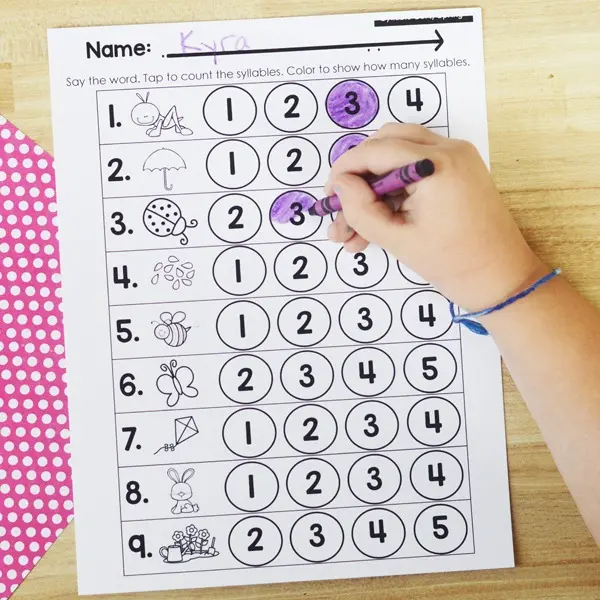
- Black and White Response Worksheets: Optional independent practice sheets that allow students to record their findings, reinforcing pencil-to-paper motor skills alongside literacy goals.
- Comprehensive Answer Key: A reliable guide for educators, teaching assistants, or parent volunteers to ensure accurate self-checking and independent student verification.
The Pedagogical Workflow
The implementation process is structured yet flexible, designed to integrate seamlessly into existing daily routines:
- Vocabulary Introduction: Before students engage with the sorting cards independently, educators introduce the target vocabulary. This step is crucial; a child cannot successfully segment a word if they do not recognize the depicted object or concept (e.g., distinguishing between a "tulip" and a generic "flower").
- Kinesthetic Segmenting: Armed with picture cards, students say the word aloud, utilizing physical movements such as clapping their hands, tapping their fingers, or stomping their feet for each individual syllable heard.
- Sorting and Categorization: Students analyze the word’s acoustic structure and sort the picture cards into designated categories based on whether the word contains one, two, or three-plus syllables.
- Independent Reflection: Following collaborative or center-based sorting, students complete the corresponding response worksheet, cementing their newly acquired phonological skills through independent practice.
3. SUPPORTING CONTEXT & METRICS: INTEGRATION ACROSS EARLY CHILDHOOD SETTINGS
The adaptability of the Spring Syllable Sort makes it an invaluable asset across diverse educational environments, ranging from traditional public school classrooms and private preschools to homeschooling households.

Versatile Classroom Integration
- Literacy Centers: The colorful card stock and tactile sorting mechanics make this an ideal independent or small-group station during literacy block rotations.
- Take-Home Practice: Recognizing the vital bridge between home and school, educators can easily package these printables for family literacy nights or take-home practice folders, empowering parents to support early reading development without requiring specialized training.
- Seasonal Thematic Units: Spring brings a wealth of natural curiosity—blooming flowers, hatching chicks, and rainy days. Leveraging this seasonal enthusiasm capitalizes on children’s intrinsic motivation, anchoring literacy lessons in real-world experiences.
Quantitative and Qualitative Impact
While formal standardized testing rarely occurs at the pre-K level, early childhood educators measure success through qualitative milestones and formative assessments. Observations from classrooms implementing multisensory syllable sorts indicate several key behavioral and academic shifts:
- Increased Engagement: Kinesthetic elements like clapping and tapping reduce off-task behavior, keeping young learners physically and mentally invested in the task.
- Vocabulary Expansion: Exposure to rich, thematic spring vocabulary (such as chrysalis, tadpole, gardening, and umbrella) significantly boosts expressive and receptive oral language skills.
- Confidence in Decoding: Children who master syllable segmentation exhibit greater confidence when transitioning to blending and decoding phonetic sounds in later kindergarten and first-grade reading curricula.
4. OFFICIAL PERSPECTIVES AND EXPERT INSIGHTS
Early childhood educators, reading specialists, and curriculum designers have long debated the optimal balance between play-based learning and direct instructional rigor. The emergence of resources like the Spring Syllable Sort reflects a harmonious consensus within the educational community.
"Phonological awareness is not something that naturally occurs by simply exposing children to books; it requires intentional, guided practice," notes a leading early literacy specialist. "However, ‘intentional’ does not mean rote memorization or tedious drills. For young children, play is the primary vehicle of cognition. When we ask a child to tap out the syllables of a word while looking at a vibrant spring illustration, we are engaging multiple neural pathways simultaneously. We are making reading an active, physical, and joyful experience."

Furthermore, curriculum developers emphasize the necessity of scaffolding. By decoupling phonological awareness from spelling (using pictures rather than written words in the initial stages), cognitive load is minimized. Children can focus entirely on the auditory properties of language without getting bogged down by irregular letter-sound correspondences—a core tenet endorsed by proponents of the Science of Reading.
5. EXPANDING THE HORIZON: THE FOUR SEASONS SYLLABLE SORT FRAMEWORK
Building upon the resounding success and positive reception of the spring-specific resource, the instructional framework has recently been expanded into a comprehensive year-round asset: the Four Seasons Syllable Sort.
Recognizing that seasonal shifts offer a natural narrative arc for the entire academic year, this comprehensive 42-page pack scales the methodology across all four seasons.

What the Expanded Framework Offers:
- Year-Round Continuity: Educators can maintain a consistent instructional routine while seamlessly updating thematic vocabulary as autumn leaves give way to winter snow, spring blossoms, and summer sunshine.
- Expanded Clip Cards: Specialized clip cards encourage fine motor development alongside phonological awareness, as students use clothespins to select the correct syllable count.
- Standardized Consistency: Because the core mechanics—segmenting, clapping, tapping, and sorting—remain identical throughout the year, cognitive friction is eliminated. Students immediately understand how to complete the task, allowing them to focus entirely on the new seasonal vocabulary and linguistic structures.
Whether accessed as a standalone seasonal freebie for spring or integrated as part of a comprehensive year-round literacy strategy through platforms like Teachers Pay Teachers or specialized preschool curricula providers, these resources represent a vital shift toward accessible, research-backed, and deeply engaging early education tools.
6. FUTURE OUTLOOK: THE EVOLUTION OF PLAY-BASED LITERACY TOOLS
As educational paradigms continue to evolve, the demand for high-quality, adaptable, and scientifically aligned instructional materials will only intensify. The transition from passive worksheets to active, multisensory literacy centers marks a permanent shift in early childhood pedagogy.
Looking ahead, developers of early learning resources are exploring ways to blend physical printables with digital tracking tools, hybrid learning models, and augmented reality extensions. Yet, the core truth highlighted by the Spring Syllable Sort remains immutable: no matter how advanced technology becomes, the fundamental building blocks of human language are mastered best through human connection, tactile manipulation, and joyful play.

By equipping teachers and parents with ready-to-use, aesthetically engaging, and cognitively sound tools, educational providers are helping ensure that the next generation of readers approaches literacy not as an intimidating hurdle, but as an exciting journey of discovery—starting with a simple clap, a spring vocabulary word, and a bright, colorful sorting card.

