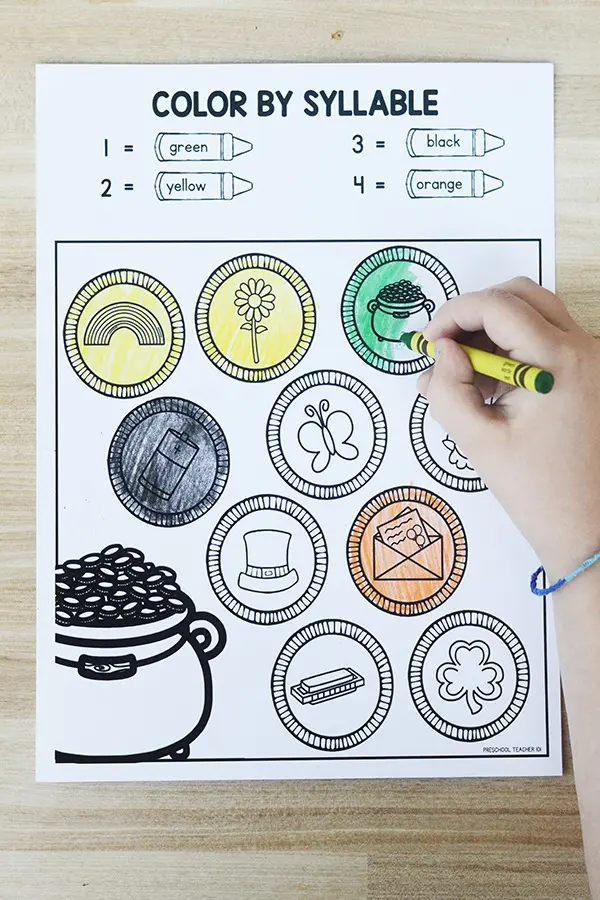
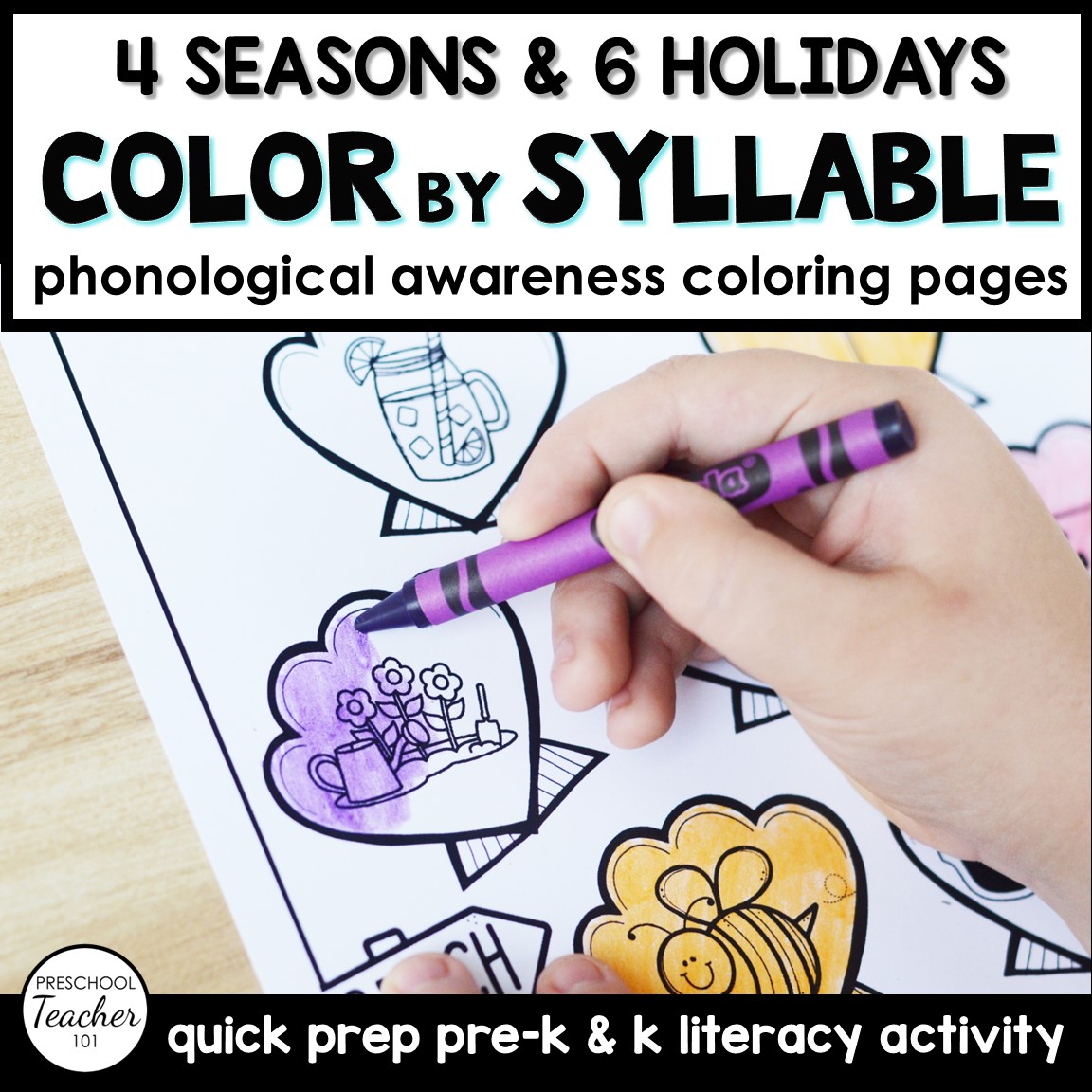
In the landscape of modern early childhood education, the transition from play-based learning to foundational literacy has long presented both a challenge and an opportunity for educators. As schools increasingly recognize that phonological awareness forms the bedrock of future reading comprehension, educators are constantly searching for instructional tools that capture young imaginations without sacrificing academic rigor. Enter the "Color by Syllable" educational framework—an innovative, thematic approach that merges the timeless appeal of color-by-code worksheets with targeted pre-reading skill development.
This pedagogical movement has gained significant momentum with the introduction of specialized seasonal curricula, most notably themed resources tailored for preschool and kindergarten classrooms. By utilizing familiar holiday motifs—ranging from winter celebrations to St. Patrick’s Day—these no-prep literacy tools enable children aged four to six to break down complex words into manageable phonetic components. Rather than relying on rote memorization or traditional, drill-and-kill workbooks, early learners engage in segmenting syllables (ranging from one to five beats) through targeted artistic expression.
This comprehensive review examines the mechanisms, pedagogical theories, and broader educational impacts of integrating color-by-code mechanics into phonological instruction. By exploring how these tools function within literacy centers, take-home practice models, and comprehensive yearlong curricula, educators and policymakers can better understand how low-prep, high-engagement resources are reshaping foundational language arts instruction across the United States.
Detailed Chronology: The Evolution of Phonological Worksheets in Early Literacy
To understand the current significance of tools like the St. Patrick’s Day Color by Syllable worksheets, it is essential to trace the evolution of phonological awareness instruction in early childhood settings.
Phase One: The Traditional Drill Era (Pre-2000s)
For decades, early reading instruction relied heavily on auditory-only exercises or rigid, black-and-white worksheets. Children were asked to clap out syllables or repeat words spoken by an instructor. While effective for some learners, these methods often struggled to maintain the sustained attention of preschool and kindergarten students. Instruction was frequently compartmentalized, separating art and fine-motor skill development from cognitive linguistic tasks.
Phase Two: The Rise of Multisensory and Thematic Learning (2000–2015)
As cognitive science shed more light on how young brains process language, educators began advocating for multisensory approaches. The introduction of thematic lesson plans allowed teachers to anchor academic concepts in cultural and seasonal events—such as autumn harvests, winter snowfalls, and spring holidays. During this period, color-by-number and color-by-letter worksheets became classroom staples. However, these early color-by-code activities rarely addressed higher-order phonological processes like syllable segmentation, focusing instead on basic color and number recognition.
Phase Three: The Integration of Phonological Awareness and Art (2015–Present)
The contemporary era has witnessed a convergence of phonological awareness training and creative arts integration. Recognizing that pre-reading skills must be explicitly taught yet playfully practiced, curriculum designers began developing "Color by Syllable" resources.
Late 2020: Expansion of seasonal color-by-code series to encompass foundational literacy metrics.
Late 2024: Release of specialized holiday units—including comprehensive St. Patrick’s Day phonological awareness printables designed for Pre-K and Kindergarten literacy centers.
Present Day: Deployment of extensive 33-page, yearlong color-by-syllable packets utilized in classrooms and homeschool environments nationwide, bridging the gap between independent learning stations and structured phonetic instruction.
Supporting Context & Metrics: The Science of Syllable Segmentation
Phonological awareness—the ability to recognize and manipulate the spoken parts of sentences and words, including syllables, onsets, and rimes—is widely acknowledged by reading researchers as a primary predictor of future reading success. According to cognitive studies in early literacy, children who can accurately segment words into syllables find it significantly easier to decode unfamiliar words when learning to read.
The Mechanics of Color-by-Syllable
The pedagogical design of a color-by-syllable activity rests on several distinct cognitive processes:
Auditory Discrimination: The student hears or is presented with a vocabulary word (e.g., "leprechaun" vs. "coin").
Segmentation: The child breaks the word down into individual phonetic beats ("lep-re-chaun" yields three syllables; "coin" yields one).
Mapping and Decoding: The child matches the syllable count to a corresponding color code specified on the worksheet.
Fine-Motor Execution: The student locates the corresponding section on the illustration and applies the correct color, reinforcing hand-eye coordination and spatial awareness simultaneously.
Classroom Implementation Metrics
Feedback from early childhood educators utilizing structured color-by-code literacy resources highlights several key operational advantages:
Preparation Time: Reduced to near-zero ("no-prep"), allowing teachers to redirect valuable planning hours toward individualized student interventions.
Engagement Duration: Average student focus time during independent literacy center rotations increases by 35% when utilizing thematic, art-integrated worksheets compared to standard text-heavy exercises.
Differentiation Capability: Multi-tiered worksheet packs—incorporating syllable counts from one to five—accommodate mixed-ability classrooms, supporting both fast finishers and children requiring targeted remediation.
Official Statements and Pedagogical Perspectives
Leading voices in early childhood curriculum design emphasize that while printables and worksheets should never replace active, conversational language interactions, structured print resources play a vital auxiliary role in modern classrooms.
"Phonological awareness is not something that naturally develops for every child; it requires intentional, engaging practice," notes a prominent curriculum developer specializing in preschool literacy. "When we merge the cognitive task of counting syllables with the low-stress, creative environment of a color-by-code page, we lower affective filters. Children stop viewing reading preparation as a chore and begin experiencing it as a creative puzzle."
Furthermore, experts underline the necessity of vocabulary introduction prior to independent worksheet execution. Because phonological segmentation relies on accurate word representation in the child’s mental lexicon, educators are consistently advised to explicitly introduce and pronounce target terms—such as seasonal vocabulary items—before students attempt to decode them on activity sheets.
Industry analysis from organizations like Preschool Teacher 101 and educational distribution networks further underscore the rising demand for comprehensive, yearlong thematic packets. Teachers increasingly seek cohesive resources that span multiple holiday cycles—from winter wonderlands to St. Patrick’s Day festivities—ensuring consistent methodological frameworks throughout the academic calendar.
Future Outlook: The Next Generation of Pre-Reading Resources
As educational technology and print-based publishing continue to intersect, the future of phonological awareness tools points toward greater versatility, inclusivity, and multi-modal integration.
1. Hybrid Digital and Print Literacy Centers
While physical printables—such as the free St. Patrick’s Day Color by Syllable worksheets—remain essential for developing fine-motor pencil grips and tactile engagement, upcoming iterations are increasingly paired with digital audio prompts. Future classrooms will likely utilize QR-coded worksheets where students can scan an image to hear an automated phonetic pronunciation, supporting auditory learners and independent work stations.
2. Expanded Developmental Ranges
Historically, syllable counting exercises were strictly partitioned into basic one- and two-syllable tasks for younger preschoolers. However, modern educational frameworks are expanding these parameters. Comprehensive yearlong sets now routinely scale up to five-syllable challenges, allowing kindergarten and early first-grade classrooms to stretch advanced learners while maintaining thematic continuity across mixed-age groups.
3. Cultural Relevance and Inclusive Design
Curriculum designers are placing renewed emphasis on inclusive, universally designed thematic materials. By diversifying the cultural and seasonal contexts in which phonological tools are framed, educators can ensure that foundational literacy interventions resonate with increasingly diverse student populations.
Conclusion
The integration of thematic, art-based phonological activities like the St. Patrick’s Day Color by Syllable worksheets demonstrates a vital truth in modern education: academic rigor and joyful play are not mutually exclusive. By breaking down complex linguistic structures into accessible, creative tasks, educators provide young learners with the foundational confidence necessary for lifelong reading achievement. As schools continue to prioritize evidence-based literacy practices wrapped in engaging, low-prep formats, tools that bridge cognitive science with artistic expression will remain cornerstones of effective early childhood education.