
Executive Overview
In the modern educational landscape, the metrics of student success have expanded far beyond standardized test scores and rote memorization. Educators, educational psychologists, and cognitive scientists are increasingly converging on a critical truth: the foundational drivers of academic achievement and lifelong resilience are executive functioning skills. Encompassing complex cognitive processes such as planning, working memory, mental flexibility, self-control, and task initiation, these internal mechanisms dictate how a child or teen navigates challenges, manages time, and organizes their daily life.
However, teaching these abstract cognitive concepts to growing minds has long presented a pedagogical hurdle. Traditional lectures on time management or emotional regulation often fail to engage students who are already overwhelmed by the demands of academic life. Enter an innovative, deceptively simple classroom strategy: the intentional deployment of daily motivational quotes.
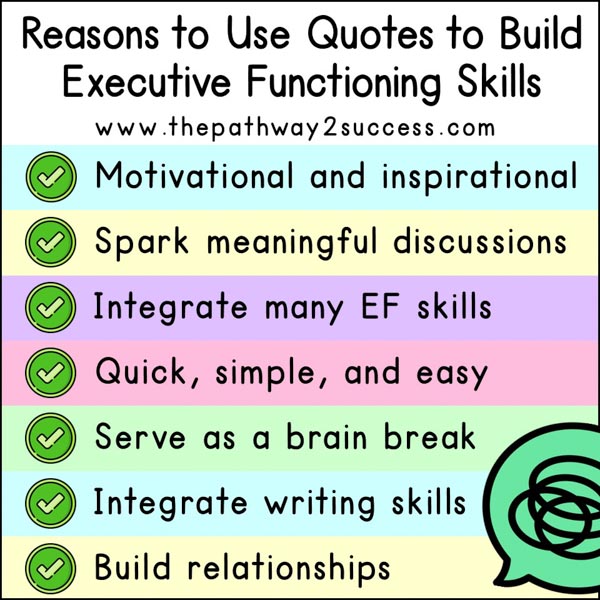
Far beyond mere hallway decoration or passive inspiration, carefully curated quotations are being leveraged as cognitive anchors. When paired with structured discussions, guided inquiry, and reflective journaling, quotes serve as accessible entry points for children and teens to dissect complex mental habits. By transforming abstract neurological concepts into relatable aphorisms, educators are discovering a powerful, low-friction tool to cultivate vital executive functioning skills. This comprehensive report explores the neuroscience behind the strategy, breaks down core competency areas, examines practical classroom integration, and evaluates the long-term outlook of utilizing language to reshape young minds.
Detailed Chronology: The Evolution of Executive Functioning in Education
To understand why quotations have emerged as a vital pedagogical vehicle, it is necessary to examine how the educational sector’s approach to cognitive skill-building has evolved over the past several decades.
Phase One: The Era of Strict Behavioral Management (Late 20th Century)
Historically, classrooms operated under a compliance-driven model. Behaviors associated with poor executive functioning—such as disorganization, impulsivity, or an inability to start assignments—were frequently viewed through a disciplinary lens. If a student forgot their homework or struggled to sit still, the intervention was typically punitive or purely behavioral, focusing on compliance rather than cognitive capacity. Little distinction was made between a student choosing to misbehave and a student whose prefrontal cortex was simply struggling to plan and organize.
Phase Two: The Neurodiversity Revolution and Recognition (Early 2000s)
As neuroscience advanced, researchers began mapping the prefrontal cortex—the command center for executive functions—and discovered that these critical neural pathways continue developing well into a person’s early twenties. Schools began recognizing that executive dysfunction is often tied to neurodevelopmental variations, trauma, or stress. Educators shifted toward accommodations, providing checklists, graphic organizers, and visual schedules to scaffold student learning. While effective, these tools often felt rigid and externalized, doing little to help students internalize the underlying cognitive processes.
Phase Three: The Shift Toward Metacognition (2010s)
Educational researchers increasingly emphasized metacognition—the ability to think about one’s own thinking. Schools realized that students needed to understand how they learn, not just what they learn. Programs targeting social-emotional learning (SEL) and mindfulness proliferated. However, integrating these lessons without adding to an already overburdened curriculum remained a significant challenge for teachers.
Phase Four: The Integration of Linguistic Anchors (Present Day)
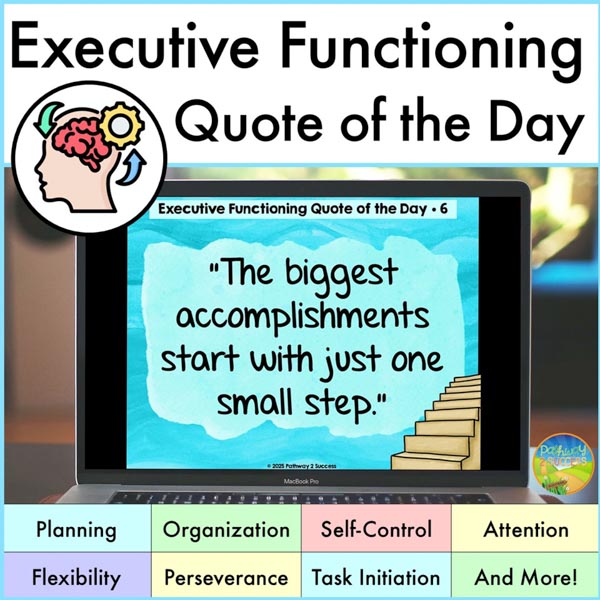
Most recently, educators have sought seamless, organic methods to weave metacognitive training into the daily routine without sacrificing instructional time. By utilizing "bell-ringers"—short, focused activities at the start of a class period—teachers began introducing daily quotes tailored specifically to cognitive skills. This current phase bridges the gap between high-level executive functioning theory and accessible, everyday student discourse, transforming the morning quote into a powerful cognitive catalyst.
Supporting Context & Metrics: The Anatomy of Executive Functioning
To appreciate the impact of quote-based interventions, one must examine the specific cognitive architecture of executive functioning. Often compared to the "air traffic control system" of the brain, these skills allow individuals to juggle multiple tasks, prioritize needs, regulate impulses, and adapt to changing environments.
The Core Components
- Task Initiation: The ability to independently begin a task without excessive procrastination.
- Self-Control (Inhibition): The capacity to override impulsive behaviors and think before acting.
- Working Memory: The ability to retain and manipulate information over short periods.
- Cognitive Flexibility: The mental agility to switch perspectives, adapt to unexpected changes, and find alternative solutions to problems.
- Planning and Organization: The skill required to set goals, map out sequential steps, and keep track of physical and digital materials.
The Data and Impact
According to developmental psychology studies, executive functioning skills are often stronger predictors of academic readiness and long-term success than IQ scores. Longitudinal research indicates that children who develop robust self-regulation and planning strategies in their youth exhibit better long-term physical health, higher socioeconomic status, and lower rates of substance abuse in adulthood.
Yet, modern distractions—ranging from hyper-stimulating digital environments to chronic academic stress—have placed unprecedented strain on developing attention spans. Educators utilizing daily quote reflections report a noticeable shift in classroom culture. By dedicating the first five minutes of class to dissecting a targeted phrase, students build a shared vocabulary around their mental processes, turning abstract neurological demands into tangible daily practices.
Official Strategies and Frameworks: Putting Quotes into Practice
Integrating quotes effectively requires more than writing a famous saying on the whiteboard. To build executive functioning skills, educators must use a structured, strategic approach that encourages deep critical thinking and personal relevance.
Step 1: Strategic Selection
A successful quote for executive functioning must do more than sound inspiring; it must target a specific cognitive domain. Whether addressing perseverance, task initiation, or emotional regulation, the statement must invite students to examine their internal thought processes and connect the message to real-world scenarios.
Step 2: The Routine "Bell-Ringer" Model
Embedding quotes into the daily routine—such as a morning meeting or the start of a class period—creates predictability and structure. This routine heavily supports students who struggle with transitions and organization, establishing a calm, focused baseline for the instructional day ahead.
Step 3: Guided Inquiry and Discussion
Instead of telling students what a quote means, educators use open-ended, targeted questions. This inquiry-based method shifts the cognitive load onto the learner, requiring them to analyze, infer, and apply the concept to their own lives.
Deconstructing the Quotes: Targeted Competencies and Insights
To illustrate how this framework operates in practice, educators analyze specific thematic quotations paired with distinct executive functioning domains.
1. The Foundation: Executive Functioning Skills
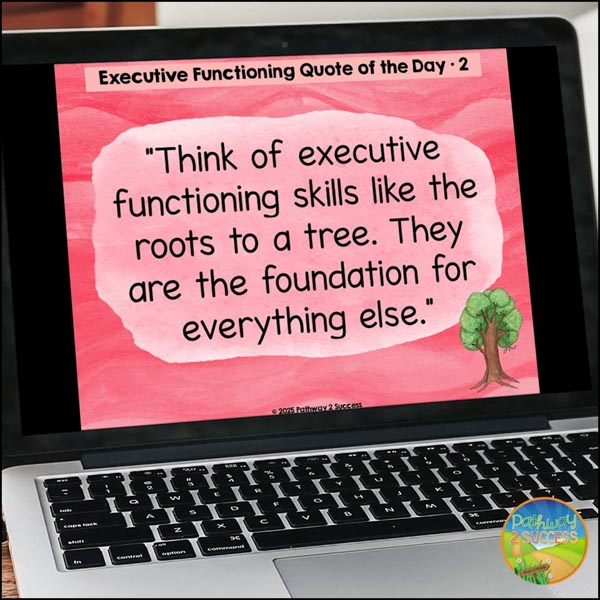
- The Quote: "Think of executive functioning skills like the roots to a tree. They are the foundation for everything else."
- The Meaning: Executive functioning encompasses the mental processes that allow us to plan, organize, initiate tasks, and manage challenges. Just as invisible roots anchor a towering tree, these cognitive skills anchor every academic and personal endeavor. Recognizing this foundation helps learners embrace skill-building rather than viewing it as arbitrary school rules.
- Guided Discussion Questions:
- What are some activities you enjoy doing, and how do planning and focus help you succeed at them?
- Why is it essential to understand how your brain works?
2. Self-Control
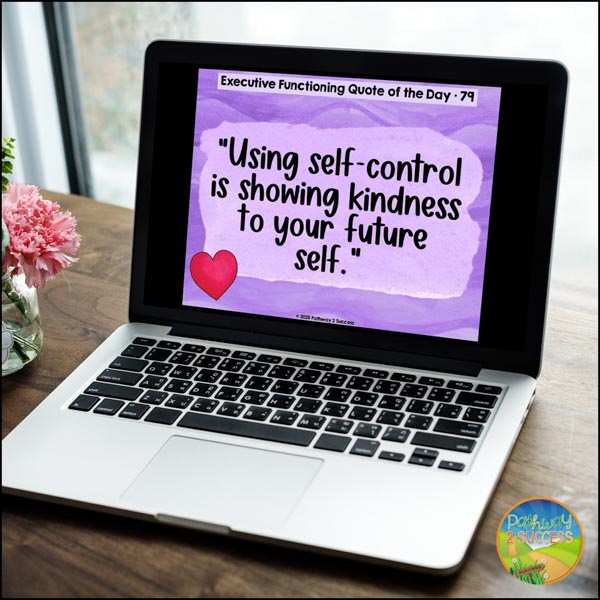
- The Quote: "Using self-control is showing kindness to your future self."
- The Meaning: Self-control is often misconstrued as rigid restriction. Reframing it as an act of self-kindness changes the psychological dynamic. Organizing a messy binder or pausing before reacting impulsively may feel challenging in the moment, but it relieves stress for the individual down the road.
- Guided Discussion Questions:
- How does self-control act as a form of self-care?
- What is one way you can show kindness to your future self today?
3. Task Initiation
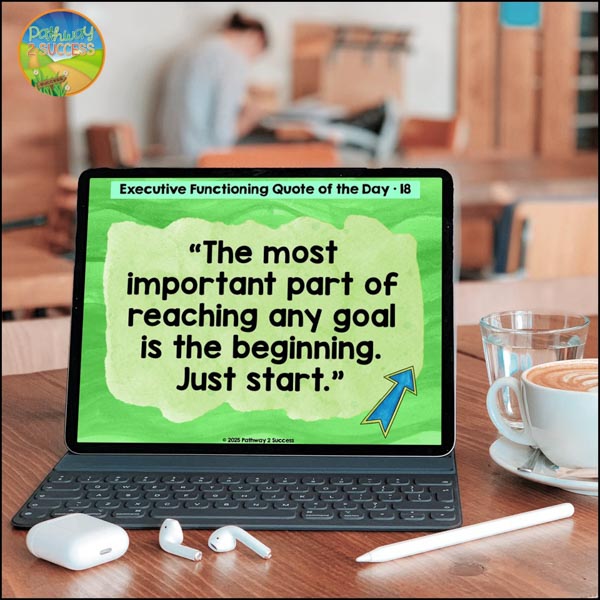
- The Quote: "The most important part of reaching any goal is the beginning. Just start."
- The Meaning: Overcoming inertia is frequently the steepest hurdle in productivity. Task initiation requires overriding the friction of starting. Once momentum is established, sustaining effort becomes significantly easier.
- Guided Discussion Questions:
- Why is taking that first step often the hardest part of any project?
- What actionable strategies can you use to break past procrastination?
4. Attention and Regulation
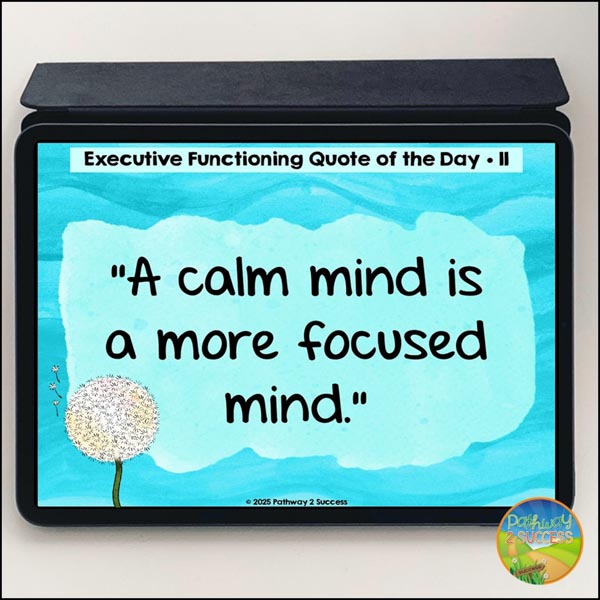
- The Quote: "A calm mind is a more focused mind."
- The Meaning: Emotional dysregulation and cognitive overload fracture attention. By teaching students mindfulness and emotional calming strategies, educators directly enhance the brain’s capacity for deep focus and clear thinking.
- Guided Discussion Questions:
- Why do you think your mind focuses better when you feel grounded rather than overwhelmed?
- What specific relaxation techniques help clear your head?
5. Perseverance
- The Quote: "Perseverance isn’t always easy, but it’s simple. Just keep going."
- The Meaning: Grit and perseverance do not require extraordinary complexity; they require endurance in the face of discomfort. The message simplifies resilience down to a single directive: persistence.
- Guided Discussion Questions:
- Can you share a time when you wanted to quit but chose to keep going?
- What mental tools help you push through difficult moments?
6. Cognitive Flexibility
- The Quote: "Every problem has a solution. Most have many."
- The Meaning: Cognitive flexibility allows individuals to pivot when initial plans fail, perspective-take, and brainstorm alternative pathways. Recognizing that problems rarely have only one correct answer fosters resilient, adaptable problem-solvers.
- Guided Discussion Questions:
- Think of a recent challenge you faced—what were several different ways you could have resolved it?
- Why is mental flexibility an asset in an unpredictable world?
Future Outlook: The Next Generation of Cognitive Education
As educational institutions increasingly prioritize holistic student development, the integration of metacognitive tools like quote-based reflection is poised for significant expansion. Looking forward, several trends are emerging in this space:
- Digital Integration: With the proliferation of 1:1 digital classrooms, daily reflection prompts are transitioning into interactive digital journals, allowing students to track their growth in executive functioning over entire academic years.
- Cross-Disciplinary Adoption: While traditionally housed within advisory periods or social-emotional learning curricula, executive functioning quotes are increasingly being adopted by STEM and humanities teachers alike to foster growth mindsets during rigorous academic instruction.
- Empirical Validation: As schools demand evidence-based interventions, ongoing qualitative and quantitative studies are expected to further validate how simple linguistic prompts contribute to measurable improvements in working memory, self-regulation, and classroom climate.
Conclusion
Building executive functioning skills in children and teens is a complex, long-term endeavor that cannot be solved by a single reform or policy. However, as educators continue to seek innovative, compassionate, and low-barrier methods to reach growing minds, the strategic use of quotations offers a beacon of clarity. By transforming abstract neurological processes into resonant daily wisdom, teachers are giving students not just words to ponder, but the foundational roots they need to branch out and thrive.

