By Lia Milgram, Managing Editor for ACTE Published in coordination with the Association for Career and Technical Education (ACTE)
Executive Overview
As the Association for Career and Technical Education (ACTE) marks a monumental century of service, the foundational questions facing educators, program leaders, and advocates have never been more urgent. From September 2025 through May 2026, ACTE’s flagship publication, Techniques, embarked on a comprehensive, year-long journalistic exploration of Career and Technical Education (CTE). The core inquiries guiding this deep dive were deceptively simple yet profoundly complex: What does it take to build pathways that reach every learner? How do learning spaces and daily experiences shape what students believe is possible for their futures?
The best stories in CTE have never been solely about bureaucratic program structures, funding formulas, or equipment upgrades. They are about people—the educators who refuse to give up, the students who dare to reimagine their trajectories, and the advocates fighting systemic inertia. Over an eight-part series published across the 2025–2026 academic year, Techniques documented these human-centric victories and struggles.
This comprehensive review synthesizes those insights, examining how the field is confronting stigma, transforming leadership, revolutionizing work-based learning, embedding wraparound supports, designing innovative spaces, leveraging documentary storytelling, securing rural investments, and retaining industry-expert educators.
Detailed Chronology: The 2025–2026 Editorial Journey
September 2025: Skills Over Stigma and the Justice-Impacted Learner
High-quality CTE functions as a promise to society: that hard work, combined with market-aligned training, yields economic mobility and stability. However, for justice-impacted learners, the stakes of that promise are exceptionally high, and the structural barriers are painfully real.
The September 2025 volume of Techniques tackled this head-on with a feature authored by an individual who is personally justice-impacted and now dedicates their life to education and reentry advocacy. Writing from lived experience, the author made a compelling case for building educational pathways that prioritize real-world skills over historical stigma.
For correctional education facilities and community reentry programs, shifting the paradigm from punitive detention to rehabilitative skill-building is transformative. By aligning incarcerated and recently released individuals with high-demand trade, technology, and service sectors, programs reduce recidivism rates while simultaneously filling critical labor market shortages.
October 2025: Leading the Change in Postsecondary CTE
The public narrative surrounding CTE is undergoing a massive cultural shift, moving away from outdated vocational stereotypes toward high-tech, high-wage career pathways. At the forefront of this transformation are the alumni of the NextLevel Postsecondary CTE Fellowship.
Featured in the October edition, these dynamic leaders hail from diverse institutions across the nation—ranging from small rural community colleges to massive urban technical university systems. Notably, these leaders frequently cite their own students as their greatest teachers. This annual feature underscored how visionary educational leadership actively dismantles historical biases, proving that postsecondary CTE is a primary engine of American economic innovation.
Work-based learning (WBL) is universally praised as a cornerstone of modern education, but its execution varies wildly. The November/December 2025 issue explored a vital truth: WBL is most effective when it actively encourages learners to explore divergent interests rather than forcing them down a rigid, predetermined track.
Meaningful career exploration requires the psychological and logistical freedom to question, refine, and redirect. Because different students arrive with unique backgrounds, learning styles, and goals, designing student-centered WBL means meeting learners precisely where they are and scaffolding their journey toward what is possible. Whether through registered youth apprenticeships, job shadows, or entrepreneurial incubators, flexible WBL models bridge the gap between classroom theory and industry reality.
January 2026: High-Quality CTE by Design and Wraparound Supports
For decades, wraparound supports—such as mental health counseling, housing assistance, childcare subsidies, and food pantries—have been treated as supplemental or optional add-ons in education. The January 2026 issue of Techniques challenged this deficit mindset, arguing that comprehensive supports are fundamentally central to student engagement and program completion.
When institutions embed wraparound services directly into program design from day one, systemic attrition plummets. Students are no longer forced to choose between feeding their families and finishing their certifications. This operational shift not only alters individual life trajectories for the better but also stabilizes the local pipelines of skilled labor that businesses and communities desperately rely upon.
February 2026: Designing Robust, Meaningful Student Experiences
The physical environment of a classroom or laboratory speaks volumes before a single lesson is taught. The strongest CTE programs begin with a clear curricular vision, and the physical spaces housing them must reflect that intentionality.
Rather than demanding astronomical budgets for brand-new construction, the February 2026 issue offered a practical, actionable roadmap for facilities design. It started with a fresh, creative look at underutilized spaces already available on campuses. The overarching design philosophy is simple yet profound: help students vividly see themselves in future careers from the very moment they walk through the door. Modern, clean, and industry-standard environments communicate respect, professionalism, and high expectations.
March 2026: A Century of Storytelling and Advocacy
Data is essential for making the economic and political case for CTE, but human stories are what make people remember why it matters. As ACTE proudly marked its centennial anniversary in March 2026, Techniques explored how the Association is leveraging modern storytelling—specifically the emotional resonance of documentary film—as a powerful tool for advocacy.
By putting a human face on educational outcomes, documentary storytelling translates complex legislative metrics into visceral, relatable narratives. This centennial feature connected a century of visionary educational leadership directly to the contemporary students, educators, and community stakeholders who are actively writing the next chapter of the CTE movement.
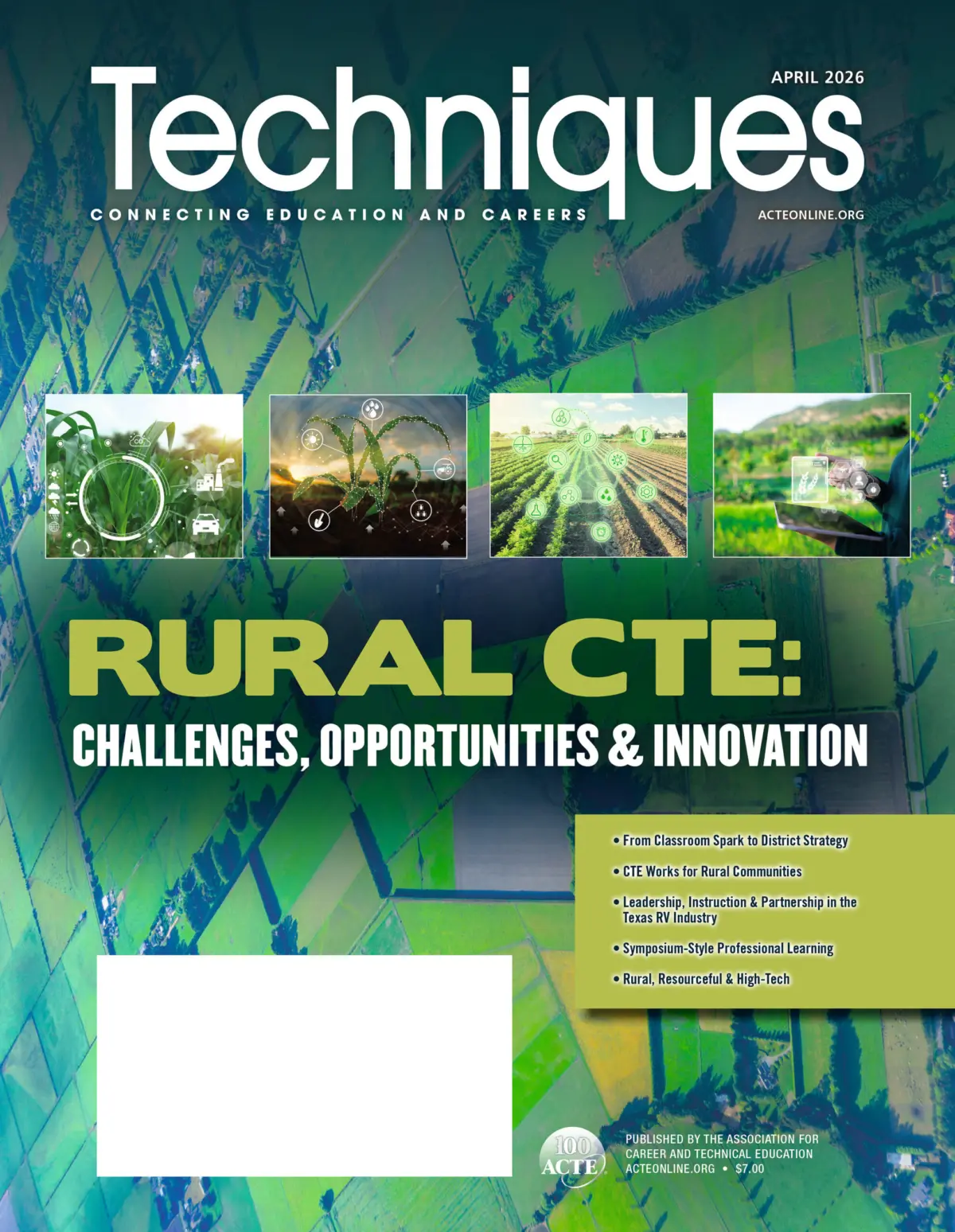
April 2026: Economic Realities and Rural Program ROI
Rural CTE programs face severe headwinds that urban and suburban districts rarely encounter. Dwindling local populations, shrinking tax bases, and geographically sparse service areas mean that rural schools often operate on razor-thin margins, constantly bracing for the threat of program closures.
The April 2026 issue provided rural administrators with a critical framework for survival and growth: translating nuanced program impact into hard data. By demonstrating clear return on investment (ROI), rural leaders can successfully make the case to state legislators and private stakeholders. This approach connects student success metrics directly to broader workforce development goals and long-term community investments, ensuring that rural America remains economically vibrant.
May 2026: Halting the Revolving Door of CTE Teacher Induction
Perhaps one of the most poignant cautionary tales published during the year-long review involved an experienced insurance professional who courageously transitioned into a CTE teaching career—only to resign just two days into the school year. This hyper-common scenario highlights a systemic crisis: the struggle to retain industry experts in the classroom.
Drawing on original research, the May 2026 issue offered educational leaders an innovative blueprint for teacher retention. The core finding was clear: when teacher induction is treated as an immersive, supportive experience rather than a bureaucratic checklist, industry professionals stay. And when expert educators stay, student achievement and program stability soar.
Supporting Context & Metrics: The State of CTE at ACTE’s Centennial
As ACTE celebrates 100 years of championing career and technical education, the macro-level landscape of workforce training has shifted dramatically. Historically sidelined as a secondary alternative track, modern CTE is now recognized as a primary driver of national economic competitiveness.
The Skills Gap Reality: According to recent labor market projections cited across Techniques analyses, millions of skilled trade and technical positions remain unfilled due to a persistent mismatch between available talent and employer requirements.
The Power of Retention: Research highlighted in the May 2026 induction study underscores that alternative-route educators—those coming directly from industry—experience significantly higher rates of first-year burnout unless paired with structured, discipline-specific mentorship and pedagogical coaching.
Economic Multipliers: Data-driven advocacy frameworks, such as those covered in the April rural ROI analysis, demonstrate that every dollar invested in high-quality secondary and postsecondary CTE yields exponential returns in local tax bases, reduced social service expenditures, and elevated median household incomes.
Official Statements and Perspectives
Reflecting on this milestone year of publication, ACTE leadership emphasizes that the association’s mission remains deeply rooted in empowerment, equity, and excellence.
"The best CTE stories are never only about programs. They are about the people inside them—what they built, what they believed, and what they refused to give up on," noted editorial reflections from the Techniques team.
Industry experts and fellows featured throughout the centennial year echoed this sentiment, stressing that the future of American innovation depends on dismantling artificial divides between academic and technical learning. Whether advocating for justice-impacted populations, reimagining rural funding models, or redesigning physical learning laboratories, the consensus among educational leaders is unified: intentional design, comprehensive wraparound support, and deep respect for the human educator are non-negotiable pillars of modern school reform.
Future Outlook: The Next Century of Career and Technical Education
As Techniques closes out its 2025–2026 review and looks toward the horizon, the lessons captured over these eight months serve as both a blueprint and a challenge for the next century of educational leadership.
The future of CTE will depend heavily on the industry’s ability to scale what works. Institutions must institutionalize comprehensive wraparound supports so that economic hardship is never a barrier to credential completion. Facilities must be designed with intentionality to inspire the workforce of tomorrow. Policymakers and administrators must prioritize robust, long-term induction models that honor the sacrifices of industry experts transitioning into teaching roles.
Above all, as ACTE steps into its second century, the association remains committed to using both rigorous data and deeply human storytelling to advocate for programs that reach every learner. By valuing skills over stigma, centering student exploration, and championing the educators on the front lines, Career and Technical Education will continue to build the pathways that power our nation.
To explore these articles in full, contribute to upcoming editorial editions, or learn more about writing for the publication, visit the official ACTE Techniques Editorial Calendar.