
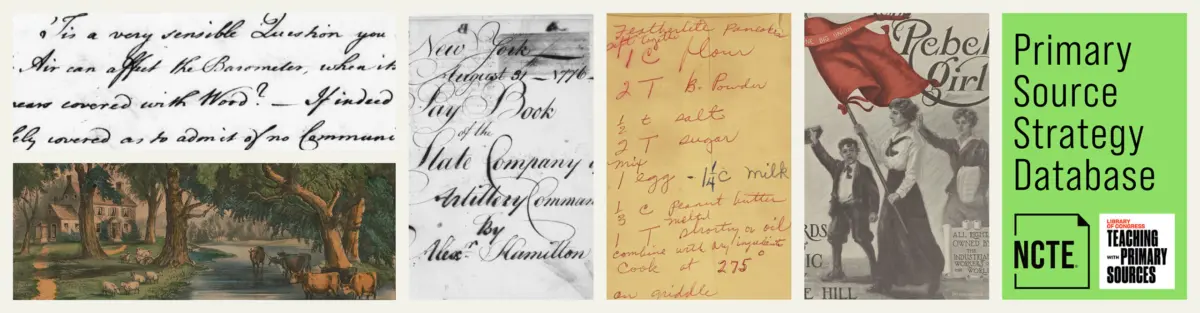
In an era where digital information is abundant yet often divorced from its historical context, educators are constantly seeking ways to ground student learning in authentic, tangible evidence. Recognizing this vital need, the National Council of Teachers of English (NCTE) has embarked on a transformative collaboration with the Library of Congress.
Operating under the auspices of the prestigious Teaching with Primary Sources (TPS) Partner Program—specifically through the TPS Consortium—this initiative is reshaping how literacy teachers and students interact with historical records. By bridging the gap between archival preservation and modern pedagogy, the partnership empowers educators to bring history to life using digitized primary sources from the world’s largest library.
At the heart of this endeavor is a robust, searchable database designed to provide educators with actionable pedagogical strategies. Featuring over 150 specific items from the Library of Congress’s vast digitized collections, the database is a testament to collaborative curriculum design. More than two dozen expert teachers and leaders in English language arts (ELA) education have contributed to the project, formulating instructional strategies that articulate specific literacy merits, suggested themes, instructional units, and alignment with state standards.
By leveraging intuitive search tags such as picturebook and argument, educators can seamlessly integrate these rich historical assets into interdisciplinary lesson plans. Among the crown jewels of this collection is a set of documents that offers a rare, ground-level look at the intersection of civil rights, personal finance, and historical resilience: the financial papers and bank books of abolitionist icon Frederick Douglass.
Executive Overview: Bridging Literacy, History, and Financial Empowerment
The inclusion of the Frederick Douglass Papers: Financial Papers, 1847–1928; Bank books within the NCTE-Library of Congress database marks a paradigm shift in how students engage with African American history. Traditionally, educational narratives surrounding Frederick Douglass focus almost exclusively on his harrowing escape from enslavement, his powerful autobiographies, and his towering oratory in the abolitionist movement. While these aspects remain foundational, the financial papers introduce a critical, often-overlooked dimension of his legacy: his pragmatic approach to economic independence and wealth accumulation.
These bank books and financial transactions—spanning more than eight decades—reveal the meticulous financial management of a man navigating a society built on institutionalized racial prejudice. By examining deposits, withdrawals, and everyday expenditures, students are presented with undeniable proof that economic stability was not merely a byproduct of Douglass’s fame, but a deliberate strategy employed to sustain his activism, writing, and public speaking engagements.
For modern classrooms, this primary source serves as a dynamic interdisciplinary bridge connecting history, economics, and civic duty. It challenges educators to move beyond standard historical summaries and engage students in deep, analytical inquiries regarding the structural barriers marginalized groups have historically faced in acquiring fair economic opportunities. Furthermore, it invites learners to explore the timeless role of financial literacy as a tool for personal autonomy and social empowerment.
Detailed Chronology: Unpacking the Financial Legacy of Frederick Douglass
To fully grasp the instructional value of the Frederick Douglass financial papers, one must examine the temporal arc these documents cover, spanning from the antebellum period through the Reconstruction era and well into the Jim Crow era.
The Antebellum Era (1847–1861): Laying the Foundation of Independence
During the 1840s and 1850s, Douglass established himself as a preeminent voice in the abolitionist movement following the publication of his groundbreaking 1845 autobiography, Narrative of the Life of Frederick Douglass, an American Slave. However, public speaking and independent journalism were financially precarious vocations, especially for a fugitive slave whose legal status remained perilous until his British supporters formally purchased his freedom in 1846.
The earliest records in the financial papers capture Douglass’s efforts to establish a secure economic footing during this turbulent decade. Managing lecture fees, subscription revenues for his newspaper The North Star (later renamed Frederick Douglass’ Paper), and travel expenses required acute financial acumen. These bank books document how Douglass maintained liquidity and financial accountability while under constant threat, proving that his survival and continued agitation depended as much on ledger books as it did on moral persuasion.
The Civil War and Reconstruction (1861–1877): Economic Resilience Amid National Upheaval
As the nation fractured and ultimately plunged into the Civil War, Douglass’s financial activities reflected the broader economic shifts of a country dismantling chattel slavery. During this period, Douglass actively advocated for the enlistment of Black troops and the emancipation of enslaved millions.
The financial records from the Reconstruction era highlight his expanding economic footprint. As a prominent statesman who would later hold federal appointments—including U.S. Marshal for the District of Columbia and Recorder of Deeds—Douglass navigated increasingly complex financial structures. These documents illustrate his ability to acquire property, manage investments, and secure his family’s generational wealth at a time when millions of newly freed African Americans were systematically denied access to basic banking services and fair labor contracts.
The Post-Reconstruction and Jim Crow Era (1878–1928): Preserving Autonomy
The final decades covered in the collection extend past Douglass’s death in 1895, capturing the handling of his estate and the continued management of his financial legacy. In an era marked by the rise of Jim Crow segregation, disenfranchisement, and economic exploitation across the American South, Douglass’s life stood as an enduring symbol of self-made success. The post-mortem and late-period entries in the bank books provide historians and students with a lens through which to examine how estates were preserved, charitable contributions were distributed, and financial independence was safeguarded in hostile political climates.
Supporting Context & Metrics: Pedagogical Framework and State Standards
The integration of the Frederick Douglass financial papers into contemporary curricula is supported by rigorous pedagogical frameworks and state educational standards. The NCTE-Library of Congress initiative ensures that teachers have the necessary tools to transform raw archival data into standards-aligned instructional units.
Interdisciplinary Learning Metrics
Educational leaders emphasize that these bank books transcend traditional history lessons by blending multiple academic disciplines:
- History & Civics: Students investigate how historical actors navigated discriminatory legal and economic frameworks.
- Economics & Financial Literacy: Learners analyze personal budgeting, asset accumulation, and the systemic impacts of capital access.
- Language Arts & Argumentation: ELA classrooms utilize the documents as textual evidence for crafting nuanced argumentative essays.
Standards Connections: Louisiana State Standards Alignment
To demonstrate the practical application of these resources, the curriculum maps specific primary sources to state educational benchmarks. For instance, the instructional strategies for the Douglass papers align directly with the Louisiana State Standards for high school ELA and social studies:
- W.11-12.1(a): Students are prompted to introduce precise, knowledgeable claims, establish the significance of these claims, distinguish them from alternate or opposing claims, and create a logical organizational structure that sequences claims, counterclaims, reasons, and evidence. The complex economic realities of Douglass’s life provide fertile ground for rigorous thesis-driven writing.
- WH.1: Analyzes ideas and events in world history from 1300 to 2010, examining how they progressed, changed, or remained the same over time. Douglass’s financial strategies serve as a case study in the evolution of civil rights and economic participation.
- WH.4: Utilizes a variety of primary and secondary sources to evaluate historical developments, compelling students to look beyond textbook narratives and engage directly with historical artifacts.
Official Statements and Educator Insights
The partnership between the NCTE and the Library of Congress has drawn widespread praise from educational administrators, literacy experts, and curriculum developers who champion inquiry-based learning.
Dr. Elena Vance, a curriculum coordinator specializing in English language arts, noted the profound impact of utilizing non-traditional primary sources in the classroom:
"When students look at a photograph or a political cartoon, they understand it as a piece of media. But when they examine a handwritten bank book or ledger belonging to Frederick Douglass, the historical figure transforms into a living, breathing human being who had to balance a checkbook, pay bills, and secure his family’s future against insurmountable odds. It humanizes history while teaching critical financial and civic literacy."
Representatives from the Library of Congress’s Teaching with Primary Sources program have similarly underscored the mission of the consortium:
"Our goal is to unlock the unimaginable wealth of knowledge housed within the Library of Congress and place it directly into the hands of educators. By partnering with organizations like the NCTE, we ensure that these historical treasures are not merely preserved in climate-controlled vaults, but are actively utilized to cultivate critical thinking, empathy, and rigorous analytical skills in the next generation of American students."
Contributors to the database also emphasize the importance of promoting critical thinking regarding contemporary socio-economic challenges. By studying the historical obstacles African Americans encountered in obtaining fair credit, property ownership, and employment, students are better equipped to analyze modern economic disparities through an informed, historically grounded lens.
Future Outlook: The Evolution of Digital Archives in Education
As educational paradigms continue to shift toward digital literacy, inquiry-based learning, and interdisciplinary instruction, initiatives like the NCTE and Library of Congress partnership point the way forward. The expansion of the searchable database to include over 150 meticulously cataloged primary sources represents only the beginning of a broader movement to democratize access to archival materials.
Future phases of the project aim to incorporate advanced digital tools, including interactive data visualizations of financial documents, augmented reality exhibits showcasing historical settings, and expanded professional development modules for teachers nationwide. By training educators to effectively deploy these resources, the initiative ensures that classrooms remain vibrant centers of inquiry where students do not simply memorize the past—they interrogate it, learn from it, and apply its lessons to the challenges of the modern world.
Ultimately, the inclusion of artifacts like the Frederick Douglass financial papers reminds us that history is not a distant abstraction. It is a continuous narrative shaped by human agency, economic resilience, and the relentless pursuit of justice. Through the collaborative efforts of the NCTE, the Library of Congress, and dedicated educators across the nation, this narrative is being brought to life for a new generation of learners, inspiring them to build a more equitable and economically empowered future.

