

Executive Overview
Artificial intelligence has officially crossed the threshold from a speculative novelty into the operational bedrock of modern scientific research. Across laboratories, universities, and corporate research and development wings worldwide, generative AI tools, specialized models, and large-scale computational platforms are fundamentally transforming how hypotheses are generated, data is analyzed, and literature is synthesized. A landmark joint study—conducted in collaboration with researchers from Google, Google DeepMind, and the Massachusetts Institute of Technology (MIT)—reveals that nearly half of active scientists now utilize AI tools on a daily basis, reaping substantial productivity benefits that average nearly seven hours of saved time per week.
Yet, this computational renaissance comes with a distinct and heavy administrative burden. The study, detailed in the September research paper AI in Science: Early Insights and further illuminated by Google’s AI & Economy ATLAS update, uncovers a complex socio-technical phenomenon: the emergence of a "verification tax." While AI is remarkably adept at accelerating the preliminary stages of research, scientists are swiftly giving a significant portion of those recovered hours back to the workflow. They are forced to meticulously audit, debug, cross-examine, and fact-check machine-generated outputs to ensure they meet the rigorous standards of the scientific method.
This dynamic reframes the broader public discourse surrounding artificial intelligence. While mainstream conversations are frequently dominated by speculative concerns regarding autonomous, misaligned, or "rogue" AI systems deceiving researchers, the reality within the laboratory is far more immediate and nuanced. The primary friction points are not catastrophic sci-fi scenarios, but rather the very earthly bottlenecks of hallucinated citations, low-quality research accumulation, and physical infrastructure constraints. As machine-driven hypothesis generation rapidly outpaces human and physical capacities for validation, the scientific community faces a critical juncture. The bottleneck of modern science is no longer the speed at which ideas can be conceived; it is the rate at which they can be rigorously verified.
Detailed Chronology and Empirical Foundation
To understand the current state of AI integration in laboratories, one must examine the empirical weight of the data compiled in the late-2025 and 2026 reports. The comprehensive picture painted by the Google, DeepMind, and MIT collaboration rests on three foundational pillars of data collection, offering an unprecedented look into the day-to-day realities of modern researchers.

The Tripartite Empirical Source
The AI in Science: Early Insights paper synthesized data from three major sources to establish its conclusions:
- Massive Interaction Logs: The researchers analyzed an anonymized dataset comprising approximately 15 million interactions with Google’s Gemini models. This telemetry provided a macroscopic view of how scientists naturally query, prompt, and collaborate with advanced language models during active research workflows.
- Specialized Model Inventory: The study cataloged an inventory of 2,690 specialized scientific AI models. This demonstrated that general-purpose chatbots represent only the tip of the iceberg; an entire ecosystem of domain-specific architectures—designed for protein folding, molecular simulation, astronomical classification, and genomic sequencing—is actively operating.
- Global Researcher Surveys: To capture the human element, the study surveyed 637 active scientists based in the United States and the United Kingdom. This qualitative and quantitative survey work bridged the gap between raw computational usage and lived laboratory experience.
The Rise of Daily AI Adoption
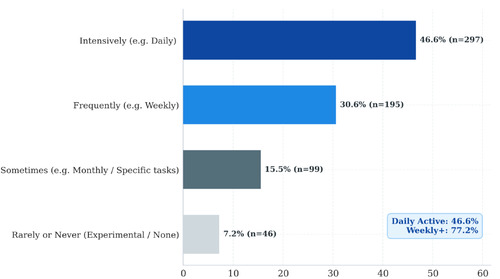
The survey data underscores a profound cultural shift within scientific disciplines. Nearly 50 percent of the surveyed researchers reported integrating some form of artificial intelligence into their daily routines. This adoption is not isolated to computer scientists or computational biologists; it spans traditional "wet lab" disciplines, social sciences, physics, and clinical medicine.
For these daily users, the immediate impacts were universally acknowledged as time-saving. Roughly three-quarters of all respondents reported that AI tools directly reduced the time required to execute routine tasks, such as writing boilerplate code, summarizing extensive literature reviews, formatting manuscripts, and drafting initial exploratory hypotheses. Among those who reported a net time savings, the average efficiency gain was calculated at just under seven hours per week—nearly the equivalent of an entire standard workday recovered over the course of a five-day week.
Furthermore, the study highlighted cognitive and cross-disciplinary expansions. Approximately 68 percent of surveyed scientists perceived that AI granted them unprecedented access to insights and methodologies from external disciplines—effectively breaking down long-standing academic silos. Meanwhile, roughly 65 percent noted that AI had successfully broadened the overall scope and ambition of their research agendas, allowing them to tackle multi-variable problems that would have previously been too resource-intensive to conceptualize.
Supporting Context and Metrics: The Anatomy of the "Verification Tax"
Despite these impressive efficiency metrics, the transition to AI-augmented science is far from a frictionless utopia. The core revelation of the MIT and Google DeepMind collaboration is the quantification of what the authors term the "verification tax"—the mandatory expenditure of human cognitive capital required to validate automated work.
Quantifying the Tax
While 75 percent of researchers enjoy time savings, the paradox lies in what happens to those saved hours. The study found that among scientists who reported net time gains, an overwhelming 89 percent stated that more than 10 percent of those saved hours were immediately funneled back into verifying, debugging, or fact-checking AI outputs.
More alarmingly for productivity models, 46 percent of those time-savers reported that more than one-quarter (25%) of their newly found time was consumed entirely by auditing the technology. In many cases, scientists found themselves spending multiple hours a week tracking down phantom citations, verifying code logic written by large language models, or running control experiments to check if an AI-suggested correlation held up under empirical scrutiny.
+--------------------------------------------------------------------------+
                  BREAKDOWN OF AI TIME SAVINGS REINVESTMENT
+--------------------------------------------------------------------------+
|                                                                          |
|  [================== Total Time Saved: ~7 hrs/week ==================]  |
|                                                                          |
|  --> Reinvested into Forward-Looking Research: ~75% - 90% of savings     |
|  --> Consumed by Verification, Debugging & Auditing: ~10% - 25%+         |
|                                                                          |
+--------------------------------------------------------------------------+
The Root Causes: Hallucinations and Illusions of Understanding
Why is this verification tax so burdensome? The study points to systemic challenges intrinsic to current machine learning architectures:

- Hallucinations and Fabrication: Generative models are fundamentally probabilistic text-predictors, not deterministic calculators. When asked to synthesize literature, they occasionally generate non-existent journal articles, fake DOIs, and misattributed historical claims. A scientist cannot cite a paper without verifying its physical existence, turning a literature review task into a digital scavenger hunt.
- Illusions of Understanding: Referencing prior research in the field, the paper highlights how fluent, beautifully structured AI explanations can create a dangerous cognitive illusion. An AI can output a complex methodological framework that sounds rigorously sound and mathematically elegant, but contains subtle, fatal flaws in its foundational logic.
- The Low-Quality Research Deluge: As the marginal cost of generating text, code, and preliminary data drops to near zero, the global scientific pipeline risks becoming oversaturated with low-quality, AI-generated manuscripts. This threatens to overwhelm traditional peer-review systems, turning academic journals into battlegrounds against automated noise.
The Physical and Clinical Bottleneck
Compounding the digital verification tax is a structural mismatch between computational speed and physical reality. As Google highlighted in its September 2026 AI & Economy ATLAS update, faster hypothesis generation does not automatically equate to accelerated discoveries if the physical downstream infrastructure remains constrained.
An AI model can generate fifty novel molecular hypotheses or clinical trial pathways in a matter of seconds. However, synthesizing those molecules in a wet lab, growing the cell cultures, securing Institutional Review Board (IRB) approvals, or executing multi-phase human clinical trials remains bound by the laws of physics, chemistry, and regulatory bureaucracy. Consequently, scientists find themselves managing an ever-growing backlog of untested hypotheses, creating a new form of professional stress: the anxiety of infinite ideation constrained by finite physical resources.
Official Perspectives and Industry Insights
The convergence of tech industry giants and academic institutions on this topic signals a maturing conversation around artificial intelligence. The days of uncritical techno-optimism are giving way to pragmatic, systems-level evaluations of how AI must be integrated into human workflows.
Google and DeepMind’s Assessment
In its official commentaries accompanying the release of the AI & Economy ATLAS update in September 2026, Google underscored the dual-edged nature of these findings. Company leadership emphasized that while the productivity metrics validate the massive investments made into scientific AI infrastructure, the industry must remain clear-eyed about the operational friction.

Google explicitly noted that the presence of the verification tax is not a failure of the technology, but rather a reflection of the extraordinarily high epistemological standards of science. In fields like software engineering or creative writing, an imperfect output may require minor tweaks; in molecular biology or particle physics, an undetected error can invalidate years of downstream funding and clinical safety. Therefore, the time spent auditing AI is not "wasted" time—it is a mandatory quality-control filter required to maintain scientific integrity. Furthermore, Google stressed that ecosystem stakeholders must focus on building better toolsets for provenance tracking, uncertainty quantification, and automated validation to help reduce this tax on human researchers.
The Academic Viewpoint from MIT
Researchers at MIT collaborating on the study have taken the position that institutions must adapt their training paradigms. If graduate students and early-career researchers are to navigate an AI-saturated landscape safely, academic institutions must formally train them in algorithmic skepticism. Scientists must learn not only how to prompt models effectively, but also how to aggressively stress-test, red-team, and reverse-engineer computational outputs. Without this pedagogical shift, the scientific workforce risks becoming overly reliant on automated systems whose inner workings they cannot fully verify.
Future Outlook: Navigating the New Scientific Paradigm
As the scientific community looks toward the remainder of the decade, the trajectory of artificial intelligence in research is clear: integration will deepen, but the nature of human labor will continue to evolve rather than disappear.
Towards Automated Verification and Self-Correcting Systems
The immediate horizon of scientific AI will likely see a massive push toward closing the validation loop. Software and AI developers are already working on closed-loop autonomous laboratories—systems where generative AI models not only propose hypotheses, but interface directly with robotic wet labs to physically synthesize and test compounds in real-time, feeding the empirical results back into the model to self-correct. By automating the verification phase alongside hypothesis generation, the industry hopes to finally lift the heavy verification tax currently weighing down human scientists.

Redefining the Role of the Modern Scientist
In the interim, the role of the research scientist is undergoing a permanent metamorphosis. The scientist of the mid-2020s and beyond is transitioning from a manual producer of data and text into an expert auditor, orchestrator, and critic of machine intelligence.
The value of human expertise is shifting away from rote memorization, formula derivation, or manuscript drafting, and toward high-level strategic judgment: knowing which AI-generated paths are worth pursuing, designing clever stress-tests to expose algorithmic blind spots, and maintaining the ethical and philosophical frameworks that keep scientific inquiry grounded in objective truth.
Ultimately, the study by Google, DeepMind, and MIT serves as a vital reality check. Artificial intelligence is an extraordinarily powerful catalyst for human ingenuity, but it possesses no intrinsic understanding of truth. As long as science demands absolute fidelity to reality, the human mind will remain the ultimate, irreplaceable arbiter of discovery—even if it has to spend a few extra hours checking the machine’s homework.

