
Executive Overview
As artificial intelligence rapidly infiltrates classrooms across the United States, school systems find themselves grappling with a dual-edged sword. On one hand, generative AI and adaptive learning platforms promise unprecedented personalization, automated administrative relief, and targeted academic interventions. On the other hand, the market is flooded with superficial, flashy technologies that prioritize impressive consumer-facing demonstrations over genuine, evidence-based pedagogical value.
In response to this growing skepticism and market saturation, the “Signals of Quality” series—a collaborative initiative between Bellwether and the Public Excellence (PIE) Network via the AI Policy Hub—is attempting to redefine how K-12 education evaluates artificial intelligence. While safety-oriented frameworks, cybersecurity guardrails, and data-privacy checklists abound, a critical gap remains: how to rigorously assess the actual educational efficacy and instructional quality of AI tools utilized daily by students and teachers.
The second installment of this series shifts the spotlight away from generic safety protocols and onto a much harder target: how state-level leaders can strategically leverage procurement to prioritize student learning outcomes. While local school districts typically execute actual vendor contracts, state education agencies (SEAs) hold the keys to shaping the broader procurement ecosystem. By deploying high-leverage policy instruments, states can help districts separate high-impact tools from over-hyped digital snake oil, ensuring that artificial intelligence genuinely enhances human teaching and deepens student comprehension.
Detailed Chronology: The Evolution of AI Ed Tech and the Shift Toward Efficacy
To understand why state-level intervention in AI procurement is now urgent, one must trace the rapid evolution of educational technology over the past decade and examine how current policy landscapes have developed.
Phase 1: The Wild West of Ed Tech Expansion (2010–2020)
For years, the ed tech market operated on a venture-capital-fueled boom-and-bust cycle. Tech companies pitched software directly to cash-strapped school districts with promises of closing achievement gaps through gamified learning and screen time. However, formal efficacy research has historically moved at a glacial pace—often taking three to five years to complete a randomized control trial. By the time researchers published evidence proving a tool was ineffective, the product had already been retired or rebranded, and millions of taxpayer dollars had been wasted.
Phase 2: The Generative AI Explosion (2022–2023)
The public release of powerful large language models in late 2022 caught the K-12 sector flat-footed. Suddenly, students could generate essays in seconds, and teachers could draft lesson plans using conversational bots. School systems panicked, swinging wildly between reactionary bans on artificial intelligence and a breathless rush to adopt unvetted tools. During this period, state and federal guidance focused almost exclusively on defensive guardrails—protecting student data privacy, preventing algorithmic bias, and blocking malicious cyber intrusions. While vital, these safety measures did nothing to answer the core pedagogical question: Does this tool actually help children learn?
Phase 3: The Birth of the "Signals of Quality" Framework (2024–Present)
Recognizing that districts were drowning in vendor hype and lacking the technical capacity to evaluate complex algorithms, Bellwether and the PIE Network launched the AI Policy Hub.
- The First Installment: Established five core “signals of quality” to help educators identify high-performing AI tools that genuinely support classroom instruction.
- The Second Installment (Current Focus): Bridges the gap between theory and practice by detailing how state leaders can operationalize these five signals within state-level procurement frameworks.
Crucially, this policy evolution is unfolding against a unique legal backdrop. Recent federal actions—such as executive directives addressing state-level regulatory authority—have affirmed that state procurement and local deployment of educational AI tools remain exempt from sweeping federal preemption efforts. This leaves state legislatures and SEAs with both the autonomy and the responsibility to establish rigorous, quality-driven purchasing standards.
Supporting Context & Metrics: The Procurement Dilemma
Why are local school districts failing to evaluate AI tools effectively on their own? The answer lies in structural limitations, market imbalances, and severe information asymmetries.
The Technical Capacity Gap
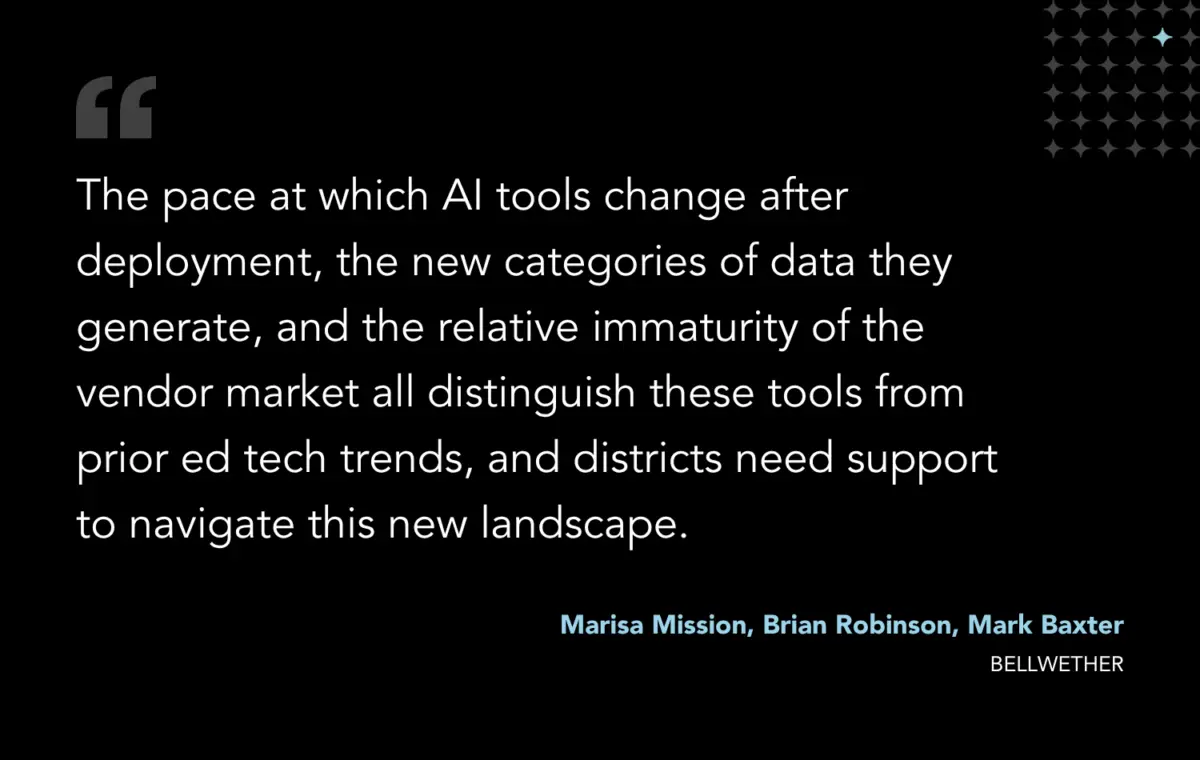
State Education Agencies and local districts are structurally unequipped to audit the inner workings of proprietary machine-learning models. Unlike traditional textbooks—which can be reviewed page-by-page by committees of veteran educators—AI tools are dynamic, adaptive, and black-boxed. They update algorithms automatically, generate infinite variations of content on the fly, and produce unprecedented categories of student interaction data. Expecting an understaffed district technology department to verify a vendor’s efficacy claims is akin to asking a community clinic to conduct a Phase III clinical trial for a novel pharmaceutical drug.
The Five Signals of Quality in Procurement
To solve this problem, state leaders must align their procurement guidelines with the five core signals of quality established in the Bellwether and PIE Network framework:
- Emphasis on Learning Outcomes, Not Technology Features: Vendors love to market cutting-edge capabilities—such as advanced neural networks or multimodal generative interfaces. Procurement policies must force a shift in conversation, requiring vendors to demonstrate how specific features directly correlate with measurable academic gains.
- Productive Struggle as a Primary Pathway for Learning: Poorly designed AI tools often rob students of the cognitive heavy lifting by providing immediate, step-by-step answers. High-quality AI acts as a Socratic tutor, scaffolding learning in a way that preserves "productive struggle"—the essential friction through which true mastery occurs.
- Sound Pedagogy and Coherence with Existing Instructional Practice: An AI tool cannot exist in a vacuum. It must align with established learning sciences and integrate smoothly into existing curricula, supporting teachers rather than adding cognitive overload or disrupting the classroom ecosystem.
- Technical Configurations Designed to Maximize Quality: State procurement frameworks should evaluate the underlying architecture of tools, ensuring they minimize algorithmic hallucinations, protect against data leakage, and maintain transparent guardrails around content generation.
- Attention to Market Sustainability and Long-Term Planning: The ed tech landscape is littered with bankrupt startups whose tools vanished mid-semester. States must evaluate whether vendors possess sustainable business models, equitable pricing structures, and long-term commitments to data stewardship.
Official Perspectives and Expert Analysis
Education reformers, policy advocates, and institutional leaders have increasingly voiced alarm over the disconnect between ed tech marketing and actual classroom utility.
"We are witnessing a gold rush mentality in educational technology unlike anything we have seen before," notes a senior policy researcher affiliated with the AI Policy Hub. "Districts are bombarded daily with pitches boasting about artificial intelligence. But when you strip away the tech-industry jargon, very few companies can point to rigorous, independent evidence that their tool improves student outcomes. States have the purchasing power and the regulatory reach to change this dynamic overnight."
Advocates point out that while cybersecurity, interoperability standards (such as those championed by Project Unicorn), and student safety guardrails remain non-negotiable baselines, treating them as the ceiling of procurement rather than the floor has left students vulnerable to subpar instruction.
Furthermore, educational economists emphasize that misallocated ed tech spending imposes severe opportunity costs. Every dollar spent on an expensive, ineffective adaptive software license is a dollar diverted from evidence-based interventions, such as high-dosage tutoring or smaller class sizes. By embedding quality signals into state-level purchasing frameworks, leaders can protect school budgets from predatory vendor contracts.
Future Outlook: The Road Ahead for State-Level AI Governance
As the dust settles on the initial wave of generative AI excitement, the K-12 education sector stands at a critical crossroads. The path forward requires moving past reactionary bans and superficial approval lists toward proactive, efficacy-driven governance.
State leaders looking to build robust, future-proof procurement ecosystems must take decisive action across three key domains:
- Establishing Clear Efficacy Standards: States must move beyond mere compliance checklists. By codifying the five signals of quality into state-level purchasing guidance, SEAs can signal to the market that flashiness will no longer substitute for proven instructional value.
- Fostering Regional Collaboration: Recognizing that individual districts lack auditing capacity, states should pool resources to create centralized evaluation clearinghouses. By partnering with research institutions and independent evaluation bodies, states can test and vet AI tools at scale.
- Empowering and Training Educators: Procurement reform is hollow if classroom teachers and instructional coaches are not trained to critically evaluate how digital tools impact student thinking. Professional development must evolve to include algorithmic literacy and pedagogical evaluation of digital media.
The integration of artificial intelligence into American classrooms is irreversible. Whether this technological revolution succeeds in narrowing achievement gaps or merely squanders another generation of instructional time depends entirely on the rigor of today’s policy decisions. By demanding proof of efficacy over impressive marketing, state leaders can ensure that the AI tools of tomorrow truly put student learning first.

