

Executive Overview
As artificial intelligence systems weave themselves deeper into the fabric of the global economy, a profound and paradoxical crisis is emerging in the modern workplace. While enterprises desperately seek human workers equipped with high-level cognitive capabilities—such as critical thinking, nuanced judgment, and the capacity to audit complex algorithms—these exact competencies are quietly being eroded at their source.
A comprehensive new global study from the IBM Institute for Business Value (IBV), titled "Designing the Thinking Organization," reveals a deeply unsettling trend: the very tools we deploy to maximize productivity may be slowly dismantling human expertise. Conducted in partnership with Oxford Economics between April and June 2026, the research highlights a widening chasm between executive aspirations and frontline realities. Although 80% of organizations boast sophisticated reskilling roadmaps, they are overwhelmingly designed to teach employees new ways to work alongside technology, utterly failing to protect the foundational cognitive skills that are currently withering away under the weight of automation.
The stakes could not be higher. More than half of surveyed employees (52%) report that their core daily responsibilities have shifted dramatically over the past year as generative and autonomous AI reshapes workflows. Yet, only 26% of enterprises have consciously mapped out how work should be divided between human-led, AI-assisted, and fully AI-executed tasks. This administrative vacuum means organizations are reactive rather than strategic, allowing day-to-day scrambling to replace deliberate architectural design. As critical thinking and professional judgment are increasingly sidelined by convenience, businesses face a looming existential question: Who will watch the machines when the human capacity to evaluate them has atrophied?
Detailed Chronology: The Unfolding of the AI Workforce Crisis
To understand how enterprises arrived at this precipice, it is necessary to examine the rapid acceleration of AI integration over recent years and how structural responses have lagged behind technological capabilities.

Phase One: The Acceleration of Adoption (2023–2024)
In the immediate aftermath of the generative AI boom, corporate leadership focused overwhelmingly on output velocity. The narrative was simple: integrate large language models and automated agents to scale operations, cut costs, and drive efficiency. During this initial gold rush, workforce strategy was largely reactionary. Companies rushed to purchase enterprise licenses and deploy software tools without a cohesive philosophy on how human roles would evolve. Training programs, where they existed, emphasized basic prompt engineering and tool navigation rather than deep critical assessment.
Phase Two: The Operational Disconnect (2025)
By 2025, the cracks in this high-speed rollout began to show. Day-to-day tasks began shifting underneath workers at a blistering pace. Employees found themselves acting as informal supervisors for autonomous systems they had never been trained to govern. However, executive suites remained detached from the operational friction on the ground. While leadership celebrated productivity metrics, employees experienced a creeping sense of alienation as routine analytical tasks were entirely swallowed by algorithms, depriving junior staff of the foundational "grunt work" that historically built deep institutional expertise and commercial judgment.
Phase Three: The Recognition of Skill Erosion (Spring–Summer 2026)
The release of the IBM and Oxford Economics study in mid-2026 marked a turning point in how corporate governance views the human-AI interface. Surveying 1,500 Chief Human Resources Officers (CHROs) and senior executives across 21 geographies and 23 industries, alongside 8,800 full-time employees in 28 countries, the study pierced the corporate optimism surrounding AI transformation.
For the first time, empirical data laid bare the reality of skill erosion—distinguishing it clearly from the traditional "skills gap." Executives woke up to the realization that providing workers with new tools does not prevent the cognitive rust that sets in when humans stop doing the heavy lifting of problem-solving. The data collected between April and June 2026 served as an urgent wake-up call: organizations are optimizing their tech stacks while inadvertently hollowing out their human capital.
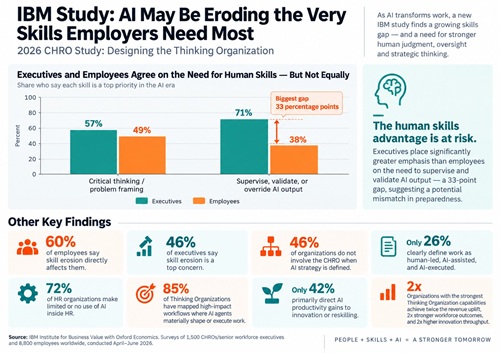
Supporting Context & Metrics: The Anatomy of a Disconnect
The empirical findings of the Designing the Thinking Organization report expose profound perceptual gaps between the executive suite and the workforce. These metrics illustrate not just a difference in opinion, but a fundamental misalignment in how value, risk, and responsibility are understood in an automated enterprise.
The Oversight Chasm
Perhaps the most alarming metric to emerge from the IBM study centers on the responsibility of validating AI outputs.
- 71% of executives prioritize the ability to supervise, validate, or override AI outputs as a paramount skill for the modern workforce.
- In stark contrast, only 38% of employees share this perspective, creating a massive 33-percentage-point gap in awareness regarding operational risk.
Furthermore, when evaluating professional judgment as a standalone capability, only 29% of employees rank it among their top priorities. This discrepancy suggests that while leadership views human workers as the ultimate quality-control safety net against algorithmic hallucinations or ethical drift, frontline workers may view AI systems as authoritative arbiters rather than tools that require constant scrutiny.
The Scale of Skill Erosion
The psychological and cognitive toll on the workforce is equally striking:

- 60% of employees report that skill erosion directly affects them, making it a pervasive anxiety across global markets.
- Among this group, three out of four employees (75%) state that AI has already measurably eroded at least some of their core professional capabilities, with critical thinking cited most frequently as the primary casualty.
- Concurrently, 46% of executives recognize skill erosion as a top-tier operational risk, though their policy responses remain largely fixated on traditional reskilling pipelines.
The Workflow Vacuum
The structural instability of the modern office is further highlighted by organizational readiness metrics:
- 52% of employees have experienced fundamental changes to their assigned daily tasks over the past twelve months.
- Yet, only 26% of organizations have established clear definitions dividing work across human-led, AI-assisted, and AI-executed activities.
This means that nearly three-quarters of enterprises are operating in a gray zone, where boundaries between human cognition and machine processing blur organically—usually to the detriment of human skill retention. Without deliberate architectural boundaries, employees naturally default to the path of least resistance, letting AI do the thinking until the human muscle for complex analysis withers away.
Official Statements and Industry Analysis
The implications of the IBM study have triggered widespread discussion among organizational psychologists, human resource leaders, and technological strategists.
In the official announcement accompanying the report, IBM underscored that the corporate approach to workforce development is suffering from a category error. Traditional enterprise programs focus heavily on the skills gap—identifying new technical capabilities that employees must acquire to operate next-generation software. However, these programs are fundamentally unequipped to handle skill erosion, which eats away at existing competencies.

"Eighty percent of enterprises have established reskilling roadmaps for their workforce to collaborate with technology," noted researchers in the analysis. "However, these frameworks address capabilities employees need to acquire, rather than safeguarding the foundational thinking skills that naturally diminish when automation takes over the underlying cognitive labor."
Management experts point out that historical workforce transitions—such as the shift from manual labor to industrial machinery, or from paper ledgers to early spreadsheets—always automated physical or repetitive tasks, leaving higher-order cognitive work to humans. The generative AI revolution, however, inverts this dynamic. By encroaching directly upon synthesis, writing, preliminary analysis, and coding, AI is cutting off the apprenticeship pipeline. Junior employees no longer spend years performing the foundational tasks that eventually forge senior-level judgment, creating a perilous leadership vacuum for the future.
Future Outlook: Designing the Thinking Organization
As businesses look toward the remainder of the decade, the findings from Oxford Economics and IBM offer both a warning and a strategic blueprint. Surviving the automation paradox will require organizations to fundamentally redesign how they cultivate human intelligence.
1. Moving Beyond Reactive Adaptation
Enterprises can no longer afford to let daily workflows evolve organically through ad-hoc tool adoption. Leadership must proactively map out organizational architecture. Defining clear demarcations between human-led, AI-assisted, and AI-executed activities will ensure that employees remain actively engaged in high-friction cognitive challenges rather than acting as passive passengers in automated pipelines.

2. Redefining Reskilling to Combat Erosion
Corporate learning and development (L&D) departments must pivot from teaching tool proficiency to preserving cognitive resilience. This means intentionally engineering "friction" back into workflows where necessary—creating environments where employees are forced to evaluate, critique, and occasionally override machine outputs rather than blindly accepting them. Training must elevate critical thinking and epistemological skepticism from nice-to-have traits to core operational competencies.
3. Closing the Executive-Employee Perception Gap
Bridging the 33-percentage-point divide on AI oversight requires transparent communication between the C-suite and the frontline. Employees must be thoroughly educated on the limitations, biases, and inherent risks of algorithmic systems. Cultivating a culture where workers feel confident—and professionally empowered—to challenge AI outputs is essential for long-term organizational safety and innovation.
Ultimately, the true measure of a successful AI transformation will not be how efficiently a company can replace human labor, but how effectively it can elevate human potential. If businesses fail to protect the cognitive foundations of their workforce, they may achieve short-term productivity gains only to discover they have built organizations incapable of independent thought.

