
Executive Overview
In the ever-evolving landscape of early childhood education, bridging the gap between physical activity and foundational cognitive development remains a paramount challenge for educators and parents alike. As winter approaches and shorter days offer children extended opportunities to observe the celestial night sky, innovative pedagogical tools are emerging to capture this natural curiosity. Among the most promising developments in early literacy resources is the Stars ABC Scavenger Hunt, an interactive, star-themed alphabet activity designed specifically for preschool, pre-kindergarten, and kindergarten learners.
Developed as part of a comprehensive yearlong series centered on kinetic learning, the Stars ABC Scavenger Hunt merges letter recognition with gross-motor movement. By transforming traditional, static desk work into dynamic spatial exploration, the program addresses a core developmental necessity: keeping young children active while fostering cognitive engagement. Whether deployed in a home-schooling environment or within a structured classroom setting, the activity provides a versatile framework for educators aiming to cultivate early literacy. This report explores the pedagogical foundations, structural components, practical implementation strategies, and broader educational implications of the Stars ABC Scavenger Hunt as it gains traction in classrooms and households nationwide.
Detailed Chronology and Program Evolution
The conceptualization of the Stars ABC Scavenger Hunt did not occur in a vacuum; it represents the culmination of years of iterative development within early childhood activity design.

The Shift Toward Kinesthetic Learning
Historically, early literacy instruction relied heavily on flashcards, worksheets, and passive visual recognition. However, over the past decade, cognitive science research has increasingly emphasized the benefits of embodied cognition—the theory that mental processes are deeply rooted in bodily interactions with the environment. Recognizing this, curriculum developers began designing systems that require children to physically move to acquire cognitive data.
Development of the Yearlong Series
The Stars ABC Scavenger Hunt is a key installment in a broader, yearlong initiative to create thematic, movement-based learning modules.
- Initial Phase: Early iterations focused on generalized outdoor and indoor searches, which quickly demonstrated high engagement metrics among children aged three to six.
- Thematic Integration: Recognizing that seasonal changes—such as the early winter nights—spark natural discussions about space, astronomy, and stars, developers formulated a celestial sub-brand.
- Release and Expansion: The program officially expanded to include dedicated recording sheets, differentiated card sets, and supplementary space-themed science lesson plans, making it easily accessible via major educational marketplaces like Teachers Pay Teachers and specialized early learning platforms.
Supporting Context & Metrics: The Science of Movement and Literacy
To understand why kinesthetic alphabet activities yield strong educational outcomes, one must examine the intersection of physical activity, cognitive development, and thematic curriculum integration.

The Power of Embodied Cognition in Pre-K
Young children possess an innate need for physical movement. Restricting this movement often leads to decreased attention spans and behavioral fatigue. By integrating letter recognition with a scavenger hunt, the activity transforms the classroom or home into an active learning laboratory.
- Cognitive Retention: Studies in educational psychology consistently show that children retain information better when multiple senses are engaged. Walking, searching, spotting, and coloring create multifaceted memory traces for each letter of the alphabet.
- Spatial Awareness: Navigating a room to locate specific letter cards enhances spatial reasoning, gross-motor coordination, and visual tracking skills—all of which are foundational for subsequent reading and writing proficiencies.
Seasonal Alignment: Capitalizing on Natural Curiosity
Winter provides a unique pedagogical window. Because darkness falls earlier in the evening, children naturally encounter the night sky with greater frequency than during long summer days. Teachers and parents can harness this cosmic fascination, using stars as an anchor for multidisciplinary units that bridge astronomy, literature, and foundational mathematics. The Stars ABC Scavenger Hunt serves as the linguistic bridge in these broader space units, ensuring that science exploration is directly reinforced by language arts practice.
Structural Anatomy: What is Included in the Pack?
The Stars ABC Scavenger Hunt is designed for immediate, frictionless deployment by educators and parents who may have limited preparation time. The program is structured into free sampling tiers and comprehensive full-packs, ensuring accessibility for diverse educational budgets.

1. The Recording Sheets
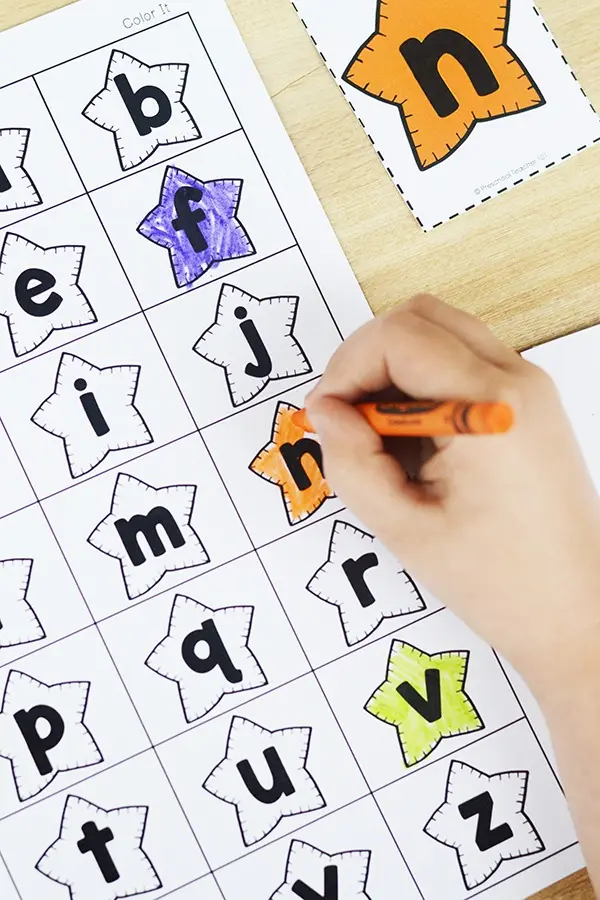
At the core of the activity are the star-themed recording sheets. These sheets feature the alphabet rendered with creative, celestial styling.
- Paper-Saving Versatility: Educators can easily laminate these sheets or slide them into reusable plastic dry-erase pouches. This transforms a single-use printable into a sustainable, multi-use classroom center.
- Interactive Coloring: As children discover hidden letter cards throughout the environment, they locate the corresponding symbol on their sheet and color it in, providing immediate visual reinforcement of task completion.
2. Large and Small Letter Cards
The kit provides versatile card sets that can be hidden in plain sight or integrated into sensory bins:
- Large Letter Cards: Ideal for whole-group games, wall displays, or large-scale room hunts where children must locate prominent typographic markers.
- Small Letter Cards: Perfectly scaled for tabletop matching games, sensory bin digs, or individualized desk-side intervention.
Implementation Strategies: Best Practices for Educators and Parents
One of the greatest strengths of the Stars ABC Scavenger Hunt is its inherent flexibility. It can be adapted to fit varying group sizes, developmental stages, and spatial constraints.

Differentiating Instruction
Not all children acquire literacy at the exact same pace. A rigid, one-size-fits-all curriculum often leaves advanced learners bored while overwhelming struggling students. The Stars ABC Scavenger Hunt allows for seamless differentiation:
- Targeted Learning: Educators do not need to scatter the entire alphabet at once. Teachers can select specific letter subsets—such as the letters found within a child’s specific name—to reduce cognitive overload.
- Scaffolding: For younger toddlers or early pre-schoolers, starting with a subset of 3 to 5 high-frequency letters builds confidence before introducing the full A-to-Z spectrum.
Indoor vs. Outdoor Execution
While classroom and home interiors offer controlled environments filled with furniture and hiding spots, the activity scales effortlessly to the outdoors. When weather permits, scattering the letter cards across a playground, garden, or courtyard infuses fresh air and wide-open movement into the learning process.
Official Statements and Pedagogical Philosophy
Educational specialists behind the development of the Stars ABC Scavenger Hunt emphasize that playful learning is not the antithesis of academic rigor; rather, it is its most effective vehicle.

"We designed these scavenger hunts because we noticed a critical gap in early education resources," notes an instructional design lead associated with the project. "Children learn best when they are physically engaged and emotionally invested in a narrative—in this case, exploring the cosmos and discovering stars. By stripping away dry, rote memorization and replacing it with purposeful play, we see dramatic increases in both student enthusiasm and alphabet retention."
Furthermore, early childhood literacy advocates stress the importance of low-prep, high-impact materials for modern educators. With teachers facing unprecedented time constraints, resources that require minimal preparation while offering maximum curricular alignment are viewed as essential tools for sustainable teaching.
Future Outlook: The Expansion of Kinesthetic Curricula
As educational paradigms continue to shift away from sedentary instruction toward holistic, brain-body compatible learning models, programs like the Stars ABC Scavenger Hunt point the way forward.

Integration with Comprehensive Lesson Plans
Looking ahead, developers are expanding these kinetic activities into fully integrated thematic lesson packs. These packages bundle literacy scavenger hunts with math counting exercises, science exploration guides (such as outer space centers), and fine-motor coordination tasks. By offering parallel versions tailored specifically for home-schooling families and institutional classroom teachers, publishers are ensuring that these resources meet the distinct operational needs of diverse educational environments.
The Digital-Physical Hybrid
While the primary medium of the Stars ABC Scavenger Hunt remains tactile and paper-based, future iterations aim to explore augmented reality (AR) integrations where children might use devices to "discover" virtual constellations and letters in physical space. However, the foundational emphasis on physical movement, tactile coloring, and interpersonal engagement will remain at the heart of the methodology.
Conclusion
The Stars ABC Scavenger Hunt is more than just a printable alphabet game; it is a thoughtfully engineered pedagogical tool that respects how young children naturally develop. By marrying the timeless wonder of the night sky with active, movement-based literacy instruction, it provides an invaluable resource for teachers and parents alike. Whether utilized to spark an interest in astronomy during the dark winter months or deployed as a dynamic daily alphabet center, this activity proves that when education is treated as an adventure, children will always rise to the challenge of reaching for the stars.

