
Executive Overview
As millions of K-12 students cross classroom thresholds each autumn, educators face a pivotal choice: proceed immediately to administrative logistics and syllabus reviews, or intentionally cultivate an environment grounded in psychological safety and social connection. Mounting research in developmental psychology and educational neuroscience indicates that the relational tone established during the initial days of the academic year dictates behavioral trajectories, student engagement, and academic performance for the subsequent ten months.
To address this critical window, Kim Harding, a leading Learning Specialist at the Michigan-based Van Andel Institute for Education (VAI), has outlined an actionable instructional paradigm known as "The Big 5." This framework posits that the first five days of school should not be viewed as an administrative warm-up, but rather as the essential foundational layer upon which all future learning rests.
Rooted in the core principle that cognitive engagement cannot occur without affective safety, Harding’s approach challenges traditional, compliance-driven classroom management strategies. By prioritizing intentional connection, explicit routine modeling, co-created classroom culture, and low-stakes inquiry during Week One, educators can dramatically reduce behavioral disruptions, boost retention, and establish an inclusive environment where curiosity, creativity, and critical thinking thrive.
Detailed Chronology: Deconstructing ‘The Big 5’ First-Week Framework
The first five days of school serve as a high-leverage period for setting operational and cultural norms. Below is an expanded day-by-day strategic breakdown of "The Big 5" model designed to maximize relational trust and operational efficiency.
       THE BIG 5 FIRST-WEEK PEDAGOGICAL ROADMAP
 ┌───────────────────────────────────────────────────────┐
 │ Day 1: Welcome & Connection (Psychological Safety)    │
 ├───────────────────────────────────────────────────────┤
 │ Day 2: Explicit Routine Modeling (Cognitive Offload)  │
 ├───────────────────────────────────────────────────────┤
 │ Day 3: Co-Creating Norms (Shared Ownership & Agency)  │
 ├───────────────────────────────────────────────────────┤
 │ Day 4: Cultivating Inquiry (Normalizing Risk-Taking) │
 ├───────────────────────────────────────────────────────┤
 │ Day 5: Synthesis & Collaborative Challenge            │
 └───────────────────────────────────────────────────────┘
Day 1 — Welcome & Connection: Establishing Psychological Safety
The primary objective of Day 1 is to eliminate social anxiety and signal to every student that they are valued, secure, and respected members of the learning community.
- Doorway Greetings: The educator greets every student individually at the threshold of the classroom before they step inside. This initial micro-interaction establishes personal rapport, allows the teacher to gauge emotional states, and immediately signals accessibility.
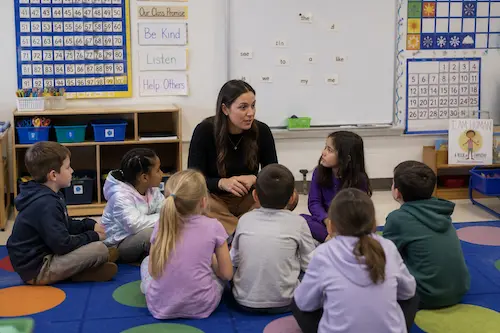
- Relational seating dynamics: Students are arranged in a physical circle—removing traditional desk barriers—to facilitate open eye contact and collective dialogue.
- Low-Anxiety Icebreakers: Rather than putting individual students on the spot with high-pressure presentations, educators facilitate low-stakes connection activities that highlight shared interests and mutual experiences.
- Predictability and Calm: Day 1 deliberately avoids heavy content diagnostic testing or rigid rule-recitation. The goal is to keep environmental stressors minimal, ensuring students depart on Day 1 feeling secure, seen, and eager to return.
Day 2 — Teaching the Routines: Operational Clarity and Cognitive Offload
Uncertainty breeds anxiety. Day 2 focuses on deconstructing classroom procedures into explicit, repeatable behaviors, shifting operational management from enforcement to transparent instruction.
- Step-by-Step Explicit Modeling: Teachers directly model daily procedures—ranging from entering the classroom, submitting assignments, and asking for help, to transitioning between group stations. The instructor narrates their actions in real-time, explaining the why behind each procedure.
- Examples vs. Non-Examples: Educators demonstrate both correct procedures and common missteps (often using lighthearted non-examples). This contrast clarifies expectations and removes ambiguity surrounding classroom mechanics.
- Guided Practice & Active Q&A: Students are given dedicated time to physically practice the routines within the space. Teachers deliberately leave space for questions, ensuring that spatial, procedural, and interpersonal norms are clearly understood.
- Eliminating Implicit Assumptions: Instructors proceed without assuming prior knowledge, recognizing that students come from diverse background environments with varying institutional norms.
Day 3 — Co-Creating Norms: Fostering Shared Ownership and Agency
On Day 3, the focus shifts from operational mechanics to democratic culture-building. Rather than imposing a top-down list of rules, educators guide students through a collaborative process of defining shared values.
- Defining the Ideal Environment: Students reflect on and discuss the question: "What conditions do we need in this space to feel supported, respected, and ready to learn?"
- Translating Values into Norms: Guided by the teacher, student responses are synthesized into 3–5 core values (e.g., mutual respect, active listening, freedom to fail).
- Drafting a Classroom Compact: The agreed-upon expectations are formulated into a shared charter or contract signed by all community members, creating collective accountability.
Day 4 — Cultivating Inquiry and Curiosity: Setting the Academic Mindset
With social safety and procedural clarity established, Day 4 introduces the cognitive expectations of the classroom through low-stakes inquiry and problem-solving.
- Introducing Low-Stakes Curiosity Prompts: Teachers present intriguing puzzles, open-ended questions, or hands-on challenges designed to spark curiosity without the fear of formal grading.
- Normalizing Productive Failure: Educators explicitly model how to handle wrong answers, reframing mistakes as vital data points in the learning process.
- Encouraging Critical Dialogue: Students engage in structured peer conversations, practicing how to disagree respectfully, ask clarifying questions, and build upon one another’s ideas.
Day 5 — Team Synthesis & Collaborative Challenge: Consolidating Culture
The final day of "The Big 5" integrates relational trust, procedural mechanics, and inquiry-based learning into a cohesive experience.
- Experiential Group Challenges: Students work in small teams to solve a practical or creative challenge (e.g., engineering a simple structure, solving a community scenario), applying the routines and behavioral norms established earlier in the week.
- Structured Reflection: The week concludes with guided metacognition. Students assess how well their teams adhered to co-created norms and reflect on their personal sense of belonging within the class.
- Celebrating Early Wins: Teachers acknowledge positive cultural benchmarks observed throughout the week, reinforcing momentum heading into standard curriculum delivery.
Supporting Context & Metrics: The Cognitive and Behavioral Science of Early Connection
The pedagogical rationale behind "The Big 5" is validated by empirical data across cognitive neuroscience, behavioral psychology, and educational economics.
The Neurobiology of Learning and Stress
When a student enters an unfamiliar or socially threatening environment, the amygdala activates the physiological stress response, releasing cortisol and adrenaline. In this state, the prefrontal cortex—the seat of executive function, working memory, and critical reasoning—is neurochemically compromised.
┌────────────────────────────────────────────────────────┐
│               THE NEUROLOGICAL CASCADE                 │
├────────────────────────────────────────────────────────┤
│ High Threat / Low Safety Environment                   │
│ └─► Amygdala Hyperactivation (Cortisol Spike)          │
│     └─► Impaired Prefrontal Cortex Function            │
│         └─► Reduced Working Memory & High Defensiveness│
├────────────────────────────────────────────────────────┤
│ High Safety / Relational Environment (The Big 5)       │
│ └─► Downregulated Stress Response                      │
│     └─► Prefrontal Cortex Engagement                   │
│         └─► Optimal Cognitive Processing & Curiosity   │
└────────────────────────────────────────────────────────┘
By dedicating the first five days of school to intentional relationship-building and clear routine-setting, educators lower student stress responses, preparing the brain for complex cognitive tasks.
Quantitative Impact on School Climate and Achievement
Educational research highlights the measurable benefits of prioritizing positive classroom climate and clear procedures during the opening weeks of school:
| Metric Category | Standard Pedagogical Model (Immediate Content Rush) | "Big 5" Relational Model (Structured Cultural Onboarding) | Long-Term Impact / Source |
|---|---|---|---|
| Teacher-Student Relationship Effect Size | Standard baseline interaction ($d = 0.20$) | High relational focus ($d = 0.52$) | Visible Learning Meta-Analysis (Hattie): Relational trust significantly exceeds the 0.40 threshold for accelerated learning. |
| Behavioral Discipline Referrals | Standard baseline referral rate | 35%–50% reduction in disciplinary incidents | Journal of Educational Psychology: Proactive routine instruction drastically reduces classroom disruption. |
| Chronic Absenteeism Rates | Elevated drop-off among high-risk demographics | 18%–24% increase in student attendance metrics | CASEL Longitudinal Reports: Strong initial sense of school belonging directly drives consistent attendance. |
| Instructional Time Saved | Loss of 10–15 mins/period handling procedural confusion | Recovery of up to 40 hours of academic learning time annually | EdWeek Research Center: Upfront investment in procedures minimizes daily operational friction long-term. |
Official Statements and Expert Analysis
The philosophy driving "The Big 5" represents a structural shift in professional development for educators nationwide. Experts emphasize that affective engagement is not an alternative to academic rigor, but its prerequisite.
"Kids don’t care about your expectations until they know you care about them. Connection is the foundation everything else stands on."
— Kim Harding, Learning Specialist at Van Andel Institute for Education
Harding stresses that teachers often fall into the trap of assuming students already understand how to navigate specific educational spaces.
"Students decide very quickly when they walk into a classroom whether that space feels safe, calm, and worth engaging with," Harding emphasizes. "The attitudes and impressions they form during the first week of school direct their actions for the rest of the year. When we teach routines out loud using clear examples and non-examples, and when we create spaces where students feel truly seen, we eliminate the guesswork that causes behavioral friction."
Leadership at the Van Andel Institute for Education (VAI) underlines that this approach directly supports their broader mission: fostering educational ecosystems where curiosity, creativity, and critical thinking can thrive without inhibition.
       VAN ANDEL INSTITUTE FOR EDUCATION (VAI) CORE PILLARS
 ┌──────────────────────────────────────────────────────────────┐
 │                        CURIOSITY                             │
 │  Encouraging natural inquiry by removing fear of failure.    │
 ├──────────────────────────────────────────────────────────────┤
 │                        CREATIVITY                            │
 │  Fostering open-ended problem solving and agency.            │
 ├──────────────────────────────────────────────────────────────┤
 │                    CRITICAL THINKING                         │
 │  Building rigorous analytical skills on a foundation of safety.│
 └──────────────────────────────────────────────────────────────┘
Instructional specialists point out that when schools fail to allocate time for culture-building during the initial week, they inevitably spend disproportionate time later in the semester managing disciplinary issues, operational misunderstandings, and student disengagement.
Future Outlook: Reimagining School Climate and Pedagogical Standards
As school systems face systemic challenges—including elevated post-pandemic chronic absenteeism, worsening student mental health crises, and high teacher turnover—the need for structured, relational frameworks like "The Big 5" becomes increasingly urgent.
Systemic Implementation Trends
- District-Wide Onboarding Frameworks: Forward-thinking school districts are moving away from traditional, content-heavy syllabus mandates for Week One. Instead, administrative teams are officially adopting "First Five Days" curricula, providing teachers with standardized time and resources to establish strong classroom cultures.
- Integration of Social-Emotional Learning (SEL) with Academic Design: School leadership increasingly recognizes that SEL cannot exist as an isolated, 15-minute weekly module. Frameworks like "The Big 5" embed relational safety and self-regulation directly into daily classroom management and instructional design.
- Teacher Retention and Burnout Mitigation: Operational friction and continuous classroom management challenges remain leading drivers of educator burnout. By equipping teachers with proactive techniques to establish clarity and rapport immediately, school districts report improvements in teacher job satisfaction and retention rates.
The Path Forward
The opening week of school is more than an entry on the academic calendar; it is a high-leverage opportunity to reshape the educational experience. By adopting Kim Harding’s "Big 5" methodology, educators move past reactive discipline toward a proactive, community-centered model.
When schools honor the fundamental truth that student connection precedes cognitive performance, they create classrooms that are not merely spaces of compliance, but vibrant communities where learning, discovery, and growth naturally occur.

