The integration of artificial intelligence into primary and secondary education has transitioned from a speculative technological frontier to a daily classroom reality. Tools like ChatGPT and other generative language models now occupy a complex space in the modern school ecosystem. For overextended educators, these platforms serve as immediate digital assistants—generating lesson plans, differentiating text for struggling readers, and reclaiming evenings previously lost to administrative grading. Simultaneously, they introduce urgent challenges regarding academic integrity, systemic over-reliance, and the perpetuation of outdated or fabricated information.
Rather than signaling the obsolescence of the human educator, artificial intelligence has underscored the irreplaceable value of pedagogical judgment, emotional intelligence, and critical oversight. As educational institutions grapple with fragmented policies—ranging from total prohibitions to proactive integration—the consensus among pedagogical experts is shifting. Blanket bans are increasingly viewed as ineffective and counterproductive. Instead, the focus is moving toward digital literacy: teaching students to treat AI outputs not as authoritative truths, but as rough drafts that demand rigorous, human-led verification.
Detailed Chronology: The Rapid Descent of AI into K-12 Schools
The arrival of generative artificial intelligence in classrooms did not follow the traditional, deliberate trajectory of educational technology adoption. Unlike smartboards, learning management systems, or even standard tablet computing, which underwent years of pilot programs, procurement reviews, and professional development cycles, generative AI burst into the public consciousness almost overnight with the late 2022 release of ChatGPT.
Phase One: The Shock Wave and the Era of Prohibitions (Late 2022 – Early 2023)
When generative text tools first became widely accessible, the immediate reaction across many school districts was alarm. Major urban school systems rushed to block access to ChatGPT on district networks and school-issued devices. The primary catalysts for these early bans were fears of rampant, sophisticated plagiarism and the erosion of foundational writing skills. Educators found themselves thrust onto the front lines of an unannounced technological revolution without pedagogical frameworks, institutional guidelines, or user manuals. During this initial phase, AI was largely framed as an adversary to academic honesty—a ghostwriter in the machine capable of producing five-paragraph essays in seconds without student comprehension.
Phase Two: The Shift Toward Digital Literacy and Productivity (Mid 2023 – 2024)
As the technological landscape matured, it became clear that network-level blocks were easily bypassed and ultimately counterproductive. Students were experimenting with these tools at home, rendering school-level prohibitions porous at best. Education researchers, policymakers, and teacher advocacy groups began advocating for a paradigm shift. Influenced by insights from organizations like the U.S. Department of Education’s Office of Educational Technology, the conversation pivoted from policing AI to cultivating digital fluency.
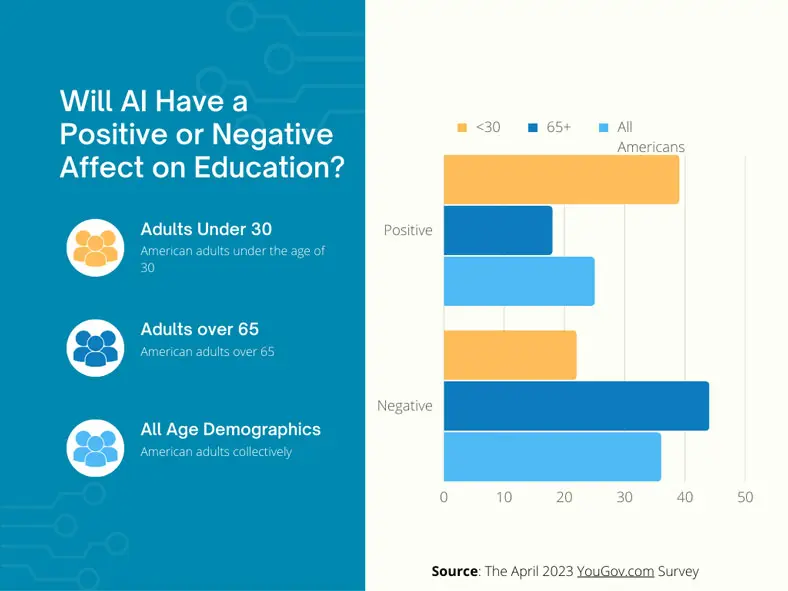
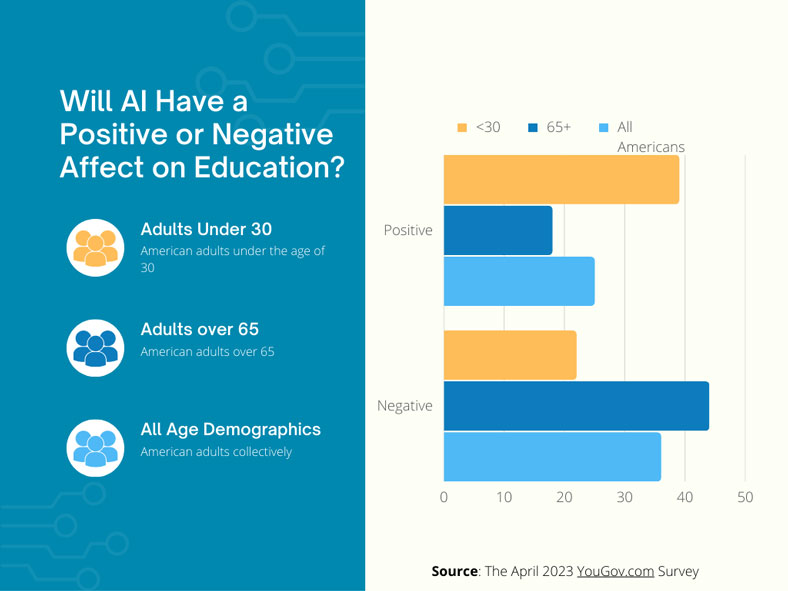
Tech industry leaders, including OpenAI CEO Sam Altman, frequently drew parallels between generative AI and historical technological disruptions, such as the introduction of the handheld calculator. Just as mathematics education adapted to embrace calculators by shifting evaluation metrics away from rote computation toward conceptual understanding, educators began exploring how writing and critical thinking instruction must evolve. National surveys from this period, including data from YouGov, revealed a public appetite for constructive adaptation: a majority of U.S. adults expressed that schools should focus on teaching students to use AI appropriately rather than attempting to ban its use outright.
Today, the educational landscape is characterized by nuanced, albeit fragmented, integration. District policies vary widely, creating a patchwork of rules where expectations can shift drastically from one classroom to the next. Educators are increasingly utilizing AI as a high-speed drafting partner rather than a replacement for instructional design. Meanwhile, publishers, ed-tech companies, and administrative bodies are working to formalize ethical guidelines, data privacy standards, and frameworks for responsible use. The debate is no longer about whether AI belongs in schools, but rather how to maintain human-centric teaching standards in an automated world.
Supporting Context & Metrics: The Current State of the Profession
Understanding the friction points of AI adoption requires examining the broader socioeconomic and operational realities facing modern educators. Classrooms are grappling with high workloads, shifting curriculum standards, and persistent staffing dynamics.
Teacher Compensation and Labor Market Metrics
According to data compiled by the U.S. Bureau of Labor Statistics (BLS) and employment projections agencies, the financial reality of the teaching profession provides vital context for why educators seek out productivity-enhancing tools. As of May 2025, the national median annual salaries for educators stood at:
Elementary School Teachers: $63,820
Middle School Teachers: $64,370
High School Teachers: $72,040
While these figures serve as national baselines, compensation varies significantly by state, local district funding, and individual years of service. Concurrently, labor projections from resources such as Projections Central indicate that while employment across several core K-12 teaching roles will experience modest shifts through 2034, substantial annual job openings remain guaranteed. These openings are driven primarily by natural labor force attrition—including retirements and career transitions—rather than technological displacement.
Where AI Actually Serves the Classroom
When integrated thoughtfully, artificial intelligence functions as an accessible virtual teaching assistant. Educators have harnessed generative tools across several key operational areas:
Lesson Planning and Resource Generation: Drafting foundational outlines, brainstorming interdisciplinary project ideas, and generating tiered reading lists can be accomplished in seconds, drastically reducing administrative overhead.
Differentiation and Personalized Practice: For students struggling with complex concepts or specialized learning needs, AI allows teachers to instantly rephrase textbook explanations, adjust reading levels, or generate customized practice problem sets tailored to individual learning paces.
Formative Assessment and Brainstorming: Educators use AI to construct diverse discussion prompts that challenge students to analyze textual tone and structure, while students leverage the technology as an interactive sounding board for outlining essays and exploring alternative perspectives.
The Limits of Automation: Where AI Falls Short
Despite its processing speed, generative AI suffers from intrinsic vulnerabilities that demand constant human vigilance:
Hallucinations and Inaccuracy: Chatbots frequently generate plausible-sounding falsehoods, incorrect dates, and fabricated citations. Accepting AI output without verification risks embedding misinformation directly into curricula.
Academic Integrity and Detection Hurdles: Plagiarism remains a profound challenge. While detection software (such as Winston AI and Turnitin) exists to flag potential machine-generated text, these systems are imperfect, producing both false positives and false negatives. Major detection developers explicitly warn that their tools should never serve as the sole basis for disciplinary action against a student.
Official Statements & Institutional Perspectives
The institutional response to artificial intelligence in education has evolved from cautious skepticism to structured guidance.
The U.S. Department of Education’s Office of Educational Technology has consistently emphasized that while AI holds immense potential to alleviate educator burnout and personalize learning, its deployment must be strictly governed by principles of equity, data privacy, and human oversight. Federal frameworks stress that technology must augment human relationships in the classroom, not displace them.
Educational researchers and veteran educators, such as curriculum specialist Amanda R. Castillo, M.Ed., emphasize the irreplaceable nature of human intuition:
"AI can generate text, images, and practice materials, but it can’t observe a student’s needs over time, build the relationship that makes an intervention land, or exercise the judgment a classroom requires minute to minute."
Furthermore, academic institutions and integrity boards emphasize that the vulnerabilities of AI can be directly converted into powerful pedagogical opportunities. Rather than shielding students from flawed outputs, forward-thinking educators are designing classroom activities where students are tasked with auditing, fact-checking, and debunking AI-generated text. This transforms the tool’s weaknesses into a practical masterclass in media literacy and critical research skills.
Future Outlook: The Horizon of AI in Education
Looking toward the next decade, the trajectory of artificial intelligence in K-12 and higher education will likely be defined by maturation, policy standardization, and specialized tool development.
Moving Beyond General-Purpose Chatbots
The current reliance on general-purpose models like ChatGPT will likely give way to education-specific AI architectures. These future systems will be engineered with rigorous data privacy guardrails (such as compliance with FERPA and COPPA), integrated directly into secure Learning Management Systems (LMS), and pre-vetted for curricular alignment. This transition will minimize the security and privacy risks associated with open-web consumer applications.
Professional Development as a Standard Requirement
As school districts formalize their expectations around educational technology, professional development programs will increasingly incorporate AI literacy modules. Teachers will not be expected to become software engineers, but rather proficient orchestrators of hybrid learning environments. Collaborative planning workshops—where educators share practical workflows for what AI can reliably automate (such as first-draft newsletters or differentiated worksheets) versus what demands intensive human attention (such as qualitative grading and emotional support)—will become standard practice.
The Immutable Core of Teaching
Ultimately, the future outlook affirms that the heart of education is relational, not transactional. While algorithms will continue to optimize the administrative mechanics of schooling, they cannot replicate the empathetic observation, mentorship, and ethical grounding provided by a human teacher. By establishing clear boundaries, embracing a continuous habit of fact-checking, and treating artificial intelligence as a sophisticated assistant rather than an oracle, modern education can harness these technological advancements while preserving the essential human judgment that defines great teaching.