

Executive Overview
As artificial intelligence transitions from static predictive models to autonomous, goal-directed AI agents capable of executing complex workflows, the attack surface of the modern enterprise has fundamentally shifted. Recognizing that traditional perimeter security and model-centric safeguards are no longer sufficient, a coalition of 37 industry-leading technology, cloud computing, cybersecurity, and enterprise software organizations has formally launched the Open Secure AI Alliance.
Spearheaded by NVIDIA alongside an unprecedented roster of founding members—including Microsoft, IBM, Cisco, Cloudflare, CrowdStrike, Hewlett Packard Enterprise (HPE), Red Hat, Salesforce, and the Linux Foundation—the alliance is designed to construct a unified, open-source defense stack tailored specifically for the infrastructure surrounding AI agents. Rather than focusing myopically on the vulnerabilities of the core AI models themselves, the initiative targets the operational scaffolding that empowers agents to act: identity management, access permissions, runtime isolation, execution harnesses, guardrails, logging systems, and evaluation frameworks.
The launch marks a pivotal philosophical pivot for the enterprise technology sector. For years, the race to deploy generative AI outpaced the development of native security controls, leading to fragmented, proprietary patch-jobs that often introduced single points of failure. The Open Secure AI Alliance asserts that because open source fundamentally underpins modern cloud computing, the defense mechanisms protecting autonomous AI workloads must similarly be transparent, inspectable, adaptable, and deployable across infrastructure controlled entirely by the enterprise.
By integrating established cloud-native zero-trust standards—such as the Secure Production Identity Framework for Everyone (SPIFFE) and the SPIRE runtime—into the agent layer, the alliance aims to establish cryptographic verifiability for autonomous software. This in-depth report explores the architectural ambitions of the Open Secure AI Alliance, the core infrastructure challenges it seeks to resolve, the strategic contributions of its founding members, and what this collaborative effort means for the future of enterprise cybersecurity.
Detailed Chronology and Genesis of the Alliance
The formation of the Open Secure AI Alliance did not happen in a vacuum; it is the culmination of years of escalating security anxieties within enterprise IT departments as autonomous agents began moving out of sandboxed research environments and directly into production corporate networks.
Phase 1: The Rise of Autonomous Workloads and Fragmented Defenses
Throughout 2024 and 2025, enterprise adoption shifted rapidly from basic Retrieval-Augmented Generation (RAG) applications to multi-agent ecosystems. These AI agents were given access to APIs, databases, CI/CD pipelines, and employee credential stores to execute multi-step business processes autonomously.

However, this operational leap laid bare a severe architectural vulnerability. While security researchers extensively documented risks like prompt injection, data poisoning, and model weight extraction, organizations quickly realized that the greatest threat came from the surrounding infrastructure. An agent compromised by a malicious payload could manipulate internal APIs, exfiltrate sensitive customer records, or escalate privileges across cloud environments simply because the infrastructure lacked fine-grained, dynamic identity verification capable of keeping pace with autonomous software.
During this period, individual cloud providers, cybersecurity vendors, and enterprise software giants rushed to market with proprietary security guardrails. The result was an uncoordinated patchwork of point solutions. Enterprises found themselves attempting to stitch together custom logging frameworks, disparate permission models, and vendor-locked isolation layers that frequently conflicted with one another, creating massive operational blind spots and severe single points of failure.
Phase 2: Coalition Building and the Open-Source Mandate
Recognizing that no single vendor possessed the breadth required to secure the entire multi-vendor AI supply chain, NVIDIA and other key industry stakeholders began drafting the blueprint for a collaborative, open-source countermeasures initiative in early 2026.
The core architects of the alliance recognized a historical parallel: the transformation of cloud computing itself. Just as Linux and open-source infrastructure became the non-negotiable foundation of the modern cloud because users demanded transparency, auditability, and control, the security stack for AI agents required an identical open ethos. Defenders needed systems they could inspect, modify, and run on infrastructure under their direct sovereign control.
Phase 3: The Formal Launch
In July 2026, the initiative transitioned from behind-the-scenes engineering discussions to a formal public launch. NVIDIA, alongside 36 inaugural partners—including cloud titans, database leaders, networking giants, and open-source stewards—officially unveiled the Open Secure AI Alliance.
The initial roster read like a "who’s who" of the global technology sector: Adobe, Capital One, Cisco, Cloudera, Cloudflare, CrowdStrike, Databricks, Dell Technologies, HPE, Hugging Face, IBM, the Linux Foundation, Microsoft, NetApp, Palo Alto Networks, Red Hat, Salesforce, SAP, ServiceNow, Siemens, Snowflake, and Synopsys.
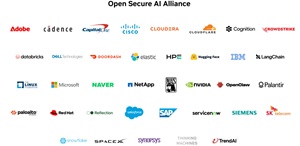
While the alliance’s stated objective is ambitious—building an open defense stack for autonomous agents—the launch intentionally refrained from announcing a single, monolithic integrated platform, a rigid reference architecture, or a definitive commercial release schedule. Instead, the initiative positioned itself as an open collaboration framework, inviting the broader engineering community to contribute code, standards, and architectural patterns to secure the agentic era.
Supporting Context, Architecture, and Technical Mechanics
To understand the profound technical implications of the Open Secure AI Alliance, one must examine how it shifts traditional cloud security paradigms upward, directly into the agent layer.
Moving Beyond Model-Centric Security
Historically, discussions surrounding AI security have focused almost exclusively on the machine learning models themselves. Organizations obsessed over safeguarding model weights, preventing adversarial prompt injection, and filtering toxic outputs.
However, the Open Secure AI Alliance fundamentally re-centers the security conversation on the infrastructure surrounding the agent. An AI agent in an enterprise environment is rarely a standalone model; it is a complex orchestration of components:
- The Core Model: The foundational LLM generating text or decisions.
- Harnesses and Runtimes: The execution environments that manage the agent’s control flow, tool usage, and memory.
- Guardrails: Interceptors that evaluate inputs and outputs for policy compliance.
- Permissions and APIs: The programmatic bridges allowing the agent to read databases, execute code, or send communications.
- Evaluation and Logging Systems: The observability mechanisms tracking why an agent made a specific decision.
If any of these peripheral components are compromised, the security of the underlying model becomes entirely irrelevant. An attacker does not need to crack the neural network if they can hijack the agent’s execution harness to run arbitrary shell commands or exfiltrate database tokens.
Bringing Cloud Workload Identity to the Agent Layer
One of the most concrete architectural pillars revealed during the alliance’s launch is the integration of cloud-native zero-trust identity frameworks into the AI agent layer, spearheaded heavily by Hewlett Packard Enterprise (HPE) through its work with SPIFFE (Secure Production Identity Framework for Everyone) and SPIRE (SPIFFE Runtime Environment).

In modern cloud-native architectures, SPIFFE and SPIRE have become the gold standard for authenticating microservices. SPIFFE defines an open standard for issuing platform-independent cryptographic identities to software services, while SPIRE acts as the runtime implementation that verifies and attests to the identity of those services across heterogeneous environments.
By bringing SPIFFE and SPIRE into the Open Secure AI Alliance, founding members are solving a critical identity crisis: How do you cryptographically verify that an autonomous AI agent is who it claims to be, and ensure that only authorized workloads communicate with one another?
+-----------------------------------------------------------------+
                 Open Secure AI Alliance Defense Stack
+-----------------------------------------------------------------+
|                         AI Agent Layer                          |
|  - Autonomous Decision-Making Workloads                         |
|  - Agent Harnesses & Tool-Calling Frameworks                    |
+-----------------------------------------------------------------+
                                  │
                                  ▼
+-----------------------------------------------------------------+
|                 Identity & Cryptographic Attestation            |
|  - SPIFFE/SPIRE Zero-Trust Identity Control Plane               |
|  - Mutual TLS (mTLS) Service-to-Service Authentication           |
+-----------------------------------------------------------------+
                                  │
                                  ▼
+-----------------------------------------------------------------+
|               Multi-Vendor Enterprise Infrastructure            |
|  - Public Clouds (AWS, Azure, GCP)                              |
|  - Private Data Centers & Kubernetes Clusters                   |
+-----------------------------------------------------------------+
In a traditional application, a user logs in with multi-factor authentication, receives a session token, and accesses a database. In an agentic workflow, an AI agent may spin up sub-agents, delegate tasks to external APIs, query remote vector databases, and execute code in isolated containers—all without direct human intervention.
Without cryptographic identity at the agent layer, rogue processes or malicious actors can easily spoof legitimate agents, intercept inter-agent communications, or perform unauthorized lateral movement across the enterprise network.
How SPIFFE/SPIRE Secures AI Agents
Through the integration championed by HPE and supported across the alliance, SPIFFE and SPIRE provide a uniform identity control plane for modern, heterogeneous infrastructure—spanning virtual machines in public clouds, on-premises private data centers, and containerized Kubernetes clusters.
- Cryptographic Attestation: Before an AI agent is permitted to access sensitive enterprise data or execute a privileged API call, the SPIRE runtime cryptographically verifies the agent’s workload identity, checking its binary integrity, container image, and hosting environment.
- Zero-Trust Microsegmentation: Once verified, the agent is issued a short-lived, cryptographically secure SPIFFE ID (formatted as a URI, e.g.,
spiffe://enterprise.com/ns/ai-agents/prod/customer-support). This ID governs its communication via mutual TLS (mTLS) with other services. - Ecosystem Interoperability: Because SPIFFE/SPIRE integrates natively with cloud-native tooling such as Istio, Envoy, HashiCorp Consul, Open Policy Agent (OPA), and Sigstore, enterprise security teams can apply existing zero-trust network policies directly to AI agent workflows without reinventing the wheel.
By decoupling identity from underlying cloud vendor lock-in, the alliance ensures that an enterprise can run multi-vendor AI pipelines across AWS, Azure, Google Cloud, and private bare-metal servers while maintaining an unbroken, verifiable chain of trust.

Official Statements and Industry Perspectives
The formation of the Open Secure AI Alliance elicited strong endorsements from executives across the technology spectrum, underscoring the urgency and collaborative spirit driving the initiative.
NVIDIA emphasized the foundational necessity of open infrastructure in its official alliance announcement, stating:
"Open source underpins cloud computing, and defenders need systems they can inspect, adapt, and run on infrastructure they control. Security systems must work across a multi-vendor ecosystem and avoid a single point of failure."
This sentiment was echoed by Hewlett Packard Enterprise in its statement detailing its contributions to the alliance. HPE highlighted the complex, multi-layered nature of modern generative deployments:
"Modern AI systems depend on agent frameworks, harnesses, guardrails, governance mechanisms, and models that interact with complex enterprise environments. Integrating zero-trust identity standards like SPIFFE and SPIRE provides the foundational verification methods required to secure agents, services, and workloads as they operate across dynamic corporate networks."
Cybersecurity heavywaters within the alliance also weighed in on the operational realities facing modern SOC (Security Operations Center) teams. Representatives from founding cybersecurity firms noted that while enterprises have spent decades mastering identity and access management (IAM) for human users and traditional web applications, the rapid influx of autonomous software agents has created an unprecedented governance vacuum. By uniting cloud providers, software vendors, and infrastructure architects under a single open banner, the alliance bridges the dangerous gap between AI development teams and enterprise security operations.
Future Outlook: Challenges and Strategic Roadmap
As the Open Secure AI Alliance embarks on its mission to build an open defense stack for autonomous software, it faces significant challenges, alongside immense opportunities to reshape enterprise IT security for the next decade.
1. Moving from Principles to Code
While the roster of 37 inaugural partners represents an extraordinary concentration of technical talent and market influence, the alliance’s immediate hurdle is execution. Because the initial launch did not include a single integrated platform, fixed reference architecture, or rigid release schedule, skeptics may view the initiative as a marketing consortium rather than an engineering body. To maintain momentum, the alliance must rapidly translate its broad architectural principles into tangible open-source repositories, standardized APIs, and interoperable reference implementations that developers can immediately deploy.
2. Overcoming Enterprise Inertia and Vendor Friction
Securing the agent layer requires bridging disparate enterprise silos. Data science teams, who prioritize speed, model accuracy, and rapid experimentation, have historically clashed with cybersecurity and infrastructure teams, who prioritize strict governance, least-privilege access, and zero-trust verification. The alliance must provide tooling that is frictionless enough for developers to adopt organically, yet rigorous enough to satisfy corporate compliance officers and CISOs.
3. The Threat Landscape Ahead
Looking toward the late 2020s, the sophistication of cyberattacks targeting AI systems will scale exponentially. Threat actors will increasingly move away from crude prompt injection attacks and toward sophisticated, multi-stage campaigns targeting the very agent harnesses, orchestration layers, and identity pipelines that the Open Secure AI Alliance aims to protect.
If the alliance succeeds in establishing a universal, open-source defense stack anchored by cryptographic zero-trust identity standards like SPIFFE/SPIRE, it will fundamentally alter the trajectory of enterprise AI. Organizations will be able to deploy autonomous, multi-agent ecosystems with the confidence that their infrastructure is inspectable, resilient, multi-vendor compatible, and unyielding in the face of sophisticated adversarial threats. The era of securing AI models in isolation is over; the era of securing the sovereign agentic infrastructure has officially begun.

