
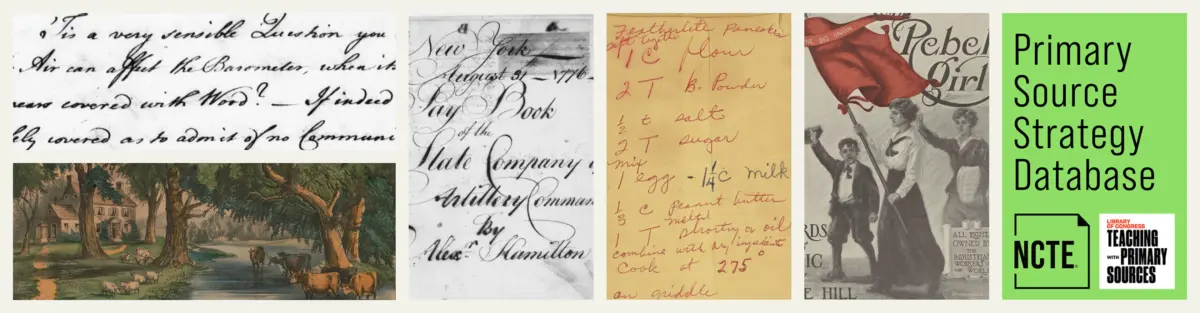
In an era defined by digital saturation, shifting cultural narratives, and an urgent demand for critical media literacy, educators face unprecedented challenges in teaching students how to parse information. To combat superficial reading habits and foster deep, analytical thinking, the National Council of Teachers of English (NCTE) has deepened its collaborative partnership with the Library of Congress. Operating under the umbrella of the prestigious Teaching with Primary Sources (TPS) Consortium, this joint initiative aims to fundamentally transform how English language arts (ELA) and literacy teachers incorporate digitized primary sources into their daily classroom routines.
At the heart of this national initiative lies a dynamic, searchable database designed by more than two dozen educators and ELA leaders. This repository houses pedagogical strategies for over 150 specific artifacts drawn directly from the Library of Congress’s vast digitized holdings. Rather than treating history as a static sequence of dates and dead names, the database articulates the explicit literacy value of each item, complete with suggested themes, thematic units, and rigorous state standard alignments. Content is easily navigated through intuitive tags such as picturebook, argument, advertising, and media analysis.
Among the crown jewels of this repository is an in-depth instructional module centered on the 1957 promotional video In the Suburbs, produced by Redbook magazine. Preserved within the Library of Congress collections and cataloged under digital ID 2019600440, this short film offers a fascinating window into post–World War II America. By examining how mid-century media constructed and perpetuated ideals of the "American Dream," gender roles, and consumerism, educators can leverage this artifact to sharpen students’ visual and textual analysis skills.
This article provides an exhaustive exploration of the NCTE-Library of Congress collaboration, a detailed breakdown of the In the Suburbs instructional framework, the historical and economic context surrounding the primary source, relevant educational standards, and a forward-looking perspective on the evolution of primary source integration in American classrooms.
Detailed Chronology: The Evolution of the NCTE and Library of Congress Partnership
To understand the scope of the current digital database, one must trace the trajectory of institutional collaboration between the nation’s leading English teachers’ organization and its premier cultural institution.
The Foundation of the TPS Consortium
The Teaching with Primary Sources Consortium was established by the Library of Congress to expand the footprint of its archival treasures beyond academic researchers and into K-12 classrooms. Recognizing that historical documents, photographs, audio recordings, and films possess immense untapped potential for developing reading comprehension and critical thinking, the Library partnered with educational organizations across the United States.
The NCTE joined this collaborative network to bring its unique pedagogical expertise to the table. While historians often view primary sources through the lens of chronology and causation, ELA teachers approach them as texts—objects of rhetoric, persuasion, and cultural production. This intersection of historical inquiry and literacy instruction formed the bedrock of the NCTE’s contribution to the TPS program.
Developing the Searchable Database
Over the past several years, the NCTE mobilized teams of expert educators, curriculum developers, and classroom teachers to review items from the Library of Congress’s digital archives. Their mission was twofold:
- Identify artifacts with high instructional value for contemporary ELA curricula.
- Draft comprehensive teaching rationales that connect historical artifacts to modern educational standards, essential questions, and cross-curricular themes.
The resulting database is not merely a static list of links; it is a living, searchable toolkit. Teachers searching for materials on rhetorical strategies or consumer persuasion can filter results by tags, instantly accessing curated lessons that bridge historical context with contemporary media literacy.
Spotlight on In the Suburbs (1957)
Within this expansive database, specific artifacts have been selected for deep-dive curricular integration. One such artifact is the 1957 promotional video In the Suburbs, created by Redbook magazine and produced by Carlo Arcamone, Tracy Ward, and Bert Spielvogel (through On Film, Inc.).
Originally designed as a marketing tool to highlight the shifting demographic and economic landscapes of the 1950s, the video captures the zenith of the post-war suburban migration. By integrating this video into high school ELA classrooms, educators are equipped with a primary source that moves beyond traditional print texts, allowing students to "read" moving images, analyze mid-century advertising rhetoric, and interrogate the cultural machinery that manufactured consensus during the Eisenhower administration.
Supporting Context & Metrics: Decoding Mid-Century Suburbia
To effectively teach In the Suburbs (1957), educators must contextualize the artifact within the broader socioeconomic tapestry of post–World War II America. The video is not a neutral documentary; it is a commercial artifact designed to sell a specific lifestyle—and, by extension, consumer goods—to a burgeoning middle class.
The Post-War Economic Boom and the Rise of Suburbia
Following the conclusion of World War II in 1945, the United States experienced an unprecedented economic expansion. Soldiers returning home from the front lines sought to build families, find stable employment, and secure permanent housing. This demographic explosion, famously known as the Baby Boom, coincided with federal incentives such as the GI Bill, which provided returning veterans with low-interest mortgages and educational subsidies.
Simultaneously, the widespread adoption of the automobile and federal investments in the Interstate Highway System fueled massive suburbanization. Communities like Levittown in New York transformed agrarian landscapes into uniform tracts of single-family homes. In the Suburbs captures this physical transformation while romanticizing the psychological shift that accompanied it.
Consumerism, Gender Roles, and the American Dream
The 1957 video produced by Redbook magazine reflects the dominant cultural norms of the era, which heavily emphasized nuclear family structures and traditional gender roles. In the idealized suburban narrative presented by mid-century media:
- The Husband/Provider: Responsible for commuting to the urban core, earning a steady corporate or blue-collar wage, and fulfilling the role of the financial breadwinner.
- The Wife/Homemaker: Centered within the domestic sphere, managing the household, raising children, and utilizing modern domestic appliances designed to streamline housework.
- The Consumer: Both roles were inextricably tied to consumption. Homeownership was marketed not merely as shelter, but as the ultimate validation of civic virtue and economic success. Purchasing lawnmowers, kitchen gadgets, and station wagons became moral imperatives within the consumer culture of the 1950s.
Media as a Cultural Architect
By incorporating In the Suburbs into literacy curricula, teachers prompt students to analyze how print and broadcast media actively constructed mid-century ideals. The video serves as an ideal text for media literacy units, encouraging students to ask critical questions:
- Who produced this video, and what was their financial or ideological motivation?
- What voices, demographics (such as racial minorities or urban residents), and economic realities are deliberately excluded from this suburban portrait?
- How do the rhetorical strategies, visual framing, and voiceover narration work together to persuade the viewer that homeownership equals happiness?
Official Standards Connections & Pedagogical Frameworks
The integration of primary sources like In the Suburbs is not an extracurricular enrichment activity; it is directly aligned with rigorous state and national standards. The NCTE-Library of Congress database meticulously maps these resources to ensure that teachers can justify their use within standard-driven school districts.
Louisiana State Standards Alignment
For instance, the instructional module for In the Suburbs connects directly to upper-level high school English language arts standards, such as those established by the Louisiana Department of Education:
- RI.11-12.4: Determine the meaning of words and phrases as they are used in a text, including figurative, connotative, and technical meanings; analyze how an author uses and refines the meaning of a key term or terms over the course of a text.
- RL.11-12.4: Determine the meaning of words and phrases as they are used in the text, including figurative and connotative meanings; analyze the impact of specific word choices on meaning and tone, including words with multiple meanings or language that is particularly fresh, engaging, or beautiful.
When applied to a multimodal text like In the Suburbs, these standards challenge students to decode not only spoken dialogue and written voiceover scripts, but also visual vocabulary, cinematic tone, and the connotative power of mid-century advertising language.
Cross-Curricular and Literacy Applications
The instructional value of the video extends beyond traditional literary analysis, bridging English language arts with economics, social studies, and media studies:
- Defining "Home": Students engage in reflective writing and classroom discussions exploring the evolving definition of home and its psychological tethering to the American Dream.
- Comparative Textual Analysis: Educators often pair In the Suburbs with complementary historical films, such as educational documentaries from the era (e.g., The Rise of Suburban Areas During the 1950s). By comparing these texts, students evaluate how different media formats depict the relationship between architecture, economics, and national identity.
- Economic Integration: In cross-curricular units involving homeownership and personal finance, the video provides a historical baseline for examining debt, consumer credit, and the long-term economic implications of the post-war housing market.
Future Outlook: The Next Frontier of Primary Source Literacy
As educational technology advances and media landscapes grow increasingly complex, initiatives like the NCTE-Library of Congress partnership will play an indispensable role in shaping 21st-century education.
Expanding the Digital Repository
The ongoing collaboration between the NCTE and the TPS Consortium is slated for continuous expansion. Future phases of the project aim to incorporate a wider array of digitized artifacts representing diverse American experiences—ensuring that primary source instruction moves beyond dominant historical narratives to include marginalized voices, urban histories, and intersectional perspectives from the mid-20th century and beyond.
Cultivating Critical Consumers of Information
In an age marked by deepfakes, algorithmic bias, and rapid-fire digital consumption, the ability to critically evaluate primary sources is more vital than ever. By teaching students to interrogate historical advertising videos like In the Suburbs, educators are instilling habits of mind that transcend the history or English classroom. Students learn to question authority, identify underlying biases, dissect persuasive rhetoric, and recognize how media shapes cultural expectations.
Through the sustained efforts of the NCTE, the Library of Congress, and dedicated educators nationwide, the classroom of tomorrow will continue to use the tangible echoes of the past to build a more critically literate, historically grounded generation of thinkers.

