
Executive Overview
The rapid integration of artificial intelligence into the educational ecosystem has fundamentally disrupted traditional paradigms of teaching, learning, and academic administration. Generative AI tools—most notably large language models like ChatGPT—have transcended the realm of speculative technology to become active, ubiquitous participants in classrooms across the globe. For educators grappling with chronic workloads, bureaucratic demands, and widening achievement gaps, these tools offer an unprecedented mechanism for operational efficiency. They can draft comprehensive lesson plans in seconds, generate differentiated practice materials for struggling learners, and drastically reduce the hours previously spent on administrative grading.
Simultaneously, the democratization of powerful text- and image-generation software has introduced complex ethical and pedagogical dilemmas. Academic institutions face mounting challenges regarding plagiarism, the proliferation of unverified or outright fabricated information ("hallucinations"), and the risk of cognitive erosion stemming from over-reliance on automated systems. Rather than serving as a wholesale replacement for human educators, AI operates most effectively as a sophisticated virtual assistant. However, integrating this technology successfully requires robust governance, explicit pedagogical boundaries, and a renewed commitment to critical thinking. This report investigates the multifaceted impact of generative AI in K-12 education, analyzing its practical applications, inherent limitations, policy implications, and future trajectory as observed by educational experts and labor market analysts.
Detailed Chronology: The Accidental Arrival of AI in Schools
The integration of artificial intelligence into daily classroom routines did not follow a methodical, top-down policy rollout. Instead, the shift occurred organically, driven by technological availability rather than institutional preparation.

The Spark: Public Release and Immediate Adoption (Late 2022)
When generative AI models became publicly accessible in late 2022, students and teachers alike began experimenting with the technology outside of formal institutional frameworks. Within weeks, educators realized that students could use these tools to generate multi-paragraph essays, solve complex mathematical equations, and synthesize research materials instantaneously. Concurrently, teachers under high administrative pressure began leveraging the same platforms to draft quizzes, summarize reading lists, and brainstorm creative project prompts. This dual-sided adoption caught school districts off guard, leaving most without administrative manuals, usage policies, or ethical frameworks.
The Reaction: The Era of Blanket Bans and Panic (2023)
By early 2023, the initial wave of enthusiasm gave way to widespread apprehension. Several major urban school districts and international education authorities enacted swift, sweeping bans on AI tools, attempting to block access via school networks and devices. The primary catalyst for these restrictions was the immediate threat to academic integrity. Educators struggled to distinguish between authentic student writing and AI-generated text, while early versions of AI detection software proved unreliable, producing frequent false positives and false negatives.
The Pivot: Toward Integration and Critical Literacy (2024–Present)
As the technological landscape matured, institutional perspectives began to shift from prohibition to accommodation. Recognizing that blanket bans were virtually impossible to enforce—given that students could easily access generative AI on personal mobile devices and home computers—policymakers started exploring frameworks for responsible use. Educational agencies, including the U.S. Department of Education’s Office of Educational Technology, began emphasizing digital literacy over policing. The conversation evolved from asking "How do we stop students from using AI?" to "How do we teach students to evaluate AI critically?" Today, pedagogical discussions center on treating AI outputs as raw drafts that require human verification, cross-referencing, and editorial judgment.
Supporting Context & Metrics
To understand the scale and perception of AI in modern education, it is essential to examine empirical data regarding public sentiment, institutional readiness, and labor market projections.
Public Perception and Student Preparation
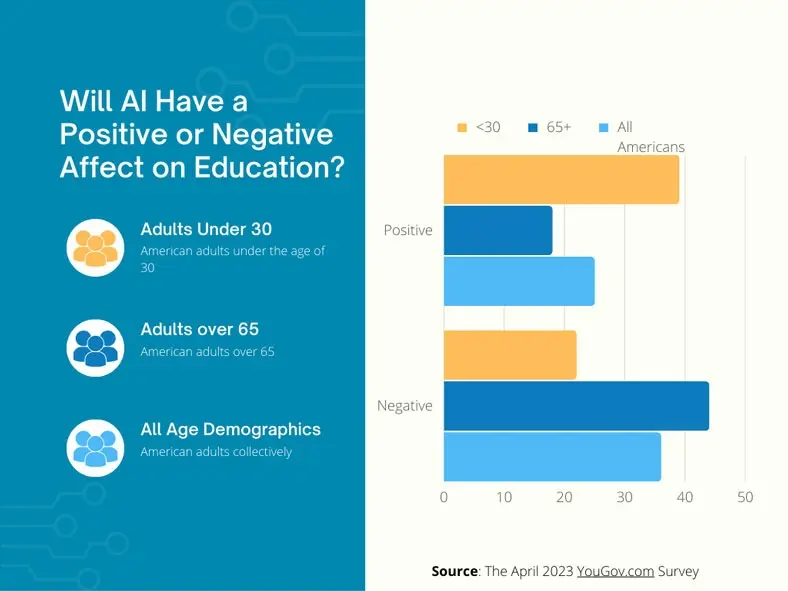
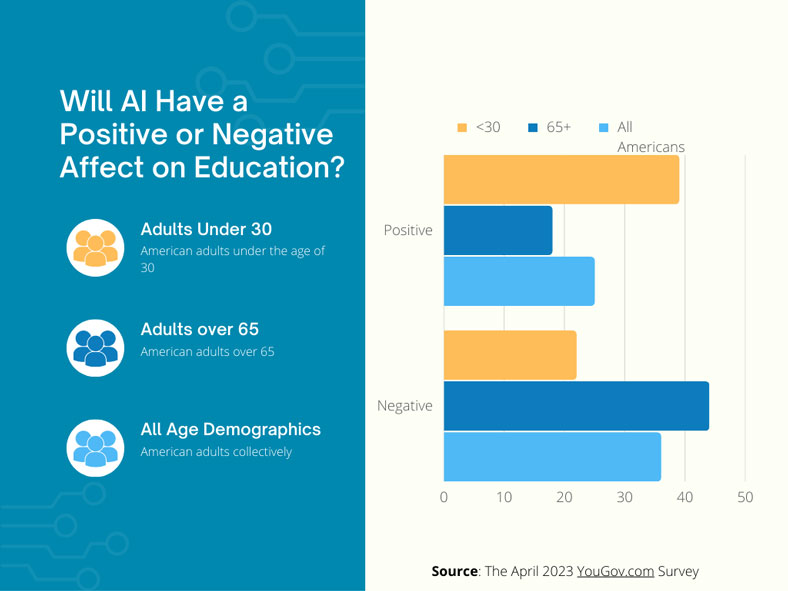
A comprehensive 2023 study by YouGov highlighted a significant divergence between punitive approaches and progressive educational strategies. The survey revealed that 52% of U.S. adults believe schools should prioritize teaching students how to use artificial intelligence appropriately. In contrast, only 24% favored a policy centered entirely on preventing its use. Furthermore, 61% of respondents considered AI-related competencies to be at least somewhat necessary for students’ future professional careers.
This perspective aligns with early technological comparisons drawn by industry leaders. OpenAI CEO Sam Altman, in public discussions regarding the societal impact of generative models, drew parallels to the historical introduction of the handheld calculator in mathematics classrooms. Rather than banning calculators, educational institutions adapted their curricula to test for higher-order conceptual understanding rather than rote arithmetic computation. Advocates argue that generative AI demands a comparable pedagogical evolution, shifting the focus from mechanical output generation to critical analysis, prompt engineering, and rigorous fact-checking.

Labor Market Realities: Teacher Compensation and Job Growth
While technological integration alters daily workflows, broader labor market metrics illustrate stability in core instructional roles alongside ongoing systemic challenges. According to data from the U.S. Bureau of Labor Statistics (BLS) as of May 2025, national median annual salaries for educators reflect variations across grade levels:
- Elementary School Teachers: $63,820
- Middle School Teachers: $64,370
- High School Teachers: $72,040
Note: Actual compensation varies widely depending on state legislation, local district funding, and individual educator experience. These figures serve as a national baseline.
Simultaneously, long-term employment projections from resources such as Projections Central (covering the 2024–2034 window) estimate modest downward adjustments in overall employment growth for specific core K-12 teaching positions. However, the data underscores that substantial annual job openings will persist. These openings are driven primarily by natural labor force attrition—including retirements and career transitions—rather than structural displacement by artificial intelligence. AI remains incapable of replacing the interpersonal mentorship, emotional intelligence, and real-time behavioral discernment required in a physical classroom.
Official Statements and Institutional Perspectives
Educational bodies, technology developers, and policy analysts maintain diverse viewpoints regarding the governance and utility of artificial intelligence in schools.
The Federal Perspective
The U.S. Department of Education has emphasized that while AI tools offer promising avenues for administrative relief and personalized learning, they must be deployed with strict adherence to data privacy, equity, and human oversight. Federal guidance consistently stresses that automated systems should not supplant human decision-making in matters of student evaluation, discipline, or special education services.
Academic Integrity and Detection Challenges
The reliability of AI detection tools remains a contentious issue. Platforms such as Winston AI and Turnitin have developed algorithms designed to identify machine-generated text. However, major developers and academic institutions issue frequent caveats regarding their accuracy. Turnitin, for instance, has officially stated that its detection feature can misidentify human-written text as AI-generated and should never serve as the sole evidentiary basis for disciplinary action against a student. Consequently, schools are encouraged to design authentic, process-oriented assessments—such as oral presentations, multi-stage writing drafts, and reflective journals—that reduce the viability of uncritical AI generation.

Practical Applications: Where AI Aids Educators
When utilized correctly, generative AI functions as a force multiplier for educators facing heavy workloads. Key areas of utility include:
- Drafting Lesson Frameworks: Teachers use AI to generate foundational outlines for units, interactive classroom activities, and discussion prompts, which are then refined to meet specific curriculum standards.
- Differentiated Instruction: Educators can quickly adapt complex reading materials into simplified versions for struggling readers or English language learners, ensuring equitable access to course content.
- Brainstorming and Resource Creation: AI assists in developing varied assignment prompts, rubrics, and formative assessment questions, allowing instructors to focus their energy on direct student engagement and targeted feedback.
Future Outlook
The trajectory of artificial intelligence in education points toward deeper integration coupled with more rigorous regulatory frameworks. As generative models become more sophisticated, the focus of educational technology will likely shift toward localized, secure, and curriculum-aligned AI assistants designed specifically for academic environments, minimizing data privacy risks.
Ultimately, the future of the classroom does not lie in an adversarial relationship between human educators and artificial intelligence, nor in the uncritical surrender of intellectual labor to algorithms. Instead, the sustainable path forward relies on cultivating digital discernment. By transforming AI’s known weaknesses—such as factual inaccuracies and formulaic logic—into active classroom lessons, educators can equip the next generation with the critical thinking skills necessary to navigate an increasingly automated world.

