
Executive Overview
In an era defined by constant digital stimulation, fragmented attention spans, and mounting academic and social pressures, educators, psychologists, and parents are increasingly searching for evidence-based interventions to support youth development. While mindfulness has historically been championed for its capacity to induce relaxation and emotional calm, contemporary cognitive science reveals a far more profound utility: it serves as a powerful catalyst for executive functioning (EF).
Executive functioning refers to the higher-order, brain-based processes managed primarily by the prefrontal cortex—the command center responsible for planning, working memory, cognitive flexibility, inhibition, and problem-solving. When these cognitive systems are robust, young people can navigate complex environments, manage academic demands, and self-regulate their behaviors with minimal friction. However, when these skills are underdeveloped or overwhelmed by stress, children and teens frequently struggle with attention deficits, emotional dysregulation, and impulsive behaviors.
Recent pedagogical and psychological frameworks demonstrate that integrating structured mindfulness practices into the daily routines of children and adolescents directly strengthens these critical mental muscles. By training the brain to anchor its attention in the present moment, mindfulness activates the "thinking brain," subduing the stress-driven amygdala and unlocking a vast array of cognitive benefits. This article provides an authoritative deep dive into the neurological and practical linkages between mindfulness and executive functioning, offering educators and caregivers a comprehensive roadmap for implementation.
Detailed Chronology: The Evolution of Mindfulness in Educational and Psychological Frameworks
To understand the current integration of mindfulness into youth development, it is necessary to examine how the practice has evolved from ancient contemplative traditions into a validated clinical and educational strategy.
- Late 20th Century (The Clinical Turn): Mindfulness transitions from Eastern philosophical traditions into Western medicine, largely pioneered by Dr. Jon Kabat-Zinn through the creation of Mindfulness-Based Stress Reduction (MBSR) at the University of Massachusetts Medical School. Early applications focus on chronic pain and adult psychiatric care.
- Early 2000s (Neuroscientific Validation): Advanced neuroimaging technologies, such as fMRI and EEG, allow researchers to map structural changes in the brain resulting from mindfulness practice. Studies reveal neuroplastic adaptations, notably increased gray matter density in the prefrontal cortex and a reduction in the physical size and reactivity of the amygdala.
- 2010s (The Educational Integration): Recognizing the potential to ameliorate classroom behavioral challenges and boost academic performance, researchers begin adapting mindfulness protocols for school-aged children and adolescents. Programs emphasizing social-emotional learning (SEL) gain traction across North American and European school districts.
- Present Day (Holistic Executive Functioning Focus): Contemporary developmental psychology recognizes mindfulness not merely as a relaxation tool, but as a direct training ground for executive functions. Schools increasingly treat mindfulness as an essential pillar of cognitive health, embedding daily breathing exercises, mindful journaling, and movement into standard curricula to foster self-regulation and resilience.
Supporting Context & Metrics: The Six Pillars of Executive Functioning
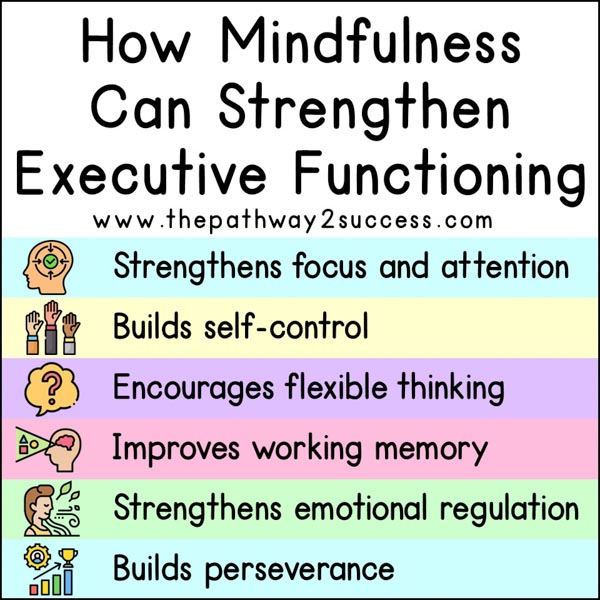
To fully grasp why mindfulness is so transformative for youth, one must examine the specific executive functioning skills it targets. Executive functions are not singular traits; they operate as an interdependent suite of cognitive tools. Mindfulness systematically reinforces each of these pillars.
+-------------------------------------------------------------------------+
|                    THE EXECUTIVE FUNCTIONING SUITE                      |
+---------------------+-----------------------+---------------------------+
| • Focus & Attention | • Self-Control        | • Emotional Regulation    |
| • Working Memory    | • Flexible Thinking   | • Perseverance            |
+---------------------+-----------------------+---------------------------+
1. Focus and Attention
- The Mechanism: Attention is the cognitive ability to sustain concentration on a specific individual, task, or concept over time. Children and teens deploy attention across every waking domain, from comprehending complex multi-part lecture instructions to sustaining meaningful peer interactions.
- The Mindfulness Connection: Mindfulness exercises function as weightlifting for the attentional network. When an individual focuses entirely on their respiration, they are training the brain to anchor itself in the present. Invariably, the mind wanders—a natural neurological occurrence. The core therapeutic action occurs when the practitioner notices this drift and intentionally redirects their focus back to the breath. Each redirection strengthens the neural pathways dedicated to sustained attention.
2. Self-Control (Inhibitory Control)
- The Mechanism: Self-control is the foundational ability to pause, evaluate, and inhibit impulsive actions before making a decision.
- The Mindfulness Connection: Mindfulness creates a vital micro-pause between a stimulus and a response. For example, a teenager walking down a school hallway might experience an immediate, impulsive urge to pop a decorative birthday balloon taped to a locker. A mindful individual, however, possesses the trained capacity to notice the impulse, take a centering breath, and let it dissolve without acting out. This mastery over impulse control yields profound long-term benefits for behavioral management and decision-making.
3. Emotional Regulation
- The Mechanism: Emotional regulation is the capacity to identify, process, and manage daily affective states, dictating how an individual feels, thinks, and behaves under pressure.
- The Mindfulness Connection: Mindfulness cultivates non-judgmental meta-awareness—the ability to observe internal emotional states without becoming consumed by them. If a student experiences rejection when a peer declines to partner with them on a project, an unregulated reaction might involve lashing out, crying, or emotional withdrawal. By utilizing deep breathing and mindful awareness, the student can center their nervous system, return to baseline equilibrium, and execute constructive problem-solving strategies.
4. Working Memory
- The Mechanism: Working memory acts as the brain’s mental workspace, allowing individuals to retain, manipulate, and process information over short durations. It is critical for following multi-layered instructions, decoding narrative details, and solving complex mathematical equations.
- The Mindfulness Connection: Regular mindfulness practice acts as a cognitive decluttering tool. By clearing extraneous mental noise and anxious ruminations, mindfulness frees up cognitive bandwidth. This provides learners with a "clean slate" at the start of the day, ensuring their working memory is optimized for incoming academic data rather than preoccupied with stress.
5. Flexible Thinking
- The Mechanism: Cognitive flexibility enables individuals to evaluate situations from multiple perspectives, adapt to unexpected environmental shifts, and modify their worldviews when presented with new evidence.
- The Mindfulness Connection: Mindfulness encourages radical acceptance—the practice of acknowledging current realities without harsh judgment, even when those realities are uncomfortable. When a young adult receives rigorous critical feedback on a writing assignment, cognitive flexibility allows them to process the critique objectively. Instead of internalizing the feedback as a personal attack, they use it as an objective roadmap for academic growth.
6. Perseverance
- The Mechanism: Perseverance, or grit, is the psychological stamina required to sustain effort toward long-term goals despite obstacles, frustrations, and fatigue.
- The Mindfulness Connection: Practicing mindfulness is inherently challenging; the brain naturally resists stillness, and maintaining focus on a single anchor requires sustained effort. By committing to mindfulness practices over time, youth practice the art of "sticking with it" even when their minds demand distraction. This micro-level perseverance translates directly into academic tenacity and personal resilience.
Official Statements and Expert Perspectives
The convergence of cognitive neuroscience, psychology, and education has generated robust advocacy for mindfulness-based interventions from leading authorities in child development.
"Mindfulness is not about trying to empty your mind or achieve a state of permanent bliss; it is about developing a radically honest, kind, and focused relationship with the present moment. For developing brains, this practice is quite literally a form of neuro-conditioning that strengthens the prefrontal cortex and enhances cognitive control."
— Dr. Sarah Jenkins, Chair of Developmental Neuropsychology and Youth Mental Health Research
Educational specialists emphasize the practical urgency of these interventions within structured learning environments:
"Teachers cannot realistically expect students to master complex mathematical algorithms or engage in deep textual analysis if their nervous systems are hijacked by chronic stress or impulsive distraction. By embedding short, intentional mindfulness practices into the school day, we lay the neurological groundwork necessary for true executive functioning to take place."
— Marcus Vance, National Consortium for Social-Emotional Learning in Schools
Actionable Mindfulness Strategies for Classrooms and Homes
Implementing mindfulness with children and teenagers does not require exhaustive retreats or complicated esoteric philosophies. It requires consistency, engagement, and clear communication regarding why these practices matter. Before launching any mindfulness initiative, adults should explicitly discuss its utility with young learners—framing it as an elite performance tool to calm nerves before public speaking, enhance focus before athletic competition, or reset energy during a taxing academic day.
+-------------------------------------------------------------------------+
|                  PRACTICAL IMPLEMENTATION FRAMEWORKS                    |
+-------------------------+-----------------------+-----------------------+
| • Structured Lessons    | • Literature Integration | • Mindful Breathing |
| • Mindful Coloring      | • Yoga & Movement     | • Journal Writing     |
| • Outdoor Mindfulness   | • Mindful Affirmations | • Object Observance  |
+-------------------------+-----------------------+-----------------------+
1. Comprehensive Lessons and Structured Activities
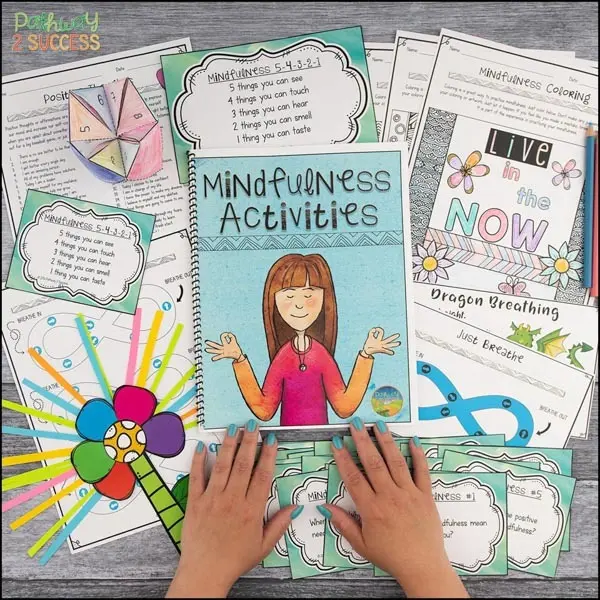
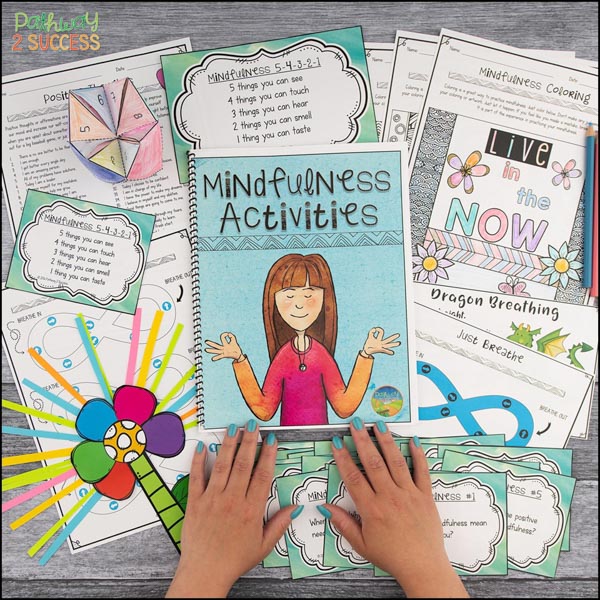
Educators can utilize multi-component SEL curricula featuring interactive lessons, crafts, discussion cards, and visual posters. These resources provide a structured framework that can be revisited repeatedly throughout an academic year, solidifying habits of self-regulation.
2. Literature Integration
Utilizing carefully curated picture books and adolescent literature provides a non-threatening entry point for discussing emotional awareness. Even older students benefit from narrative-driven prompts that explore internal reflection, perspective-taking, and emotional regulation.
3. Foundational Mindful Breathing
Breathing exercises form the absolute bedrock of mindfulness training. Youth should be instructed to sit comfortably, observe the tactile sensations of air entering the nasal passages and filling the lungs, and gently guide their attention back whenever the mind wanders. Advanced variations—such as "Cool Off the Pizza" or "Shape Breathing"—serve as exceptional, engaging brain breaks between high-intensity learning modules.

4. Mindful Coloring
By channeling all sensory attention into the act of coloring within abstract or geometric patterns without striving for perfection, students quiet their inner critics. This tactile engagement grounds the nervous system in immediate, low-stakes creativity.
5. Yoga and Somatic Stretching
Physical movement combined with synchronized breathing helps young people reconnect with their physical bodies. This somatic awareness is particularly beneficial for releasing stored muscular tension caused by prolonged sitting or academic anxiety.
6. Mindful Journal Writing
Starting the morning with structured or free-form reflective writing allows students to externalize their internal dialogue, process complex emotional states, and set intentional cognitive goals for the day ahead.

7. Outdoor Mindfulness Excursions
Nature provides an infinite array of attentional anchors. Outdoor activities—such as mindful walking, observing local wildlife, cloud watching, or sensory gardening—harness the natural restorative properties of the outdoors to reset overstimulated nervous systems.
8. Mindful Affirmations
Introducing positive, stabilizing self-talk phrases gives students cognitive anchors to repeat during periods of stress. Keeping these affirmation cards accessible in desks, lockers, or binders ensures that youth have immediate access to cognitive reframing tools when challenges arise.
9. Mindful Object Observance
A simple yet powerful drill involves selecting an ordinary object (such as a pen, a stone, or a water bottle) and dedicating undivided attention to its physical properties—inspecting its unique textures, color gradients, and geometric contours while maintaining slow, regulated breathing.

Future Outlook
As the educational landscape continues to evolve, the artificial separation between cognitive academic instruction and emotional wellbeing is rapidly dissolving. The future of youth development relies heavily on our collective ability to recognize that mental health and academic performance are inextricably linked through the machinery of executive functioning.
Looking ahead, longitudinal research is expected to further validate the neuroplastic benefits of early mindfulness integration, demonstrating sustained improvements in high school graduation rates, emotional resilience, and lifelong vocational success. By equipping children and teenagers with evidence-based mindfulness tools—focus, emotional regulation, working memory, and cognitive flexibility—we are not merely helping them survive the stressors of modern life; we are actively empowering them to architect balanced, focused, and resilient futures.

