

Executive Overview
As educators across the globe look for innovative ways to re-engage students as a new academic year gets underway, the conversation has increasingly turned toward scalable, low-stakes pedagogical pivots. Traditional instructional strategies often place the burden of content synthesis entirely on the teacher: the educator reviews the curriculum, designs the formative assessments, writes the review quizzes, and evaluates the outcomes. However, a growing body of practice highlights the efficacy of classroom micro-experiments—deliberate, highly focused, low-risk operational changes executed over a short, fixed window of time.
In this installment of our Back-to-School series on classroom micro-experiments, we examine a fundamental shift in instructional design: handing the pen over to the learners. Instead of teachers generating the weekly review game, students take the helm by authoring their own review questions for their peers using interactive platforms like Kahoot!.
This strategic delegation is far more than a clever classroom management technique or a time-saving device for busy teachers. Grounded in Bloom’s Taxonomy and cognitive science, this approach moves students past passive recall and thrusts them into the upper echelons of cognitive processing: analyzing, evaluating, and creating. When learners are tasked with designing review questions, they are effectively asked to teach the material. This acts as a powerful catalyst for authentic understanding, self-assessment, and metacognition. By structuring this shift as a rigorous micro-experiment, educators can test, measure, and refine student-led learning without committing to sweeping, disruptive curricular overhauls.
Detailed Chronology: The Evolution of Classroom Micro-Experiments
To understand the mechanics of student-led question creation, it is essential to trace the operational framework of classroom micro-experiments. This methodology represents a departure from traditional, long-term educational planning, where teachers often attempt massive, semester-long interventions with little room for mid-course corrections.
Phase 1: The Conceptualization of the Micro-Experiment
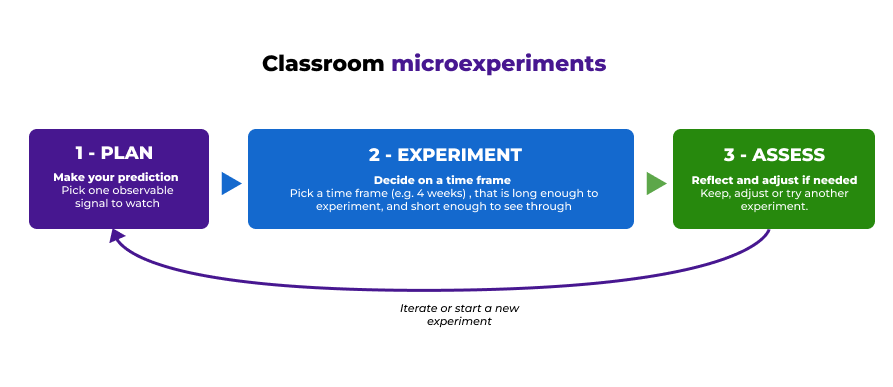
The methodology of the micro-experiment is defined by its precision and boundaries. It is, fundamentally, the smallest change an educator can make that still yields valid, actionable data. It relies on three rigid parameters:
- One tiny action: A specific, isolated procedural change (e.g., rotating student groups to write a weekly review game).
- A fixed window of time: A short, bounded duration (e.g., a four-week trial period).
- One observable signal: A pre-determined metric or behavior to monitor (e.g., question quality, peer engagement levels, or formative check accuracy).
Crucially, the educator is not committing to a permanent pedagogical overhaul or a risky gamble on student performance. Instead, they commit exclusively to running the test, reading the resulting signals objectively, and deciding the next tactical move: retain the practice, adjust a single variable, or abandon it for a different approach.
Phase 2: From Teacher-Led Formative Checks to Student Authorship
In part one of this ongoing series, the focus rested on the traditional weekly formative check: the educator curates a brief review kahoot, and the students play it. While effective for gauging knowledge retention, this method leaves the heavy cognitive lifting in the hands of the instructor. The teacher must dissect the previous week’s curriculum, determine core competencies from peripheral trivia, formulate plausible distractor answers, and construct a balanced assessment.
Part two of the series fundamentally inverts this workflow. By shifting the question-authoring responsibility to student groups on a rotating basis, the pedagogical paradigm changes. The students must now perform the rigorous analytical work previously reserved for the podium.

Phase 3: Practical Implementation in the Classroom
Executing this micro-experiment requires minimal structural disruption. Teachers can introduce the framework at the beginning of a term by establishing a simple weekly rotation:
- Group Division: The class is partitioned into small collaborative teams.
- The Assignment: Each week, a single designated group is responsible for crafting a short, curriculum-aligned review game (e.g., a 10-question kahoot) covering the week’s core concepts.
- The Review Cycle: At the conclusion of the week, the entire class plays the student-generated game.
- The Evaluation: The teacher observes both the quality of the questions generated by the authors and the performance of the wider class during gameplay, using these dual signals to evaluate comprehension.
Supporting Context & Metrics: The Cognitive Science of Question Creation
To evaluate why student-led question design produces superior learning outcomes, educational researchers look to established cognitive frameworks, most notably Bloom’s Taxonomy.
[ CREATING ]    ---> Writing review questions, designing peer challenges (Highest Cognitive Load)
[ EVALUATING ]  ---> Judging distractor validity, assessing core vs. peripheral ideas
[ ANALYZING ]   ---> Deconstructing weekly lessons, categorizing themes
[ APPLYING ]    ---> Using knowledge in new contexts
[ UNDERSTANDING]-> Explaining ideas or concepts
[ REMEMBERING ] ---> Recalling facts and basic data (Lowest Cognitive Load)
Navigating Bloom’s Taxonomy
Bloom’s Taxonomy classifies cognitive skills along a continuum from basic recall to complex evaluation and creation.
- The Base Levels (Remembering & Understanding): Answering standard multiple-choice quiz questions typically operates at the foundation of the taxonomy. Students are asked to recall definitions, recognize historical dates, or identify formulas. While necessary, these skills represent lower-order thinking.
- The Apex Levels (Analyzing, Evaluating, & Creating): Formulating a fair, rigorous, and intellectually stimulating question demands an entirely different level of cognitive engagement. To write a successful review question, a student must:
- Analyze the past week’s instruction to separate essential learning objectives from tangential trivia.
- Evaluate what constitutes a fair challenge—ensuring the correct answer is unambiguously right while crafting plausible, educational "distractor" wrong answers that target common misconceptions.
- Create an interactive assessment asset that effectively challenges their peers.
Simply put, formulating a question demands significantly more cognitive horsepower than answering one. When students engage in this process, they are forced to confront gaps in their own understanding. They cannot write a coherent question about a topic they have only half-grasped.
The Double-Win Paradigm: Teaching as the Ultimate Test
The adage "to teach is to learn twice" finds immediate validation in this micro-experiment. Preparing to teach—even on a micro-scale, such as building a five-minute review game for classmates—fundamentally alters how students approach studying.
When students realize their work will be experienced and judged by their peers, intrinsic motivation spikes. They acquire genuine ownership over the material. They are no longer studying passively simply to pass an external test administered by an authority figure; they are studying actively to curate an engaging, accurate experience for their community.
This dynamic creates a powerful "double-win":
- For the Authors: The act of reviewing, filtering, and structuring the material serves as a deep, immersive study session.
- For the Players: The resulting gameplay session acts as an immediate, low-stakes formative check for the educator, illuminating class-wide areas of mastery and persistent misconceptions in real time.
Official Guidelines & Implementation Frameworks
To transition this theory into practice, educators must provide students with clear, structured parameters. Without guidance, student-generated questions can veer into extreme obscurity, trivial trick questions, or overly simplistic inquiries that fail to assess true comprehension.
Structuring Student Expectations: A Short Guide for Question Authors
Educators can distribute a one-page template or run a brief preparatory training session before students take their first turn at question authorship. An effective student guide focuses on three core pillars:
- Target the Core, Skip the Trivia: A good question focuses on the central concepts of the week’s lessons, not minor footnotes or spelling details. Ask: Does this question test a concept we will need to build upon next week?
- Craft Plausible Distractors: In a multiple-choice game, the incorrect options (distractors) are just as important as the right answer. Good distractors should target common student mistakes or partial understandings, revealing where a classmate might be confused.
- Keep Language Clear and Concise: Ambiguous wording leads to frustration rather than learning. If a question requires a lengthy paragraph to explain itself, it needs to be simplified.
Maximizing Impact Through Intentionality
Many teachers occasionally invite students to write review questions on the fly—perhaps when a lesson concludes early or as an ad-hoc reward activity. However, these sporadic instances rarely yield measurable data.
The transformative power of the micro-experiment lies in intent. By structuring the activity with explicit boundaries—a predetermined time limit, clear learning objectives, and a specific observational metric—the educator turns a casual classroom exercise into a rigorous pedagogical test. Teachers can compare question quality from week to week, share observations with colleagues, and make deliberate adjustments based on empirical evidence rather than gut feeling.
Future Outlook: Scaling Micro-Experiments Across the Curriculum
As education systems grapple with the need for agile, responsive teaching methodologies, the classroom micro-experiment offers a sustainable path forward. Educators do not need to discard their existing curricula or undertake exhausting overhauls to innovate. By decentralizing minor operational workflows—such as delegating review creation to learners—teachers can foster an environment of active inquiry, higher-order thinking, and shared ownership.
The journey does not end with individual student authorship. As demonstrated in this ongoing series, micro-experiments serve as stepping stones to broader pedagogical explorations. Having tested the impact of student-led question creation, the logical next frontier involves examining collaborative dynamics.
In part three of our Back-to-School series, the focus shifts outward from individual authorship to collaborative gameplay structures. Specifically, researchers and educators will explore a compelling question: What happens when the review game is played in teams? By analyzing whether team-based play successfully engages historically quiet students, educators can continue stacking small, measured micro-experiments to build a more inclusive, dynamic, and cognitively rich classroom environment.
For educators ready to take the first step, the barrier to entry is remarkably low. Establish a student group, share a clear question-authoring guide, and let the learners build next week’s review. The insights gained from their creations may redefine how learning is measured for the rest of the academic year.

