

Executive Overview
Instructional planning is the foundational bedrock of effective education, yet it remains one of the most consistently daunting tasks for educators at every career stage. Whether entering the classroom for the very first time or returning after decades of service, teachers often grapple with the overwhelming challenge of translating broad educational standards into cohesive, engaging, and meaningful units of instruction.
In response to this perennial pedagogical challenge, educational platforms and instructional experts are leaning back into fundamentals. A multi-part instructional series designed to demystify the architectural process behind unit building offers a reliable, step-by-step framework. Rather than relying on last-minute lesson generation or disparate activities, this methodology anchors itself in backward design—a time-tested approach that prioritizes student outcomes by establishing objectives and assessments before drafting daily lesson plans.
This comprehensive guide breaks down the macro-level view of unit planning. By establishing clear definitions for educational standards, curricula, and instructional units, and by applying a rigorous three-step design framework, educators can eliminate guesswork, ensure curriculum alignment, and foster genuine student mastery.
Detailed Chronology: The Evolution and Application of Backward Design
To fully appreciate modern unit planning, one must examine its historical and operational evolution. For decades, traditional lesson planning followed a reactive trajectory: teachers designed daily lessons based on immediate availability or inspiration, piecing together activities as they went, and ultimately developed a final test based on whatever content happened to be covered.
This ad-hoc approach often resulted in disjointed units where assessments failed to accurately reflect true student comprehension or standard alignment.
The paradigm shifted significantly in 1991 with the publication of Understanding by Design by education theorists Grant Wiggins and Jay McTighe. They popularized backward design, a methodology that fundamentally inverted the planning timeline.

The Three-Phase Backward Design Sequence
- Identify Desired Results (Step 1): Educators begin by examining institutional or state standards to establish clear, measurable learning objectives. This phase also involves framing the unit with an overarching "essential question" and a descriptive title to maintain thematic integrity.
- Determine Acceptable Evidence (Step 2): Before planning a single worksheet or lecture, teachers design the summative assessment. This step answers the crucial question: How will students prove they have mastered the objectives?
- Plan Learning Experiences and Instruction (Step 3): Only after the objectives and assessments are firmly established do educators design the daily lessons, activities, and formative checks designed to scaffold students toward success.
By implementing this sequence, teachers ensure complete alignment between what is taught, how it is practiced, and how it is evaluated. Far from "teaching to the test" in a manipulative sense, backward design ensures that the test itself is a rigorous, high-quality measure of meaningful educational objectives.
Supporting Context & Metrics: Deconstructing Standards, Curricula, and Units
Before an educator can successfully architect a unit, a precise common vocabulary must be established. Misunderstandings between what constitutes a standard, a curriculum, or a unit often lead to fragmented instructional delivery.
To illustrate these concepts, instructional design experts frequently turn to practical, non-traditional analogies, such as designing a community education course titled Cooking Fundamentals.
Defining the Core Elements
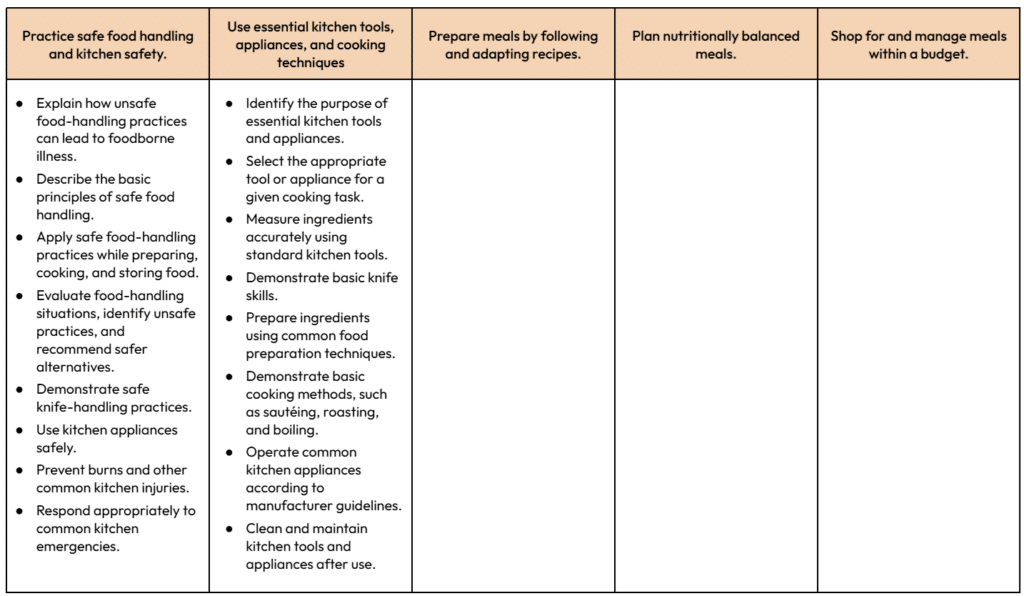
- Standards: These are the broad goals or statutory requirements mandated by educational bodies. In the context of a cooking course, a standard might state: "Students will be able to practice safe food handling and kitchen safety." When expanded into a comprehensive chart, a handful of broad standards can branch out into dozens of specific sub-skills, tools, and techniques.
- Curriculum: While standards provide the destination, the curriculum provides the roadmap. It organizes and sequences the vast array of knowledge and skills derived from standards into manageable clusters known as units. A curriculum outlines how topics are grouped and paced across a semester or academic year.
- Unit: A unit is a focused collection of individual lessons dedicated to a specific subset of the curriculum, lasting anywhere from a few days to several weeks. In a typical semester, an educator might navigate five to ten distinct units.
A Case Study in Unit Organization: Safe Food Handling
To visualize how this process works in practice, consider the hypothetical Cooking Fundamentals course. Rather than organizing the course strictly by meals (e.g., breakfast, lunch, dinner), the instructor decides to partition the curriculum into six distinct units:
- Food Safety
- Kitchen Tools and Appliances
- Food Prep and Cooking Techniques
- Everyday Meal Preparation
- Nutrition
- Grocery Shopping and Budgeting
Focusing on the shortest and most foundational module—Food Safety (estimated at three to four instructional days)—the instructor applies the three-step backward design framework to build a robust, foolproof instructional sequence.
Official Guidelines: The Three-Step Unit Design Framework in Action
Translating pedagogical theory into classroom reality requires a systematic, repeatable process. The three-step unit design framework provides precisely that structure.
Step 1: Establishing Measurable Objectives
The cornerstone of any effective unit is clarity of purpose. Once standards are selected, teachers must draft measurable learning objectives.
- The Observability Rule: For an objective to be truly measurable, it must require students to do something observable rather than engaging in an unobservable internal mental process. Words like "understand" or "know" are replaced with action verbs such as "demonstrate," "identify," "calculate," or "explain."
For the Safe Food Handling unit, the instructor isolates the food-handling components and establishes four precise, measurable objectives:
- Identify common vectors of cross-contamination in a domestic kitchen environment.
- Demonstrate correct handwashing protocols and sanitation procedures.
- Distinguish between safe and unsafe internal temperatures for various cooked meats.
- Explain the proper methods for thawing frozen foods to prevent bacterial proliferation.
To elevate these technical objectives into a cohesive learning experience, the instructor establishes a unit title ("Safe Food Handling") and an essential question: "How do your choices in the kitchen affect the safety of the food you prepare?"
Step 2: Designing the Summative Assessment
With objectives locked in, the educator immediately moves to assessment design. The central inquiry of this phase is: If students have truly mastered these safety protocols, what evidence will prove it?
For a compact, three-to-four-day unit, a lengthy project or comprehensive practical exam may be impractical. Instead, the instructor designs an open-response scenario test.
- The Mechanism: Students are presented with realistic narratives depicting individuals preparing various meals. Embedded within each narrative are subtle or overt food safety violations.
- The Task: Students must successfully identify the mistakes, explain the biological or procedural rationale for why each error is dangerous, and articulate the correct alternative action.
This assessment effectively evaluates higher-order application skills, ensuring that students can transfer theoretical knowledge to novel, real-world culinary scenarios.
Step 3: Architecting Daily Lessons and Formative Scaffolding
The final phase involves mapping out the daily learning experiences. With the destination (objectives) and the proof of arrival (summative assessment) clearly defined, crafting daily lesson plans becomes a streamlined and purposeful endeavor.
- Diagnostic and Formative Checks: Instructors weave low-stakes checks throughout the lessons to gauge student progress, ensuring no learner falls behind before reaching the summative assessment.
- Targeted Activities: Every lecture, demonstration, and hands-on practice session is deliberately aligned with preparing students for the open-response scenarios they will encounter at the end of the unit.
Future Outlook: Professional Development and Modern Instructional Design
As educational landscapes continue to evolve, the demand for structured, high-yield instructional planning tools remains at an all-time high. Modern educators—both novices navigating teacher preparation programs and veteran teachers seeking to refine their craft—increasingly recognize that intuitive teaching must be paired with disciplined architectural planning.
To bridge the gap between abstract educational theory and daily classroom execution, industry resources have expanded to include self-paced professional development. Comprehensive programs, such as specialized online curricula focusing on lesson plan mastery, provide educators with downloadable templates, audit tools, and practical workshops designed to streamline the unit-building process.
The Broader Impact on Student Achievement
When school districts and individual educators adopt systematic unit-planning protocols like backward design, the cascading benefits are profound:
- Reduced Teacher Burnout: Eliminating last-minute lesson scrambling reduces cognitive fatigue and stress among educators.
- Enhanced Transparency: Students gain a clearer understanding of expectations when units are organized around transparent essential questions and well-defined objectives.
- Equitable Learning Outcomes: Rigorous alignment guarantees that all students—regardless of background—receive targeted instruction directly linked to core educational standards.
Ultimately, mastering the art of unit planning is not merely an administrative checkbox; it is a profound commitment to instructional intentionality. By defining clear standards, establishing rigorous assessments upfront, and building purposeful daily pathways, educators lay the groundwork for enduring student success.

