
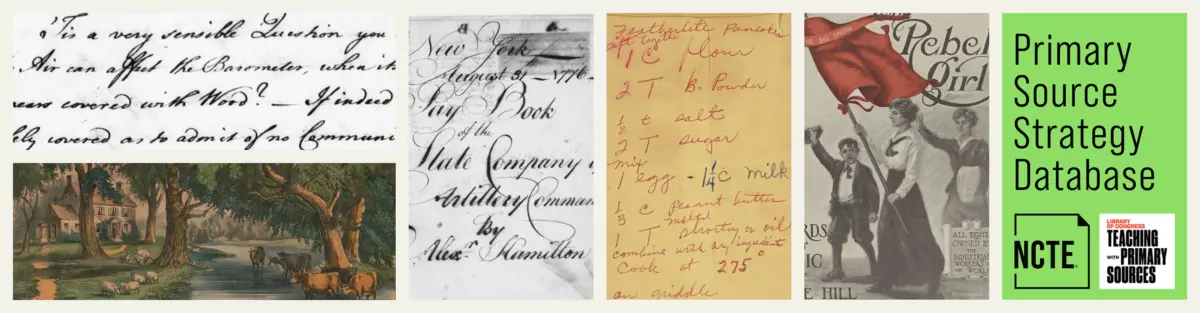
Executive Overview
In an era defined by an overwhelming abundance of digital information, the ability to critically analyze historical documents, historical journalism, and original artifacts has never been more vital. Recognizing this pedagogical necessity, the National Council of Teachers of English (NCTE) has forged a dynamic partnership with the Library of Congress. Operating as an active participant in the prestigious Teaching with Primary Sources (TPS) Consortium, the NCTE is spearheading a nationwide initiative designed to fundamentally transform how literacy teachers and students integrate primary sources into their daily educational routines.
At the heart of this collaborative enterprise is an innovative, highly searchable digital database housing instructional strategies for more than 150 specific historical artifacts culled directly from the Library of Congress’s vast digitized collections. Developed through the rigorous efforts of over two dozen master educators and leaders in English language arts (ELA) education, this repository bridges the gap between raw historical data and actionable classroom instruction. Each entry is meticulously curated to articulate specific literacy merits, mapping out ideal curriculum applications, thematic connections, interdisciplinary unit plans, and direct alignments with state content standards.
By leveraging intuitive tagging systems—such as picturebook, argument, STEM, and history—educators can effortlessly source materials that challenge traditional historical narratives, foster inclusive representation, and cultivate advanced critical literacy skills. This comprehensive report explores the architecture of this transformative educational initiative, examines the critical role of inclusive historical inquiry, details specific archival highlights like Denver’s historic Statesman newspaper, outlines relevant academic standards, and projects the long-term impact of primary source integration on the future of American education.
Detailed Chronology: Building the TPS Consortium Partnership
The integration of primary sources into modern ELA instruction did not happen overnight; it represents the culmination of decades of archival digitization and pedagogical evolution. To understand the gravity of the NCTE-Library of Congress partnership, one must examine the systematic development of programs aimed at democratizing access to historical records.
- Phase I: The Digitization Movement (Late 1990s – Early 2000s)
The Library of Congress initiated massive undertakings like American Memory and later Chronicling America, converting millions of fragile historical manuscripts, newspapers, photographs, and audio recordings into accessible digital formats. However, accessibility alone proved insufficient; educators required specialized training to translate raw archival assets into effective pedagogical tools. - Phase II: Inception of the Teaching with Primary Sources Program
To bridge the gap between archival repositories and K-12 classrooms, the Library of Congress established the Teaching with Primary Sources program, building a nationwide network of higher education institutions, school districts, and educational organizations dedicated to teacher professional development. - Phase III: The NCTE Integration and Consortium Expansion
Recognizing that literacy teachers occupy the front lines of historical and textual analysis, the NCTE formalized its partnership within the TPS Consortium. By uniting the Library of Congress’s unparalleled archival wealth with the NCTE’s unmatched expertise in English language arts pedagogy, the organizations launched a targeted campaign to embed primary source literacy into ELA curricula nationwide. - Phase IV: Collaborative Database Launch and Expansion
More than two dozen ELA leaders and classroom practitioners were commissioned to author pedagogical strategies for over 150 foundational items within the Library of Congress collection. This resulted in the creation of the searchable, tag-based database currently utilized by educators across the country, serving as an evolving model for standards-aligned, inquiry-based teaching.
Supporting Context & Metrics: Challenging Traditional Narratives in the ELA Classroom
The pedagogical value of incorporating primary sources—particularly historical journalism and records detailing marginalized innovators—extends far beyond standard historical instruction. It strikes at the core of equitable literacy education. Historically, school curricula have suffered from a persistent homogeneity, presenting narratives of invention, progress, and historical agency that overwhelmingly center on white men.
Deconstructing Limited Historical Perspectives
When educational materials consistently spotlight a single demographic, students internalize a skewed understanding of who possesses the capacity for innovation and historical impact. This systemic oversight perpetuates both racial and gender injustice through erasure. The NCTE-Library of Congress database actively counters this dynamic by elevating the stories of diverse innovators, such as Black female inventors and historical figures whose contributions have been systematically overlooked.
For example, studying historical figures like Madam C. Walker, or unsung innovators who transformed daily life without formal academic credentials, allows students to recognize that brilliance emerges from diverse communities. When learners interact with primary sources documenting these figures, they see themselves reflected in the historical record. This psychological shift validates their experiences, boosts academic engagement, and fosters an inclusive academic environment.
The Power of Historical Community Newspapers
A prime illustration of the pedagogical materials featured in the NCTE database is the archival collection surrounding historical regional publications, such as The Statesman.
Founded in 1888 and published weekly in Denver, Colorado, The Statesman served as a critical informational lifeline for the African American community across Colorado, Wyoming, Montana, Utah, and New Mexico. During an era defined by aggressive disenfranchisement and institutionalized segregation, the newspaper acted as an authorized channel through which its readers could "voice their opinions, assert their rights, and demand their due recognition."
The inclusion of The Statesman in literacy curricula provides students with an authentic window into the Mountain West during the early 20th century. The publication reported on local community milestones, church events, and society gatherings, alongside hard-hitting national stories of direct relevance to Black Americans. Furthermore, its op-ed pages fearlessly tackled controversial, systemic issues of the day, including interracial marriage, the enforcement of Jim Crow laws, and institutional segregation. Analyzing these primary source texts trains students to evaluate authorial intent, identify rhetorical strategies, and understand the historical mechanics of social justice movements.
Official Standards Connections and Pedagogical Frameworks
To ensure seamless adoption by school districts striving to meet rigorous state mandates, the instructional strategies housed within the NCTE database are explicitly mapped to established educational benchmarks. Taking New Mexico’s Adopted Content Standards as a representative model, the framework demonstrates direct alignment across multiple grade bands in both English Language Arts and disciplinary literacy (History/Social Sciences, Science, and Technical Subjects).
Reading Standards for Informational Text (RI) & History/Social Studies (RH)
| Grade Band / Standard | Focus Area | Pedagogical Application via Primary Sources |
|---|---|---|
| RI.6.1 | Cite textual evidence | Students analyze explicit statements and draw inferences from historical documents, such as editorials from The Statesman, supporting their conclusions with direct textual quotes. |
| RI.7.2 | Central ideas & objective summaries | Learners determine two or more central ideas within a primary source text, track their development across the document, and formulate objective, unbiased summaries. |
| RH.9-10.1 | Evidence in primary/secondary sources | Students cite specific textual evidence while remaining attentive to critical source features, including the exact date, geographical origin, and sociopolitical context of the document. |
| RH.11-12.2 | Complex historical synthesis | Advanced learners determine core ideas within primary sources, producing accurate summaries that articulate the intricate relationships among key historical details and overarching ideas. |
By anchoring primary source analysis to these standards, educators do not have to choose between teaching historical content and meeting literacy benchmarks. Instead, the database proves that historical inquiry is literacy instruction, offering fertile ground for close reading, argumentative writing, and evidence-based synthesis.
Future Outlook: The Evolution of Primary Source Literacy
As educational technology continues to evolve, the partnership between the National Council of Teachers of English and the Library of Congress via the TPS Consortium is poised for exponential growth. The roadmap for the future centers on several strategic imperatives designed to deepen classroom impact:
- Expansion of the Artifact Repository: Plans are currently underway to scale the database well beyond its initial 150 items, incorporating newly digitized collections that highlight indigenous histories, immigrant experiences, and contributions from disabled innovators.
- Enhanced Digital Interactivity: Future iterations of the searchable database will integrate advanced multimedia tools, allowing students to engage in digital annotation, collaborative document analysis, and cross-collection comparisons directly within web-enabled learning environments.
- Professional Development Scaling: Through localized workshops, webinar series, and graduate-level partnerships, the NCTE aims to train thousands of additional educators in the art of inquiry-based primary source instruction, ensuring that teachers feel confident guiding students through complex, multi-perspective historical texts.
- Interdisciplinary STEM Integration: Recognizing that innovation bridges the humanities and sciences, upcoming curriculum modules will increasingly blend historical texts with STEM curricula, encouraging students to explore the socio-historical contexts behind scientific breakthroughs and technological inventions.
Conclusion
The collaborative initiative between the NCTE and the Library of Congress represents a watershed moment for modern literacy education. By transforming the overwhelming wealth of the Library of Congress archives into structured, standards-aligned, and inclusive instructional strategies, this partnership empowers educators to move beyond rote memorization.
Students are no longer passive recipients of sanitized historical narratives; instead, they become active historians, investigative readers, and critical thinkers. Through engagement with diverse primary sources—whether examining the editorials of a 20th-century Black-owned Western newspaper or analyzing the blueprints of an unsung inventor—learners develop the analytical tools necessary to navigate, question, and ultimately shape the world around them.
Educators and literacy leaders interested in accessing the searchable database, exploring instructional strategies, and reviewing additional professional development resources can visit the official NCTE Teaching with Primary Sources portal.

