
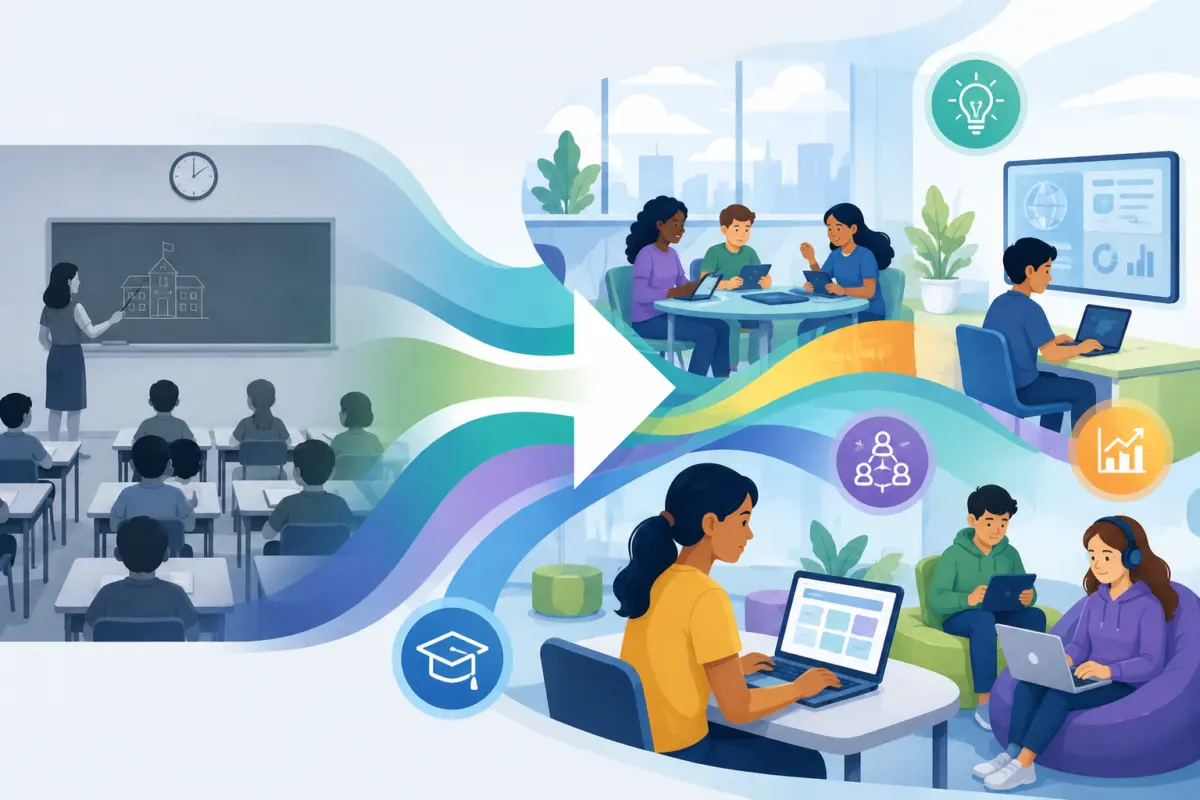
Executive Overview: The Structural Paradox of Modern K–12 Education
Across the United States, traditional K–12 public and private schooling operates on a foundational model engineered more than a century ago: uniform age-based cohorting, standardized instructional pacing, and fixed seat-time requirements. While this assembly-line architecture succeeded in delivering mass literacy and foundational equity during the Industrial Era, it is increasingly encountering systemic friction in the 21st century.
A growing segment of America’s student population—particularly high-achieving, specialized, and highly driven learners—is hitting an invisible yet rigid ceiling within conventional classrooms. These students are not failing the system; rather, the system’s structural limitations are failing them. Capable of mastering complex concepts well ahead of standardized schedules, advanced learners often find themselves constrained by instructional models designed for average pacing. The resulting mismatch manifests not only in acute student disengagement and chronic underachievement relative to potential, but also in a broader macroeconomic failure to fully cultivate top-tier talent.
To bypass these institutional bottlenecks, families are increasingly seeking alternative learning environments. Driven by an expansion in digital infrastructure, dual-enrollment pathways, and hybrid models, the movement toward personalized, competency-based education is moving from the margins to the mainstream. This transformation is forcing educational policymakers, district superintendents, and pedagogical leaders to confront a pivotal question: How can the American educational system evolve from measuring compliance through hours spent in a classroom seat to evaluating true academic mastery, individual growth, and real-world application?
Detailed Chronology: From Industrial Uniformity to Digital Personalization
The structural evolution of American education reflects a multi-decade tension between standardizing educational access and catering to individual learning trajectories. Understanding current systemic friction requires examining how these structural constraints were built and how modern acceleration mechanisms emerged.
+-----------------------------------------------------------------------------------+
| CHRONOLOGY OF AMERICAN K-12 STRUCTURAL EVOLUTION                                 |
+-----------------------------------------------------------------------------------+
| 1906: Establishing the Carnegie Unit                                             |
|       - Standardized high school credit based on seat time (120 hours/year).      |
|       - Tied institutional funding and progression to physical attendance.        |
+-----------------------------------------------------------------------------------+
| 1983: "A Nation at Risk" Publication                                              |
|       - Highlighted declining academic standards; catalyzed national reform.      |
|       - Reinforced standardized testing and uniform curriculum mandates.          |
+-----------------------------------------------------------------------------------+
| 2001: No Child Left Behind (NCLB) Passed                                         |
|       - Systemically prioritized achieving minimum baseline proficiency.          |
|       - Diverted administrative resources away from advanced/gifted acceleration. |
+-----------------------------------------------------------------------------------+
| 2010–2019: Expansion of Alternative Learning Pathways                            |
|       - Rapid growth of AP/IB programs and high school dual-enrollment structures.|
|       - Maturation of accredited online independent schools and distance learning.|
+-----------------------------------------------------------------------------------+
| 2020–Present: Post-Pandemic Personalization Imperative                           |
|       - Over 2.5 million students participating in dual enrollment annually.      |
|       - Shift toward asynchronous, competency-based, and hybrid education models. |
+-----------------------------------------------------------------------------------+
The Carnegie Unit and the Assembly-Line Framework (1906–1980s)
In 1906, the Carnegie Foundation for the Advancement of Teaching established the "Carnegie Unit"—a metric defining standard high school credit as 120 hours of classroom instruction in a given subject over an academic year. Originally designed to establish a standardized basis for faculty pensions and university admissions, the metric inadvertently locked American K–12 education into a time-bound paradigm. Progression was tied strictly to chronological age and physical presence rather than demonstrated subject mastery.
The Accountability Era and the Baseline Focus (1983–2000s)
The publication of A Nation at Risk in 1983 and the subsequent passage of the No Child Left Behind (NCLB) Act in 2001 shifted national education policy toward federal accountability and standardized testing. While intended to close achievement gaps, these policies focused institutional energy and fiscal resources heavily on bringing low-performing students to minimum baseline proficiency. Consequently, high-performing and gifted education programs experienced funding cuts and administrative marginalization, cementing a floor for academic performance while effectively lowering the systemic ceiling.
The Rise of Digital Pathways and Dual Enrollment (2010s–Present)
Over the past decade, technological infrastructure and modern learning platforms transformed non-traditional education from a niche contingency for isolated populations into a robust ecosystem for academic acceleration. Driven by high-achieving students seeking advanced STEM sequences, specialized performing arts schedules, and elite athletic training, independent online schools and dual-enrollment programs surged. The post-pandemic landscape accelerated this trend, normalizing asynchronous coursework and personalized learning models that untether academic progress from rigid geographic and physical mandates.
Supporting Context & Metrics: Quantifying the Ceiling Effect
Empirical evidence demonstrates that the traditional classroom’s rigid pacing directly impacts student development at the upper tail of the achievement distribution. Research indicates that when advanced learners are confined to standardized instructional speeds, their academic trajectory decelerates significantly.
                   ACADEMIC PACING MODELS COMPARED

   TRADITIONAL MODEL (Seat-Time / Time-Based)
   [ Content Fixed ] ---------> [ Time Fixed (180 Days) ] ---------> [ Variable Mastery ]
   * Students move at identical pace regardless of prior knowledge or learning velocity.

   COMPETENCY-BASED MODEL (Mastery-Based)
   [ Content Fixed ] ---------> [ Time Variable ] -----------------> [ Complete Mastery ]
   * Students accelerate upon demonstrating proficiency, eliminating academic ceilings.
The High-Achiever Growth Deficit
According to longitudinal research published by the Thomas B. Fordham Institute, high-achieving elementary and middle school students frequently experience a phenomenon known as "growth stagnation." The study revealed that a substantial percentage of students who score in the top quartile on standardized assessments fail to make a full year’s worth of academic progress during an academic year. Because traditional classroom instruction must cater to the median or struggling student, advanced learners often spend significant operational time reviewing material they have already mastered, leading to administrative disengagement and diminished long-term academic potential.
The Dual Enrollment Explosion
Data from the National Center for Education Statistics (NCES) underscores the massive demand among high school students for academic environments that transcend traditional secondary school offerings:
- 2.5+ Million Students: Over 2.5 million U.S. high school students now participate in college-level dual-enrollment courses annually.
- Decadal Growth: Dual enrollment has grown by double digits over the past ten years, making it one of the fastest-growing sectors in American secondary education.
- Driver of Demand: The surge is driven largely by students who exhaust their local high school’s advanced placement (AP) or honors curricula well before their senior year, requiring higher-education partnerships to maintain academic momentum.
Comparative Metrics: Standard vs. Accelerated Pathways
| Metric Dimension | Traditional K–12 Classroom | Competency-Based / Flexible Model |
|---|---|---|
| Progress Metric | Seat-Time (Carnegie Units / Hours) | Demonstrated Mastery of Learning Objectives |
| Pacing Control | Teacher/District-Driven (Uniform) | Student-Driven (Adaptive / Asynchronous) |
| Curricular Scope | Grade-Level Standardized | Variable (Advanced, Honors, Dual-Enrollment) |
| Primary Risk Factor | Student Disengagement due to Pacing | Requires High Internal Motivation / Self-Regulation |
| Institutional Goal | Systemic Consistency & Floor Proficiency | Individualized Potential & Growth Ceiling |
Official Statements & Expert Perspectives
Educational leaders directly managing alternative and accelerated learning environments stress that the current momentum toward flexible learning should not be interpreted as an indictment of classroom teachers, but rather as a critical critique of systemic architecture.
Operational Insights from Educational Leadership
Addressing the structural mismatch in contemporary education, Allison Altvater, Dean of Middle and High School at Laurel Springs School—a pioneer in flexible, online K–12 education—emphasizes that traditional educational frameworks were built for a vastly different economic era.
"Walk into almost any classroom in America, and you’ll see a system designed for consistency: same lesson, same pace, same expectations for every student. For decades, that model has served millions well. But today’s learners are changing, and some of the most driven among them are quietly outgrowing the structure meant to support them," states Altvater.
"High-achieving students are hitting an unexpected ceiling. Not because they lack ability or ambition, but because traditional classrooms weren’t designed to move at their pace. Progress is traditionally measured by time spent in a classroom, not mastery of material. For students ready to move faster or at a different pace, this can create a growing disconnect."
Altvater clarifies that abandoning rigid, one-size-fits-all instruction does not equate to compromising academic rigor. Instead, it redefines how rigor is delivered and measured.
"This isn’t about creating a fast track for a select few. It’s about acknowledging that one-size-fits-all no longer fits anyone particularly well. When we expand what school can look like, we create space for more students to thrive. Rigor, in this model, isn’t about moving faster for the sake of speed. It’s about meeting students where they are at the edge of their ability and helping them grow from there."
"Education isn’t broken. But it is at an inflection point. If we want to serve today’s most driven students and prepare all learners for what comes next, we have to be willing to rethink long-held assumptions. Because when we do, we’re not lowering standards. We’re raising the ceiling for all."
Pedagogical Consensus on Competency-Based Frameworks
Educational researchers echo Altvater’s perspective, noting that when highly motivated learners are held back by rigid seating schedules, they risk developing passive learning habits, under-performing relative to their cognitive abilities, or dropping out of advanced career trajectories altogether. Transitioning to personalized, adaptive learning environments allows these students to compress foundational requirements, allocate time to independent research or specialized disciplines, and engage in meaningful real-world applications.
Future Outlook & Strategic Imperatives
As the gap widens between industrial-era schooling models and the demands of a modernized, technology-driven economy, educational systems must adapt or face systemic disintermediation. To build a public and private educational ecosystem that accommodates both foundational support and advanced acceleration, policy analysts and institutional leaders point to several critical imperatives:
+-----------------------------------------------------------------------------------+
| STRATEGIC IMPERATIVES FOR SYSTEMIC K-12 REFORM                                    |
+-----------------------------------------------------------------------------------+
| 1. Modernizing Credit Policies                                                    |
|    - Legislative decoupling of state funding from physical seat-time metrics.      |
|    - Adoption of competency-based credit frameworks across all secondary schools.|
+-----------------------------------------------------------------------------------+
| 2. Scaling Dual Enrollment Infrastructure                                         |
|    - Expanding higher-education partnerships to high school students nationwide.  |
|    - Removing geographic and socio-economic barriers to college-level coursework. |
+-----------------------------------------------------------------------------------+
| 3. Integrating Adaptive Learning Technologies                                    |
|    - Deploying AI-assisted diagnostic tools for real-time skill assessments.      |
|    - Enabling continuous progression models that eliminate artificial grade caps.|
+-----------------------------------------------------------------------------------+
| 4. Normalizing Hybrid and Asynchronous Pathways                                   |
|    - Blending physical classroom community with flexible digital acceleration.    |
|    - Supporting student-athletes, artists, and hyper-accelerated academic trajectories.|
+-----------------------------------------------------------------------------------+
Decoupling Funding from Seat-Time Requirements
For state educational authorities, the primary policy barrier remains state funding mechanisms tied to Average Daily Attendance (ADA). To foster innovation, state legislatures must modernize funding formulas to recognize competency-based outcomes, allowing public school districts to offer flexible, self-paced, and hybrid learning options without incurring financial penalties.
Leveraging Artificial Intelligence and Adaptive Assessment
Advances in generative AI and adaptive learning platforms offer unprecedented opportunities to operationalize competency-based education at scale. Rather than relying solely on high-stakes, end-of-year summative evaluations, modern educational software can continuously assess a student’s depth of understanding in real time, automatically accelerating them through mastered concepts while diagnosing and remediating specific skill gaps instantly.
Redefining the Educational Horizon
The ultimate objective of modernizing K–12 education is not the wholesale elimination of traditional brick-and-mortar schools, but the eradication of structural friction that limits human potential. By removing artificial barriers built on rigid scheduling and standard pacing, the educational sector can establish an agile infrastructure where learning velocity is determined by individual capability, engagement, and ambition. Re-engineering K–12 education around flexibility and mastery ensures that the national educational system serves not merely as a manager of baseline proficiency, but as an engine for human potential.

