By Educational Technology & Pedagogy Desk Published: Special Feature
Executive Overview
For over a decade, educators worldwide have recognized Kahoot! as the ultimate classroom energizer. Whether deployed as a lively Friday afternoon review, a high-stakes breaker before lunch, or an interactive hook to start a lesson, the platform has reliably driven student engagement through gamified competition. However, for most teachers, its utility has traditionally ended at the scoreboard. The prevailing paradigm treated Kahoot! as an instructional reward—a fun diversion divorced from rigorous, systematic academic data collection.
Enter Simon Hunt, a Year 4 primary school teacher in the UK and a longtime Kahoot! Ambassador. Faced with the daunting prospect of preparing nine-year-olds for the UK Department for Education’s (DfE) standardized Multiplication Tables Check (MTC), Hunt radically re-engineered his pedagogical approach. Rather than relying on traditional rote memorization or utilizing the gamification platform solely at the conclusion of a unit, Hunt flipped the script: he began deploying his quizzes before teaching the material and treated the incoming metrics not as final grades, but as actionable data to rewrite his lesson plans.
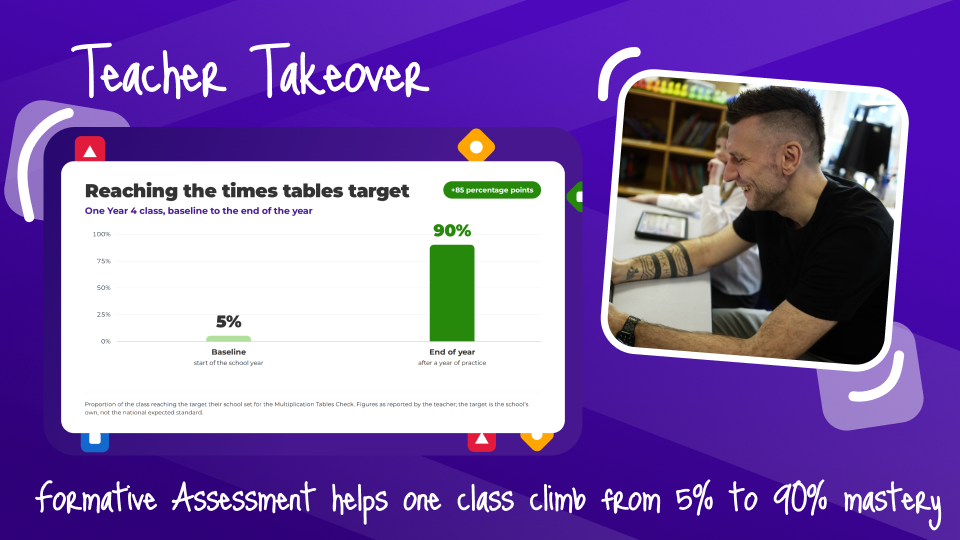
The results of this strategic pivot have been nothing short of transformative. Over the course of a single academic year, the proportion of Hunt’s students meeting the school’s rigorous MTC targets skyrocketed from a baseline of 5% to an extraordinary 90%. This in-depth investigative report examines the mechanics of Hunt’s methodology, the cognitive science behind progressive skill-building, and the broader implications for modern formative assessment in primary education.
Detailed Chronology: Rethinking the Gamified Classroom
To understand the magnitude of Hunt’s transformation, one must first look at conventional classroom practices. Historically, educators design a curriculum, deliver weeks of lectures and worksheets, and finally administer a quiz to measure retention. If students fail, remediation is rushed, or students are simply left behind as the syllabus marches forward.
Hunt’s methodology challenges this linear model through a deliberate, multi-phase cyclical process:
Phase 1: Pre-Assessment Without the Pressure
Ahead of any instructional unit—such as a history module on the Romans or a mathematics block on multiplication—Hunt builds a ten-question Kahoot! quiz. Crucially, these questions do not reflect what he plans to teach that week; instead, they target what he expects the students to master six weeks later, upon the unit’s completion.
Crucially, Hunt removes the competitive elements during this initial diagnostic phase. He disables the timer-based scoring system so that answers carry identical weight whether submitted in two seconds or twenty.
"The first game is not there to be passed," Hunt explains. "It is there to show me where to aim: what the children already know, where the gaps sit, and which questions a surprising number of them can already handle."
Phase 2: Data-Driven Curriculum Redesign
Instead of pushing forward with a pre-written lesson plan, Hunt analyzes the automated data reports generated by the platform. The software categorizes questions by overall class failure rates while isolating individual student knowledge gaps. This transforms the lesson planning process:
Pruning Redundancies: If the diagnostic reveals that the class has already mastered a core concept, Hunt eliminates redundant instructional lessons, saving valuable classroom hours.
Targeted Intervention: If a systemic misconception surfaces in week one, it is addressed immediately rather than discovered in week six when remedial time has vanished.
Phase 3: Progressive Complexity and Scaffolding
To prepare students for high-stakes standardized assessments like the DfE Multiplication Tables Check—where students face twenty-five rapid-fire questions with a strict six-second limit per screen—Hunt avoids throwing children straight into the deep end.
Instead, he builds confidence and muscle memory iteratively:
Multiple Choice with Generous Timers: Students begin with familiar multiple-choice formats paired with comfortable time limits.
Gradual Speed Compression: Over successive weeks, the timer is incrementally reduced. Because the changes are microscopic, students adapt without experiencing examination panic.
Format Shifts: Once comfortable with the speed, Hunt transitions from multiple-choice options to free-recall typing ("Type Answer"), forcing students to generate the numerical product (e.g., producing "56") entirely from memory rather than picking it out of a visual line-up.
Phase 4: Post-Instructional Benchmarking
At the conclusion of the unit, Hunt re-administers the exact same ten-question Kahoot! diagnostic. Because students log in using consistent identifiers, the platform matches the initial report against the final report on a student-by-student basis. This longitudinal tracking provides undeniable proof of individual growth while flagging lingering vulnerabilities for subsequent teachers.
Supporting Context & Metrics: Tackling the Multiplication Tables Check
The DfE Multiplication Tables Check is a notorious stress point for UK primary schools. Administered every June to Year 4 students, it evaluates rapid arithmetic fluency across the 2 to 12 times tables.
When the assessment was first introduced, schools encountered a widespread barrier: nine-year-olds faced with a rigid, six-second digital timer frequently succumbed to cognitive overload and performance anxiety. Baseline metrics across Hunt’s school historically reflected this barrier, with only about 5% of incoming Year 4 pupils meeting the target benchmarks organically.
By substituting traditional drill-and-kill worksheets with carefully scaffolded, gamified micro-assessments, Hunt achieved a staggering 17-fold increase in benchmark attainment. More importantly, the acquisition of mathematical fluency shifted from an arduous chore to an engaging, low-anxiety daily routine.
Official Statements and Expert Perspectives
Hunt’s success has resonated deeply within the broader educational technology community, drawing praise from fellow educators and pedagogical specialists alike.
Reflecting on his philosophical shift regarding educational software, Hunt notes:
"A few years ago, I probably wouldn’t have thought of Kahoot! as an assessment tool. It was engaging, the children loved it, and it brought that little bit of competition into the classroom. Now, however, assessment is one of the main reasons we use it."
Emphasizing the logistical and planning advantages of automated data capture, Hunt adds:
"That pre-assessment information can actually change my lesson planning. There is little point spending several lessons teaching something the children already know. Equally, if the data highlights a misconception, I can make sure we tackle it."
Furthermore, Hunt highlights the collaborative and longitudinal value of retaining these digital performance reports:
"We can see the progress, identify anything that still needs revisiting, and keep that information for the next teacher too. That, for me, is where Kahoot! becomes much more than a quiz. For me, the data behind Kahoot! is just as useful as the game itself."
Future Outlook: The Evolution of Formative Assessment
Simon Hunt’s methodology offers a compelling blueprint for the future of EdTech integration in primary and secondary education. As schools increasingly seek evidence-based strategies to bridge learning gaps exacerbated by educational disruptions, passive screen time is rapidly losing favor.
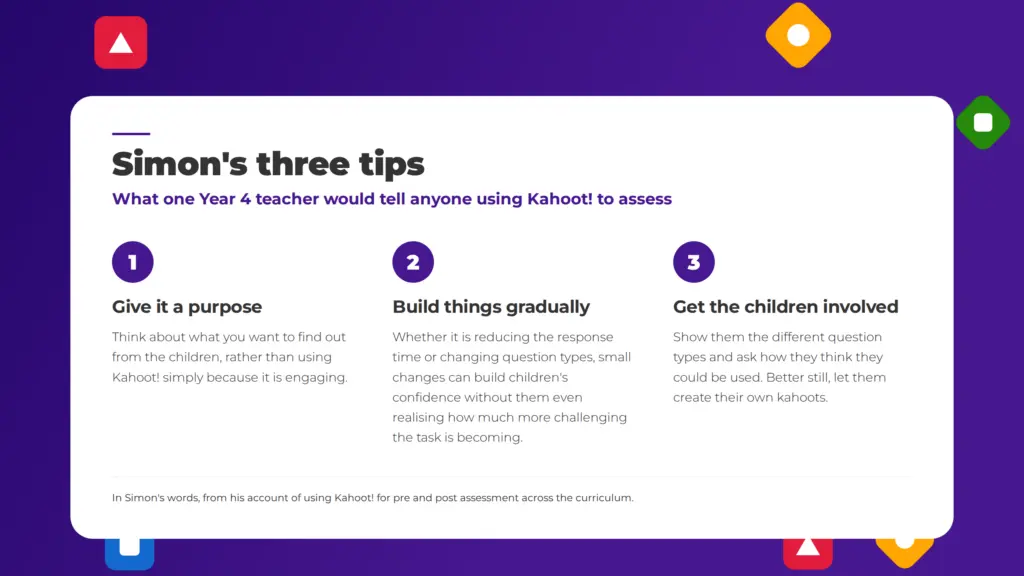
The industry is moving toward active learning frameworks where digital tools act as diagnostic partners rather than mere entertainment. Hunt’s pragmatic advice for educators looking to replicate his success centers on three core principles:
Intentional Design: Always determine what specific data you need to extract before building a game.
Iterative Scaffolding: Adjust only one variable at a time (e.g., reducing the timer one week, switching question types the next) to allow student confidence to match increasing cognitive loads.
Student Empowerment: Involve the children in the creation process. By having students build their own quizzes and explore question mechanics, educators cultivate deep meta-cognitive awareness.
Ultimately, Hunt’s journey demonstrates that the most powerful educational innovations do not always require purchasing expensive new curricula or overhauling school infrastructure. Often, true transformation occurs simply by unlocking the latent potential of tools already present in the classroom, transforming casual play into purposeful, data-driven mastery.