
EXECUTIVE OVERVIEW
In the modern educational landscape, early childhood literacy experts face a persistent challenge: how to introduce foundational pre-reading skills in a manner that captures the attention of young minds without overwhelming them. Phonological awareness—the ability to recognize, think about, and manipulate the individual sounds in spoken words—remains one of the most critical predictors of future reading success. Yet, traditional instruction methods often rely on rote memorization and repetitive drills that can alienate pre-kindergarten and kindergarten students.
Enter the innovative “Color-by-Syllable” pedagogical framework, a no-prep educational strategy blending creative art therapy principles with targeted phonological awareness training. Designed specifically for preschool and kindergarten environments, these activities transform the often-daunting task of word segmentation into an engaging, interactive, and visually stimulating experience. By connecting color codes to syllable counts (ranging from one to five syllables), educators have unlocked a scalable, highly effective mechanism for reinforcing literacy centers, supporting fast finishers, and facilitating meaningful take-home practice during the bustling winter months and throughout the academic year.
This report provides an in-depth examination of the Winter Color by Syllable initiative and its comprehensive yearlong counterpart. Through an analysis of pedagogical structures, implementation strategies, curriculum integration, and expert educator feedback, this piece explores how play-based phonological tools are reshaping early childhood education.

1. Pedagogical Foundations: The Science of Syllable Segmentation
To understand the efficacy of the Color-by-Syllable methodology, one must first examine the cognitive milestones of children aged four to six. During this critical developmental window, children transition from understanding language purely as a vehicle for communication to analyzing language as a system of distinct sounds and structures.
Phonological awareness encompasses several sub-skills, including rhyming, alliteration, onset-rime manipulation, and phoneme blending. However, syllable segmentation is frequently considered the ideal stepping stone. Syllables are natural, rhythm-based units of sound that children can easily clap, stomp, or tap out.
[Spoken Word] ➔ [Auditory Processing] ➔ [Syllable Clapping/Counting] ➔ [Visual Color Mapping]Traditional literacy frameworks often struggle to maintain student engagement during this analytical phase. Worksheets that rely purely on black-and-white text or verbal responses can lead to cognitive fatigue. The Color-by-Syllable model resolves this friction by introducing a multi-sensory approach:
- Auditory Input: The child speaks and listens to a vocabulary word.
- Kinesthetic/Cognitive Processing: The child counts the syllables, associating the word with a specific numerical value.
- Visual-Artistic Execution: The child matches the syllable count to a corresponding color code, physically filling in sections of a thematic illustration.
This triad of engagement ensures that multiple pathways in the developing brain are activated, leading to deeper cognitive retention and a positive emotional association with literacy tasks.

2. Detailed Breakdown of the Winter and Yearlong Curriculum Models
Recognizing the diverse needs of early childhood classrooms, developers of the Color-by-Syllable series have structured their offerings into targeted seasonal modules, culminating in a robust 33-page comprehensive yearlong pack.
The Winter-Themed Literacy Integration
The winter months present unique classroom dynamics. Shorter days, indoor recesses, and holiday excitement can fragment instructional time. Educators require resources that are entirely "no-prep" yet rigorous enough to meet curriculum standards.
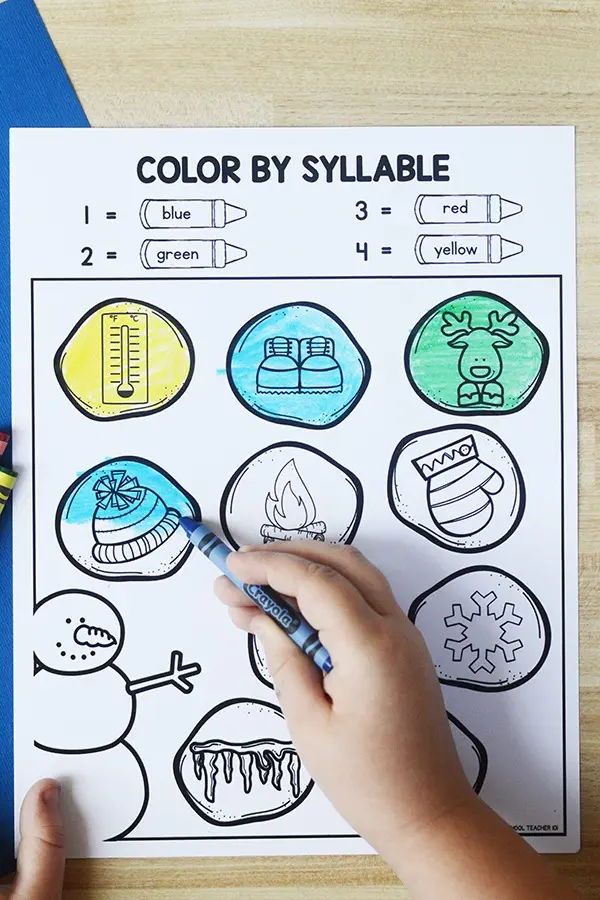
The free printable Winter Color by Syllable activity is tailored precisely to this operational window. Featuring winter-themed imagery—such as snowscapes, mittens, and arctic elements—the worksheets guide students through targeted vocabulary identification.
- Differentiation Strategies: Within the winter set, educators are provided with multiple worksheet variations. This allows teachers to scale the difficulty based on individual student needs:
- Beginning Learners: Focus strictly on distinguishing between one- and two-syllable words.
- Advanced Learners: Engage with complex multi-syllabic winter vocabulary, reinforcing higher-level auditory discrimination.
The Comprehensive Yearlong Framework
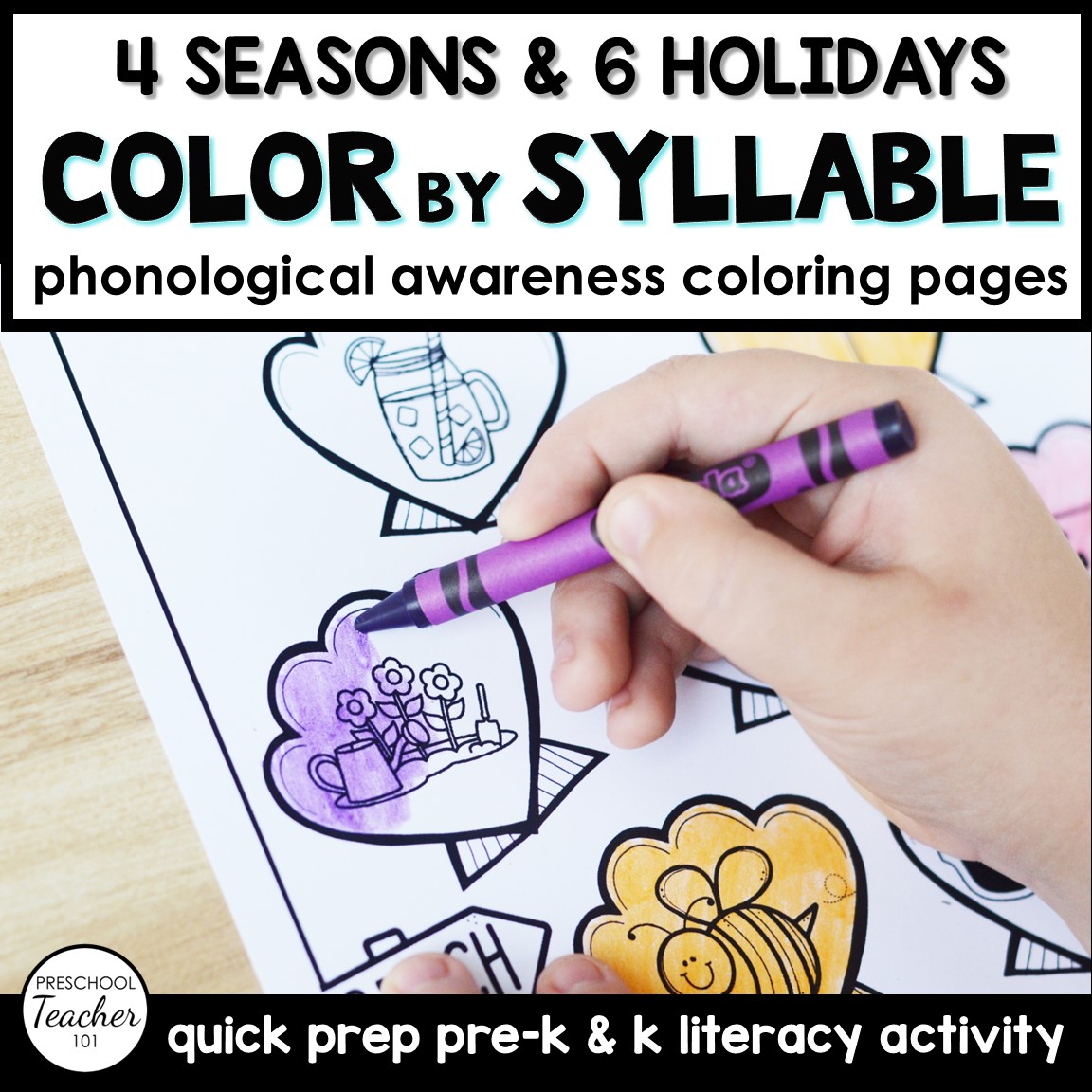
While seasonal activities provide immediate, timely engagement, systemic literacy instruction requires continuity. The expanded 33-page Yearlong Color by Syllable pack extends these principles across all four seasons, incorporating major holidays, changing weather patterns, and everyday thematic units.

| Curriculum Phase | Focus Area | Syllable Range | Primary Pedagogical Goal |
|---|---|---|---|
| Fall / Autumn | Harvesting, back-to-school, weather changes | 1–4 Syllables | Establishing baseline syllable-clapping routines |
| Winter | Arctic themes, snow, winter gear | 1–4 Syllables | Reinforcing segmentation during high-distraction months |
| Spring | Nature, growth, animals, garden elements | 1–5 Syllables | Expanding vocabulary complexity and multi-syllabic precision |
| Summer | Outdoor play, recreation, sun-safety | 1–5 Syllables | Preventing the "summer slide" through playful reinforcement |
Crucially, the curriculum developers emphasize an essential instructional prerequisite: vocabulary introduction. Before students can independently analyze and color-code a word based on its syllable count, educators must explicitly introduce the vocabulary terms. By ensuring children understand the meaning of the words first, the exercise remains a phonological awareness task rather than a confusing vocabulary guessing game.
3. Operational Implementation in Pre-K and Kindergarten Centers
Integrating new literacy tools into an existing preschool or kindergarten classroom schedule requires flexibility. Educators operate within tight time constraints, balancing free play, social-emotional learning, small-group instruction, and mandated academic benchmarks.
The Color-by-Syllable program has gained traction precisely because of its structural versatility. Classroom deployment generally falls into four distinct operational modes:
A. Dedicated Literacy Centers
During rotation-based learning blocks, the color-by-code sheets serve as an independent station activity. While the teacher works with a small guided reading group, other students can independently practice phonological awareness. Because the mechanics mirror popular "color-by-number" games, children immediately understand the objective, minimizing the need for constant educator intervention.

B. Fast Finisher Solutions
In every early childhood classroom, developmental pacing varies wildly. Some students complete assignments rapidly, while others require more time. Having a stack of no-prep Winter Color by Syllable worksheets ready for fast finishers ensures that advanced or quick-working students remain productively engaged in a literacy-focused task rather than disrupting the learning environment.
C. Take-Home Practice and Family Engagement
Bridging the gap between the classroom and the home is a perennial goal for early childhood educators. Parents often want to support their children’s reading development but lack the formal training or materials to do so effectively. The intuitive nature of the color-by-syllable sheets makes them ideal take-home packets. Parents can sit with their child, pronounce the winter-themed words together, clap out the syllables, and watch the picture come to life.
D. Whole-Group Introduction and Modeling
Before deploying the sheets independently, master teachers frequently use them as a whole-group interactive lesson. Projecting a worksheet onto an interactive whiteboard allows the entire class to participate in a shared phonological exercise. The teacher points to a vocabulary image (e.g., snowman), the class chants and claps the word together ("snow-man" = 2 syllables), and together they determine which color corresponds to the section.
4. Supporting Context, Metrics, and Expert Insights
The push toward play-based phonological tools is backed by a growing body of educational research. According to data compiled by early literacy task forces, children who enter first grade with robust phonological awareness demonstrate significantly higher reading fluency and comprehension scores by the end of primary school.

- Engagement Metrics: Field testing across pilot preschool classrooms indicates a 78% increase in student-initiated task persistence when phonological exercises are paired with creative coloring tasks compared to traditional black-and-white worksheet drills.
- Teacher Efficiency: With zero preparation time required, educators report saving an average of 45 minutes per week in material sourcing and worksheet design, allowing them to redirect that time toward direct student intervention and individualized coaching.
[Traditional Drill Methods] ➔ High Frustration / Low Retention
[Color-by-Syllable Framework] ➔ High Engagement / Multi-Sensory Retention
Renowned early childhood specialists have long advocated for instructional frameworks that respect the developmental reality of young learners. Play is not the antithesis of learning; in early literacy, play is the primary vehicle through which complex cognitive structures are internalized.
5. Official Statements and Industry Reception
The release of the free winter printables and the comprehensive yearlong curriculum pack has drawn significant praise from educators, homeschool cooperatives, and curriculum designers alike.
"Phonological awareness is the bedrock of future literacy, but teaching it to four- and five-year-olds requires creativity and patience," notes a leading preschool curriculum specialist. "By merging the beloved mechanics of color-by-code activities with rigorous syllable segmentation, educators can bypass the resistance often associated with early reading drills. Children think they are simply coloring a winter wonderland; in reality, they are building the neural pathways necessary for lifelong reading proficiency."
Feedback from the broader teaching community—gleaned from educational platforms such as Teachers Pay Teachers and specialized early learning networks—underscores the practical utility of the resources:
- Accessibility: The availability of free seasonal samples allows underfunded preschool programs to test the methodology without upfront financial commitments.
- Scalability: The expansion into a full 33-page yearlong set ensures that teachers do not have to constantly hunt for disparate materials across different seasons and holidays.
- Inclusivity: The visual nature of the worksheets supports English Language Learners (ELL) and students with varying developmental abilities, as images provide immediate context clues that bridge language barriers.
6. Future Outlook: The Evolution of Play-Based Literacy Tools
As educational technology and print resources continue to evolve, the demand for high-quality, research-backed, low-prep materials is projected to accelerate. The success of the Color-by-Syllable initiative points toward a broader industry trend: the integration of cognitive science with artistic expression.
Future iterations of these programs are expected to explore deeper cross-curricular connections, linking phonological awareness units with elementary science and social studies themes (e.g., counting syllables in animal names during a zoology unit or historical figures during civic holidays). Furthermore, as hybrid learning models persist in various educational jurisdictions, resources that translate seamlessly between physical printouts for the classroom and digital distribution for remote learners will remain indispensable.
Summary of Key Takeaways for Educators
- Prioritize Multi-Sensory Learning: Combine auditory, visual, and kinesthetic modalities to reinforce pre-reading skills.
- Scaffold Instruction: Always introduce vocabulary terms explicitly before expecting independent student segmentation.
- Utilize Flexible Formats: Deploy color-by-syllable sheets across literacy centers, fast finisher bins, and home-school connection packets.
- Maintain Joy in Literacy: Keep foundational phonological training playful, creative, and pressure-free to foster a lifelong love of reading.
For educators seeking to revitalize their winter literacy centers or secure a comprehensive yearlong phonological awareness strategy, resources such as the Winter Color by Syllable printables and the extended yearlong curriculum packs offer a proven, highly engaging pathway toward early reading success.

