
By Lia Milgram, Managing Editor for ACTE
Executive Overview
As the Association for Career and Technical Education (ACTE) marks a monumental century of service, the fundamental questions guiding vocational and technical education have never felt more urgent. From September 2025 through May 2026, Techniques magazine embarked on an extensive journalistic inquiry, tracking educators, program leaders, and advocates as they confronted Career and Technical Education’s (CTE) most enduring and complex challenges.
What does it truly take to construct educational pathways that reach every single learner, leaving no demographic behind? How do physical learning spaces, institutional cultures, and daily experiences actively shape what students believe is possible for their futures?
The resulting archive—comprising eight landmark features published across the academic year—proves that the finest CTE narratives are never solely about structural programs or funding formulas. Instead, they are deeply human stories. They are chronicles of the individuals inside the classrooms, labs, and workshops: what they built, what they believed, and what they stubbornly refused to give up on. This retrospective explores those defining moments, offering a rigorous examination of the state of modern CTE as it bridges a storied past with an innovative future.

Detailed Chronology: A Year of Transformative Inquiry
The academic year 2025–2026 served as a crucible for testing, redefining, and elevating CTE standards nationwide. Through a month-by-month exploration, Techniques captured the shifting paradigms of vocational and professional instruction.
September 2025: Skills Over Stigma
The academic year opened with a stark look at equity and redemption. High-quality CTE is fundamentally a promise of upward mobility, but for justice-impacted learners, the stakes of that promise are exceptionally high, and the systemic barriers are painfully real.
Writing from direct, lived experience, a guest contributor—once justice-impacted and now a dedicated leader in education and reentry—made a compelling case for building educational pathways that prioritize raw skills over outdated stigmas. This foundational piece challenged educators to dismantle institutional biases, proving that second chances backed by rigorous technical training can radically alter recidivism rates and community stability.
October 2025: Leading the Change
As the fall semester gained momentum, the conversation shifted to leadership and perception. The national narrative surrounding CTE is undergoing a massive transformation, spearheaded in large part by the alumni of the NextLevel Postsecondary CTE Fellowship.

Representing a diverse cross-section of institutions—from sprawling community college systems to specialized technical institutes across the country—these leaders shared a unifying revelation: their students have been their greatest teachers. The October feature celebrated these education pioneers who are actively dismantling historical stigmas, proving that modern CTE is a primary driver of higher-education innovation.
November–December 2025: Student-Centered Work-Based Learning
Closing out the calendar year, Techniques turned its focus to the mechanics of experience. Work-based learning (WBL) reaches peak effectiveness only when it actively encourages learners to explore their authentic interests rather than forcing them down rigid, pre-determined tracks.
Meaningful career exploration demands the institutional freedom to question, refine, and occasionally redirect one’s focus. Because this developmental journey looks entirely different for every student, the November/December issue dissected the precise architectural frameworks required to design WBL experiences that meet students precisely where they are and propel them toward what is possible.
January 2026: High-Quality CTE by Design
Kicking off the new calendar year, the publication tackled a critical operational blind spot: wraparound student supports. Too often treated as secondary, supplemental additions to a budget, these services are, in reality, the structural glue keeping students engaged and on track for program completion.

When services like mental health counseling, childcare assistance, food security programs, and academic tutoring are embedded directly into program design from day one, the institutional culture shifts dramatically. January’s feature mapped out how this proactive integration transforms outcomes not just for individual students, but for the institutions and local economies counting on their success.
February 2026: Meaningful Student Experiences Through Space
Physical environments communicate volumes before a single lesson is taught. The strongest CTE programs are built upon a cohesive curricular vision, and the physical spaces housing them must reflect that intentionality.
The February feature provided administrators with a practical, highly actionable roadmap for facilities design. Crucially, this framework rarely requires expensive new construction; instead, it begins with an imaginative, mission-driven reassessment of existing footprints. By optimizing physical spaces, programs ensure that students can visualize themselves in high-demand future careers the exact moment they walk through the door.
March 2026: A Century of Storytelling and Advocacy
In March, ACTE celebrated its historic centenary, prompting a deep dive into the mechanics of advocacy. While hard quantitative data is indispensable for making the fiscal case for CTE, human stories are what compel people to remember why it matters.

This commemorative feature explored how ACTE leverages storytelling as an advocacy tool, most notably through the intimate, resonant medium of documentary film. By capturing the human element, the Association brought the tangible impact of CTE into sharp focus, connecting a century of visionary educational leadership to the modern students, instructors, and communities writing the next chapter.
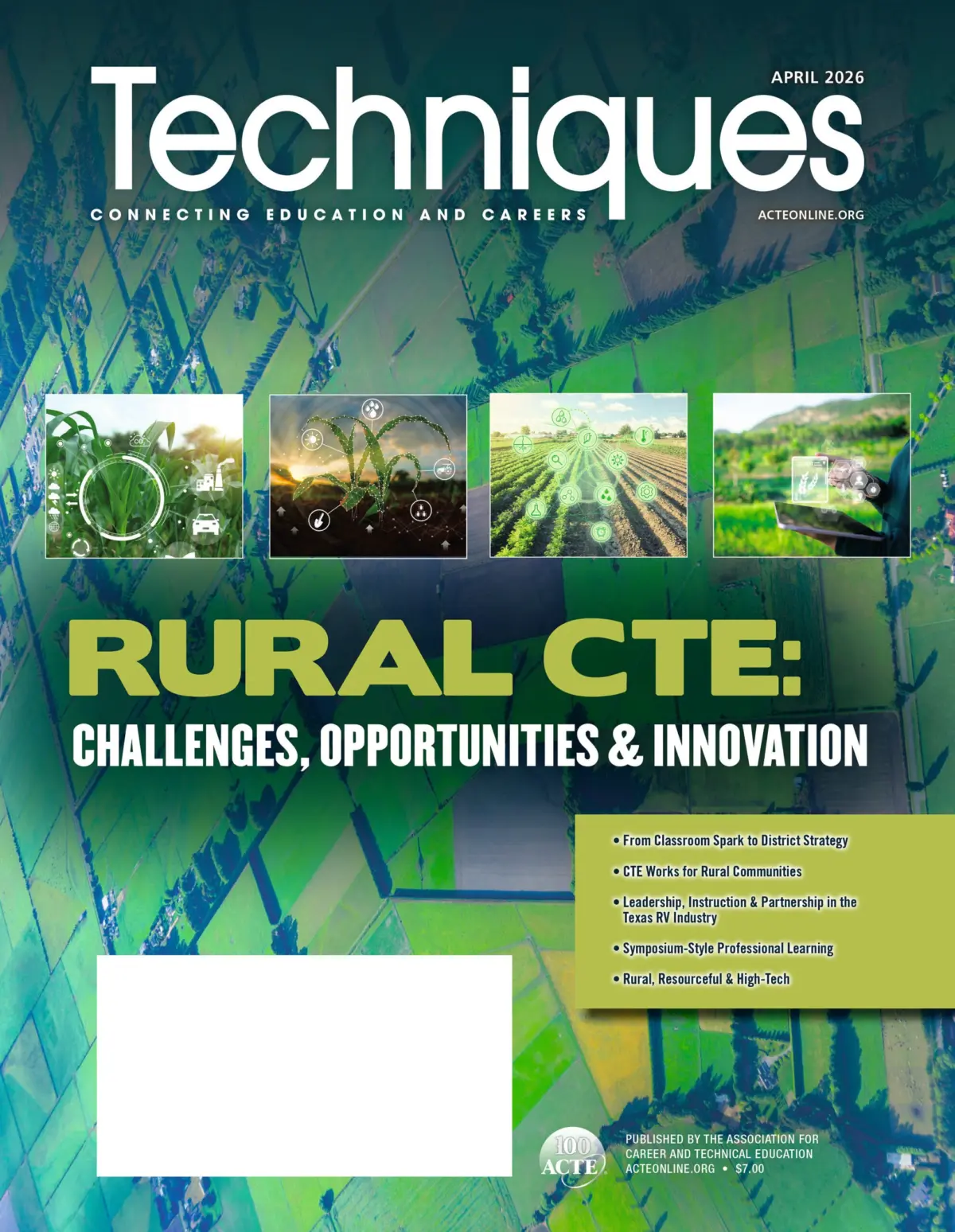
April 2026: Navigating Rural Challenges and Opportunities
Rural America faces distinct, severe headwinds in education. With dwindling local workforce numbers, shrinking tax bases, and severely limited community services, rural CTE programs often operate under the constant threat of closure.
The April issue delivered a critical lifeline: a practical framework designed to help rural administrators translate qualitative program impact into hard, persuasive data. By connecting immediate student achievement metrics directly to broader workforce development needs and long-term community investments, this article offered a blueprint for survival and growth in America’s heartland.
May 2026: Ending the Revolving Door of Teacher Retention
The academic year culminated in May with an unvarnished look at the educator retention crisis. Consider a composite reality highlighted in the issue: a seasoned professional leaves a lucrative career in the insurance industry to answer the call of the classroom as a CTE teacher, only to resign just two days into the school year.
Utilizing original research, the May feature examined a systemic pattern that plagues technical education nationwide. It offered program leaders a research-backed blueprint for retaining industry experts in the classroom. The core finding was clear: when teacher induction is treated as an immersive, supportive developmental experience rather than a perfunctory administrative checklist, industry professionals stay—and when they stay, students and programs thrive.
Supporting Context & Metrics: The State of CTE Today
To fully appreciate the insights gathered by Techniques across this academic year, one must examine the broader socio-economic landscape of modern Career and Technical Education.
+-----------------------------------------------------------------------------------+
|                         THE MODERN CTE ECOSYSTEM AT A GLANCE                      |
+------------------------------+----------------------------------------------------+
| Focus Area                   | Key Impact Metric / Strategic Shift                |
+------------------------------+----------------------------------------------------+
| Justice-Impacted Learners    | Prioritizing skill acquisition to reduce recidivism|
| Postsecondary Leadership     | Scaling innovation via alumni fellowship networks  |
| Work-Based Learning          | Transitioning from rigid tracks to flexible models |
| Wraparound Services          | Embedding support systems into foundational design |
| Facilities Optimization      | Aligning physical environments with career identity|
| Rural Sustainability         | Converting program outcomes into data-driven ROI   |
| Educator Induction           | Moving from checklists to immersive support        |
+------------------------------+----------------------------------------------------+
The data gathered across these eight focus areas reveals several vital trends:
- The Skills Gap Reality: Industries across manufacturing, healthcare, information technology, and green energy face unprecedented talent shortages, placing immense pressure on CTE programs to scale efficiently.
- The Retention Imperative: With industry professionals often taking significant pay cuts to enter education, standard bureaucratic onboarding has proven catastrophic for retention. Programs utilizing high-touch, immersive induction models report drastically lower first-year turnover.
- Holistic Student Demographics: Modern CTE classrooms are not monolithic. They serve justice-impacted individuals seeking reinvention, rural students combating geographic isolation, and traditional learners requiring robust wraparound supports to balance work, life, and study.
Official Statements & Expert Perspectives
The collective wisdom of the educators, researchers, and administrators featured in Techniques underscores a unified philosophy: CTE is not an alternative educational track; it is an essential engine of American ingenuity and economic equity.

"The best CTE stories are never only about programs. They are about the people inside them—what they built, what they believed, and what they refused to give up on."
— Lia Milgram, Managing Editor, ACTE
Throughout the centennial year, contributors consistently emphasized that structural reform must be matched by cultural evolution. Whether discussing the reimagining of physical workshops to mirror modern industrial spaces, or arguing for the systemic inclusion of wraparound services, the consensus among educational leaders is unequivocal. Quality cannot be an afterthought; it must be engineered into the very DNA of vocational program design.
Furthermore, leadership voices from the NextLevel Fellowship underscored the necessity of narrative reclamation. For decades, vocational education suffered from a persistent, undeserved stigma. Today, fellowship alumni and institutional advocates are actively rewriting that narrative, proving that technical proficiency requires advanced critical thinking, complex problem-solving, and continuous adaptation.
Future Outlook: The Next Century of Educational Leadership
As ACTE closes its first hundred years and looks toward the horizon, the roadmap established by Techniques provides a clear vision for the future of Career and Technical Education.

- Bridging Equity Gaps: Future program development must double down on equitable access, ensuring that justice-impacted individuals, rural communities, and historically marginalized groups find clear, unobstructed pathways to high-wage, high-demand careers.
- Modernizing the Educator Pipeline: Solving the teacher shortage will require a wholesale reinvention of how industry experts are welcomed into education. Transforming induction from a paper-pushing exercise into a supportive professional community will be paramount.
- Data-Driven Advocacy: As federal and state funding environments fluctuate, programs must master the art of articulating their return on investment (ROI). Translating student success stories into rigorous, quantifiable data will secure the long-term community investments necessary for survival and expansion.
- Holistic Infrastructure: The integration of wraparound supports and flexible, identity-affirming physical spaces will transition from being "nice-to-have" amenities to becoming baseline requirements for institutional accreditation and student success.
The questions asked by Techniques between September 2025 and May 2026—What does it take to build pathways that reach every learner? How do spaces shape possibility?—will continue to serve as the guiding light for educators committed to shaping the next century of American workforce development.
To explore these topics in greater depth or to submit your own work for consideration in upcoming editions, visit the official ACTE Techniques Editorial Calendar.

