

Executive Overview
As artificial intelligence rapidly transitions from an experimental novelty to the operational backbone of the modern enterprise, a profound and unintended consequence is coming to light: the technology designed to augment human potential may actually be degrading it. A comprehensive global study released by the IBM Institute for Business Value (IBV), titled "Designing the Thinking Organization," reveals a startling paradox at the heart of the modern workplace. While generative and autonomous AI systems are actively reshaping the daily responsibilities of professionals across the globe, they are simultaneously eroding the exact human capabilities—critical thinking, independent judgment, and rigorous oversight—that employers need most to manage these very tools.
The research exposes a dangerous disconnect between corporate leadership and the frontline workforce. Executives increasingly rely on AI to drive efficiency, yet they underestimate the cognitive atrophy occurring among employees who are delegating complex problem-solving tasks to algorithms. More than half of surveyed employees report that their day-to-day duties have shifted dramatically over the past year due to AI integration. However, organizations are largely failing to keep pace; fewer than three in ten companies have clearly defined workflows distinguishing human-led, AI-assisted, and fully automated activities.
This governance vacuum has transformed the workplace into a reactive environment where ad-hoc adaptation replaces deliberate organizational design. As AI assumes the foundational layers of cognitive labor, workers risk losing the muscle memory of analysis and validation. For C-suite leaders, chief human resources officers (CHROs), and workforce strategists, the findings serve as an urgent call to action. Traditional reskilling programs—which focus primarily on teaching employees how to use new technologies—are no longer sufficient. Enterprises must now confront the silent erosion of core cognitive faculties and fundamentally redesign how humans and machines collaborate before the foundation of workplace expertise collapses entirely.
Detailed Chronology and Research Methodology
The insights compiled in "Designing the Thinking Organization" are the result of an extensive international empirical research initiative conducted between April and June 2026. Recognizing that the integration of artificial intelligence is no longer merely an IT challenge but an existential workforce transformation, the IBM Institute for Business Value partnered with economic research firm Oxford Economics to map the shifting dynamics of the global labor market.

The study’s methodology is expansive, drawing data from two distinct, highly targeted surveys designed to capture both top-down strategic perspectives and bottom-up employee experiences:
- The Executive Cohort: Researchers surveyed 1,500 Chief Human Resources Officers (CHROs) and senior executives holding direct responsibility for workforce strategy, organizational design, and talent management. This group spanned 21 distinct geographic regions and 23 major industries, offering a panoramic view of how global leadership perceives the AI-driven transformation of labor.
- The Employee Cohort: To counterbalance executive assumptions, the study surveyed 8,800 full-time employees operating across 28 countries. This diverse pool provided a granular, grassroots look at how daily workflows, skill requirements, and job satisfaction are actually evolving on the ground.
The timeline of the study’s release coincides with a critical inflection point in enterprise AI adoption. Throughout late 2024 and 2025, organizations raced to deploy generative AI tools to capture immediate productivity gains. By early 2026, however, the initial honeymoon phase of deployment gave way to operational friction. Enterprises began encountering the limits of unsupervised AI, hallucinations, workflow bottlenecks, and—most critically—a growing competency gap among workers who had grown overly reliant on automated systems.
By capturing data during this precise window, the IBM and Oxford Economics study documented the exact moment realization dawned on corporate leadership: the bottleneck of the AI era is not computational power or software capability, but human cognitive readiness. The resulting data visualisations, summarized in analytical graphics produced from the underlying datasets, map out stark divergences in how executives and employees view critical thinking, skill degradation, workflow definition, and the reinvestment of AI-driven productivity dividends.
Supporting Context, Metrics, and the Executive-Employee Disconnect
The empirical data gathered in the IBM study reveals a web of disconnects between what leadership believes is happening and what employees experience on the factory floors, in corporate offices, and across remote workspaces. Chief among these disconnects is the velocity of change versus the intentionality of organizational design.
The Workflow Deficit
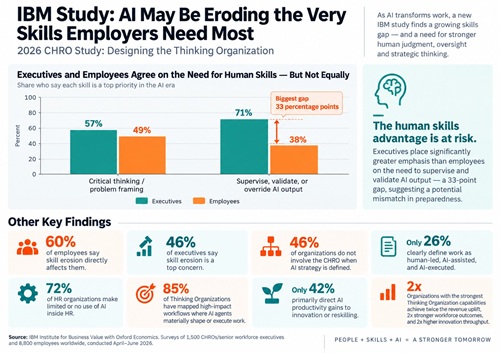
According to the study, 52% of employees report that their assigned tasks and core responsibilities changed significantly over the past 12 months as AI reshaped their day-to-day routines. Yet, when researchers examined how organizations are managing this seismic shift, a profound structural vulnerability emerged: only 26% of enterprises have clearly defined their workflows across human-led, AI-assisted, and AI-executed activities.
This data indicates that work is changing at a pace far faster than organizations are redesigning it. Instead of deliberate, strategic structural re-engineering, daily adaptation has become the default. Employees are left to figure out the boundaries of human-machine collaboration on the fly, leading to cognitive fatigue, role ambiguity, and an over-reliance on automated tools without adequate supervisory frameworks.
The Oversight and Judgment Divide
The stakes of this unstructured transition are highlighted by the widening gap in how leadership and labor view critical thinking and AI validation.
- Problem Framing and Critical Thinking: There is moderate baseline agreement on the foundational importance of problem framing. Approximately 57% of executives and 49% of employees place critical thinking near the top of the skills required for modern, AI-enabled work.
- Supervising and Overriding AI: A massive chasm opens when discussing the mechanical realities of AI validation. Fully 71% of executives prioritize the ability of workers to supervise, validate, or override AI outputs. In stark contrast, only 38% of employees share this priority—representing a glaring 33-percentage-point perceptual gap.
- Valuing Professional Judgment: Further compounding this issue, only 29% of employees actively rank professional judgment as a top priority in their day-to-day roles.
This disconnect explains why errors propagate in AI-integrated workflows. Executives assume workers are maintaining a vigilant posture of critical oversight, constantly checking algorithms for bias, factual drift, or hallucinations. Meanwhile, employees—overwhelmed by volume and conditioned to view AI outputs as authoritative—are increasingly adopting a passive role, treating machine-generated suggestions as final answers rather than provisional drafts requiring rigorous interrogation.

The Anatomy of Skill Erosion
Perhaps the most alarming metric uncovered by the research centers on skill erosion. While 46% of executives acknowledge skill erosion as a top corporate concern, a staggering 60% of employees report that it directly affects them on an individual level.
Among the workforce cohort that worries about skill degradation, three out of four respondents (75%) state that AI has already begun to erode at least some of their core professional capabilities. When asked which specific faculty is declining most rapidly, workers point overwhelmingly to critical thinking.
IBM draws a sharp, critical distinction between this phenomenon and a conventional skills gap. Traditionally, a skills gap implies that workers lack new competencies required by emerging technologies—a challenge that can be solved by teaching employees new tools. To address this, 80% of enterprises have already established reskilling roadmaps. However, IBM argues that these traditional training programs miss the mark entirely. Reskilling focuses on what employees need to acquire, failing to address existing foundational skills that quietly wither away as automated systems take over the underlying cognitive labor. When an algorithm writes the first draft, constructs the financial model, or synthesizes the research report, the human worker loses the cognitive repetition necessary to maintain mastery over those very tasks.
Official Statements and Industry Perspectives
The release of "Designing the Thinking Organization" has triggered intense debate across the human resources and corporate governance landscapes, prompting major commentary from corporate leaders and research analysts alike.

Highlighting the gravity of the findings, leadership at IBM emphasized that the future of enterprise productivity hinges on preserving human agency. In the official corporate announcement accompanying the study, executives stressed that artificial intelligence must act as a catalyst for cognitive enhancement rather than cognitive outsourcing.
"AI is fundamentally altering the architecture of work, but organizations are making a critical mistake if they treat this purely as a technology deployment challenge," industry analysts note regarding the findings. "When you automate the friction out of work, you often automate out the cognitive struggle required to build and maintain expertise. Enterprises must consciously design workspaces that force human engagement, deliberation, and critical friction."
Human resources leaders surveyed in the global cohort echoed these sentiments, pointing out that the traditional metrics of productivity are blinding organizations to long-term talent risks. While short-term efficiency metrics spike when AI absorbs routine administrative and analytical loads, the long-term health of the organization is compromised if the workforce loses its ability to think independently, solve novel problems, or exercise sound ethical judgment when algorithms fail.
Furthermore, workforce strategists have warned against the temptation to lean entirely into automation without establishing robust internal "human-in-the-loop" accountability. Without active intervention from CHROs and operational leaders, companies risk creating a generation of corporate workers who are fluent in prompting AI systems, yet fundamentally incapable of auditing, challenging, or replacing flawed machine outputs when high-stakes decisions are on the line.

Future Outlook: Redesigning the Thinking Organization
As enterprises look toward the remainder of the decade, the implications of the IBM Institute for Business Value study demand a radical pivot in workforce strategy. The era of unchecked, ad-hoc AI adoption is reaching its limits. To survive and thrive in an increasingly automated economy, organizations must move from passive AI consumers to active architects of human-machine symbiosis.
1. Moving Beyond Traditional Reskilling
Corporate training programs must evolve. Standard modules that teach employees how to write better prompts or navigate software interfaces are no longer sufficient. Organizations must design continuous learning environments that deliberately simulate cognitive challenges, forcing employees to practice manual problem-solving, data auditing, and critical evaluation. Just as physical workers require training to prevent physical atrophy, knowledge workers will require structured cognitive workouts to maintain mental acuity in highly automated environments.
2. Formalizing Workflow Architecture
With only 26% of organizations currently defining work across human-led, AI-assisted, and AI-executed tiers, closing the governance gap is paramount. CHROs and operations leaders must collaborate to map every critical business process. By explicitly designating which tasks require rigorous human oversight and which can be safely delegated to automation, enterprises can eliminate ambiguity and restore a healthy sense of ownership and accountability to the workforce.
3. Re-evaluating Productivity and Judgment
Executive leadership must decouple short-term speed metrics from long-term competence. Efficiency gains achieved through AI should be partially reinvested not just into top-line growth, but into structured employee development, mentorship, and deep-thinking time. Valuing professional judgment must be embedded into corporate performance reviews, shifting the cultural incentive structure away from blind acceptance of AI outputs toward rigorous validation and critical inquiry.

Ultimately, the IBM study delivers a clear and sobering verdict: the ultimate limitation of artificial intelligence in the workplace is not technological, but human. If organizations fail to protect and cultivate critical thinking, judgment, and oversight capabilities, they risk building highly efficient enterprises populated by a workforce no longer equipped to steer them. The challenge for the modern C-suite is clear—design the thinking organization today, or manage an unthinking workforce tomorrow.

