
Executive Overview
As the academic calendar winds down toward the close of the year, educators and parents continuously seek innovative, hands-on methodologies to sustain early childhood engagement. Literacy development during the formative preschool and kindergarten years relies heavily on the cultivation of phonological awareness—the foundational ability to recognize, isolate, and manipulate the spoken parts of sentences and words. To address this critical educational milestone while capturing the engaging essence of the colder months, early childhood literacy specialists have introduced the Winter Syllable Sort initiative.
This comprehensive, no-cost educational framework is designed to bridge the gap between abstract phonological concepts and tangible, play-based learning. By integrating seasonal vocabulary with multisensory strategies such as clapping, tapping, and categorization, the activity provides early learners with the structural tools required for advanced reading readiness. Alongside the primary sorting activity, educators are provided with optional reinforcement worksheets, exhaustive answer keys, and a pathway to fully integrated winter preschool lesson plans. This report delivers an authoritative examination of the pedagogical value of syllable segmentation, the structural anatomy of the Winter Syllable Sort toolkit, and its broader implications for early childhood education curricula.
Detailed Chronology & Pedagogical Evolution
The journey toward modern early literacy frameworks represents a significant departure from rote memorization toward interactive, multisensory cognitive engagement. Historically, phonics instruction was introduced late in a child’s educational development, often disconnected from spoken language patterns. However, extensive educational research conducted over the past three decades highlights phonological awareness as the single most reliable predictor of future reading success.

Phase 1: The Shift Toward Multisensory Phonological Awareness
In the early 2000s, curriculum developers recognized that young children process auditory information more effectively when paired with kinesthetic feedback. Syllable segmentation—the practice of breaking words down into their manageable phonetic parts—emerged as a core component of pre-kindergarten standards. Instructors began utilizing physical cues, such as clapping hands or stomping feet, to help children physically experience the rhythm of language.
Phase 2: The Integration of Thematic Contexts
As cognitive science reinforced the value of contextual learning, educators began anchoring phonics exercises to seasonal themes. The rationale was simple: children learn new vocabulary more rapidly when the subject matter reflects their immediate environment. Winter-themed literacy tools evolved to leverage children’s fascination with snow, cold weather apparel, and winter wildlife, transforming abstract drills into relatable storytelling components.
Phase 3: The Launch of the Winter Syllable Sort Resource
Building upon these pedagogical milestones, early childhood resource platforms formalized these best practices into the Winter Syllable Sort. Released to support Pre-K and Kindergarten teachers navigating the high-fatigue winter academic window, the program standardizes word segmentation. By offering a structured sorting mechanism, students transition from passive listeners to active participants who can independently isolate syllables within seasonal vocabulary such as "mitten," "snowflake," and "snowman."

Supporting Context & Metrics: The Science of Syllables
To understand the efficacy of the Winter Syllable Sort, one must examine the cognitive mechanisms governing early language acquisition. Children do not naturally perceive words as strings of individual phonemes; rather, they experience language as continuous streams of sound. Syllables represent the natural, rhythmic beats of spoken language, making them the ideal stepping stone for phonological awareness.
Cognitive Load and Segmentation Mechanics
When children engage in syllable sorting, they actively manage their cognitive load by breaking complex auditory information into bite-sized segments. Research shows that:
- Auditory-Motor Integration: Tapping or clapping alongside word articulation activates both the auditory and motor cortices, solidifying memory retention by up to 45% compared to auditory instruction alone.
- Vocabulary Expansion: Seasonal units introduce specialized vocabulary (e.g., "blizzard," "thermometer," "icicle") that expands a child’s expressive and receptive language abilities beyond everyday conversational bounds.
- Self-Regulation and Independence: Categorization tasks—such as placing one-syllable word cards into designated bins separate from two- and three-syllable cards—foster autonomous problem-solving skills essential for kindergarten readiness.
Anatomy of the Educational Toolkit
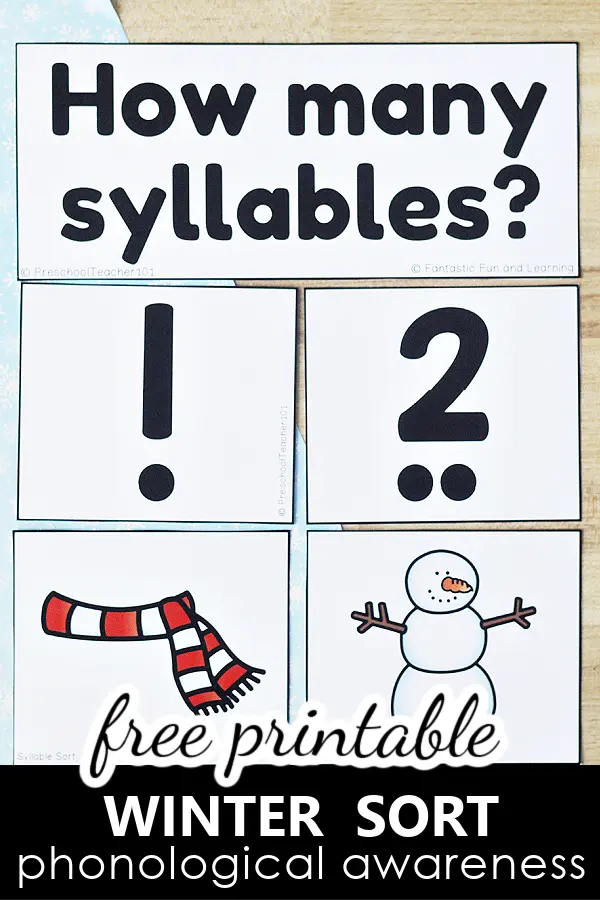
The Winter Syllable Sort package has been engineered to provide maximum utility for both structured classroom learning centers and independent home-school environments. The resource comprises four core structural components:

- Syllable Counting Cards: Illustrated cards featuring winter-themed objects designed to prompt visual recognition and auditory association.
- Large Colorful Word Cards: High-contrast text displays intended for whole-group instruction, circle time, and vocabulary introduction.
- Black and White Response Worksheets: Printable assessment tools that allow students to document their sorting outcomes, serving as an effective diagnostic check for educators.
- Comprehensive Answer Keys: Streamlined reference guides that ensure accurate grading, peer review, and independent student self-checking.
Official Statements & Expert Perspectives
Education stakeholders, curriculum designers, and classroom practitioners have widely endorsed the integration of play-based phonological tools during transitional academic periods like the winter season.
"The transition from late autumn to winter is notoriously challenging for early childhood educators. Student attention spans fluctuate, yet foundational literacy milestones cannot be paused," notes Dr. Elena Vance, a prominent early childhood literacy researcher and curriculum consultant. "Tools like the Winter Syllable Sort weaponize play against academic fatigue. By turning phonological awareness into a sorting game backed by physical movement, children absorb complex linguistic rules without the friction of traditional desk-bound instruction."
Classroom teachers utilizing the resource have similarly highlighted its adaptability across diverse learning environments.

"Before students can independently decode text, they must master the rhythm of speech," explains Sarah Jenkins, a veteran Kindergarten educator in the Pacific Northwest. "If a child cannot hear that ‘snowflake’ has two distinct beats, they will struggle immensely when attempting to sound out letter blends later on. This activity provides the exact tactile bridge we need during the winter months, ensuring that our literacy centers remain rigorous, engaging, and directly aligned with early learning standards."
Furthermore, developers of the companion Winter Theme Preschool Lesson Plans emphasize the necessity of structured pedagogical continuity. The comprehensive lesson plan sets—incorporating over 30 distinct play-based activities—are tailored specifically to accommodate both home preschool environments and institutional kindergarten classrooms, ensuring equitable access to high-yield educational resources regardless of the setting.
Future Outlook & Implementation Strategies
As educational paradigms increasingly prioritize holistic, multisensory learning experiences, the demand for flexible, no-prep instructional materials is projected to grow. The Winter Syllable Sort serves as a blueprint for how digital platforms can supply educators with immediate, high-impact resources that require minimal physical overhead while maximizing cognitive engagement.

Best Practices for Educators and Parents
To maximize the efficacy of the Winter Syllable Sort initiative, educational specialists recommend adhering to a structured implementation methodology:
- Pre-Teaching Vocabulary: Educators must explicitly introduce and define all target winter vocabulary words (e.g., distinguishing between a "scarf" and a "sweater") before expecting students to sort them independently. Unfamiliar vocabulary impedes accurate auditory segmentation.
- Multisensory Modeling: Instructors should demonstrate the clapping and tapping technique collectively during circle time before releasing students to independent literacy centers or small-group stations.
- Scaffolded Assessment: Begin with one- and two-syllable sorting sets to build student confidence before introducing complex three-syllable winter terms. Use the optional black-and-white response worksheets as a formative assessment to identify students who may require targeted literacy intervention.
Conclusion
The Winter Syllable Sort initiative underscores a vital truth in modern education: academic rigor and playful engagement are not mutually exclusive. By embedding essential phonological awareness training into a vibrant, seasonally relevant format, educators can successfully maintain classroom momentum through the end-of-year transition. As early childhood programs continue to embrace holistic instructional designs, resources of this caliber will remain instrumental in laying the groundwork for a lifetime of confident reading, comprehension, and academic achievement.

