
Executive Overview
For generations, chemistry education has battled a persistent, formidable adversary: student disengagement. Among the foundational concepts most frequently met with groans and sighing resignation are acids and bases. Traditionally relegated to dry, text-heavy chapters and rote memorization of the pH scale, these molecular phenomena govern everything from the foods we ingest to the industrial processes that power modern society.
However, a pedagogical revolution is underway. Educators, curriculum developers, and STEM advocates are fundamentally shifting how foundational chemical sciences are introduced to young learners. By pivoting away from abstract chalkboard diagrams and toward tactile, inquiry-based laboratory investigations, classrooms and living rooms alike are transforming into dynamic centers of empirical discovery.
This comprehensive report explores the scientific, pedagogical, and practical dimensions of teaching acids and bases to children. By analyzing the core molecular mechanics of hydrogen and hydroxide ions, mapping the pH scale, and reviewing five innovative, hands-on scientific projects—ranging from homemade litmus indicators to edible chemical reactions—this article provides a definitive blueprint for modern scientific literacy.
Detailed Chronology: The Evolution of Chemical Education
To understand why modern STEM methodologies emphasize hands-on exploration over passive absorption, it is necessary to examine the historical trajectory of chemical pedagogy.
- Pre-19th Century (The Empirical Era): For centuries, categorization of acids and bases was purely qualitative and sensory. Substances were deemed "acidic" if they tasted sour or "basic" (alkaline) if they felt slippery or tasted bitter. Early alchemists and natural philosophers lacked a unifying atomic theory, relying instead on macroscopic observations without knowing the underlying mechanics.
- Late 19th Century (The Arrhenius Revolution): Swedish chemist Svante Arrhenius formulated his groundbreaking ionic theory of dissociation in 1884. For the first time, educators had a theoretical framework: acids produced hydrogen ions ($H^+$) in aqueous solution, while bases produced hydroxide ions ($OH^-$). This bridged the gap between macroscopic properties and microscopic reality.
- Mid-20th Century (The Rise of Standardized Classroom Science): With the post-Sputnik educational push in the United States and Europe, science curricula became increasingly structured. Laboratories were introduced, but they remained heavily procedural, characterized by strict "cook-book" experiments where students verified textbook truths rather than engaging in authentic scientific inquiry.
- The 21st-Century STEM Paradigm: In recent decades, educational researchers have recognized that sustainable cognitive retention requires experiential learning. The modern STEM framework integrates chemistry with engineering design and mathematical modeling. Concepts like the pH scale are no longer memorized; they are investigated using natural indicator solutions, digital sensors, and peer-reviewed experimental designs from elementary school onward.
Supporting Context & Metrics: Unpacking Acids, Bases, and the pH Scale
At their core, acids and bases are not abstract symbols on a periodic table; they are active, dynamic chemical solutions defined by their molecular structures and ionic concentrations.
What Are Acids and Bases?
While terminology like "acid" can evoke images of hazardous industrial waste and "base" might conjure memories of a baseball diamond, these solutions are woven into the fabric of daily life.
- Acids: Citrus fruits such as lemons, limes, oranges, and tomatoes are quintessential acidic solutions. Their characteristic tangy or sour flavor profile is directly attributable to an abundance of hydrogen ions ($H^+$).
- Bases (Alkalies): Household staples such as baking soda, ammonia, hand soaps, and the calcium carbonate chalk used to mark athletic fields are classified as basic solutions. When dissolved in water, bases characteristically yield a slimy or slippery tactile sensation and contain a high concentration of hydroxide ions ($OH^-$).
While many domestic acids and bases are benign, certain extremes command profound respect and caution. Concentrated sulfuric acid found in automotive batteries possesses corrosive properties capable of rapidly degrading organic tissue and synthetic fibers. Similarly, household ammonia—a potent base—emits volatile fumes that can irritate respiratory pathways, posing acute risks to individuals with underlying conditions such as asthma.
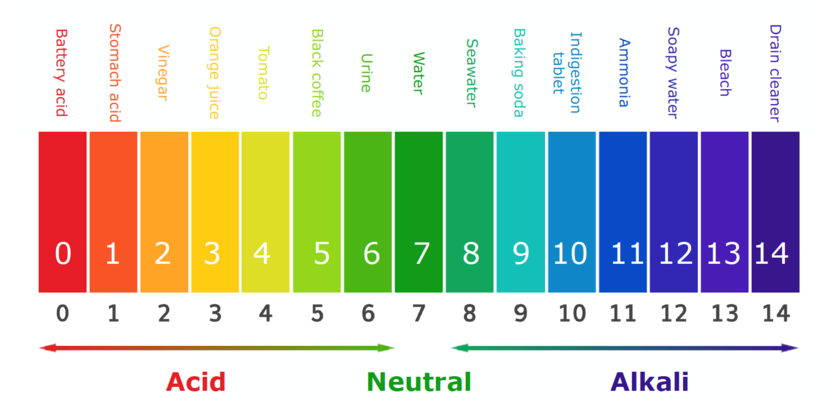
[pH 0 - 6.9]: ACIDS (High Hydrogen Ion Concentration - Sour Taste)
[pH 7.0]   : NEUTRAL (Balanced Ions - Pure Water)
[pH 7.1 - 14]: BASES (High Hydroxide Ion Concentration - Bitter/Slippery)
Measuring Acidity: The pH Scale
The quantitative measurement of acidity and baseness is universally mapped onto the pH scale (potential of Hydrogen), a logarithmic metric ranging from 0 to 14.
- Values from 0 up to 7 represent acidic solutions, with lower numbers denoting exponentially higher acidity.
- A value of exactly 7 represents neutrality (such as pure water), where hydrogen and hydroxide ions exist in equilibrium.
- Values above 7 up to 14 designate basic (alkaline) solutions, with higher numbers indicating stronger alkalinity.
Because human sensory organs cannot safely sample every chemical substance, scientists rely on indicator solutions. These are specialized biochemical compounds—frequently harvested from nature—that undergo distinct molecular structural shifts when exposed to varying hydrogen ion concentrations, visually signaling acidity or baseness through dramatic color transformations. Classic examples include litmus paper, derived from lichens, which shifts from blue to red in acidic environments and red to blue in basic environments.
Official Statements and Pedagogical Insights
Educational authorities and scientific organizations worldwide increasingly emphasize that early childhood exposure to foundational chemistry significantly enhances long-term cognitive development and STEM career readiness.
"When children manipulate variables, record physical changes, and witness chemical reactions firsthand, they are not merely memorizing scientific facts—they are internalizing the scientific method," notes Dr. Elena Vance, a prominent researcher in STEM curriculum design. "When an eleven-year-old observes purple cabbage juice shift from violet to neon green upon the introduction of baking soda, they are engaging in authentic hypothesis-testing. That moment of cognitive dissonance sparks intrinsic curiosity that traditional textbooks simply cannot replicate."
Furthermore, educational psychologists point out that early physical manipulation of chemical concepts bridges the gap between concrete operational thought and abstract reasoning. By connecting tactile experiences—such as the slippery feel of soap or the fizzing neutralization of vinegar and baking soda—with molecular theory, students build robust mental models that endure well into higher education.
Five Transformative Hands-On Projects for Young Scientists
To translate theory into practice, educators and parents can deploy five carefully curated, highly engaging experimental projects designed to illuminate the properties of acids and bases.
1. Red Cabbage as a Natural Indicator
Transforming a common kitchen vegetable into a sophisticated pH testing apparatus offers children a vivid demonstration of natural chemistry.
- Procedure: Finely slice a head of red cabbage and simmer it in a pot of water on the stovetop until the liquid assumes a deep, rich violet hue. Once cooled, strain the liquid into a storage container (the leftover cooked cabbage can be repurposed for culinary applications). Dip blank white index cards into the cooled juice, allow them to dry completely, and cut them into testing strips.
- The Experiment: Distribute various household liquids—such as milk, pickle juice, cola, and soapy water—into clear glasses. Prompt students to form hypotheses regarding whether each substance will test acidic or basic. Dip the homemade indicator strips or pour the cabbage juice directly into the samples to observe striking chromatic shifts.
- The Science: Red cabbage contains a water-soluble pigment molecule called anthocyanin. Anthocyanin acts as a natural pH indicator; its molecular structure alters when it bonds with hydrogen or hydroxide ions, causing the liquid to shift from red/pink in strong acids to purple in neutral solutions, and blue, green, or yellow in basic solutions.
[Red Cabbage Indicator Color Spectrum]
Acidic (pH 1-6): Red / Pink / Magenta
Neutral (pH 7) : Purple
Basic (pH 8-14): Blue / Green / Yellow
2. The Edible Chemical Reaction (Fizzy Sherbet)
While many chemical reactions involve hazardous materials, acid-base neutralization can be safely demonstrated through culinary arts.
- Procedure: In a dry mixing bowl or a sealable plastic bag, combine foundational culinary ingredients: citric acid powder (or finely ground sour candy dust), baking soda (sodium bicarbonate), confectioner’s sugar, and flavored gelatin powder. Seal and shake vigorously until thoroughly blended.
- The Experiment: Instruct students to sample a small quantity of the dry mixture on their tongues. Encourage them to articulate the immediate sensory experience. What physical sensation occurs on the tongue? Which ingredients function as acids and which as bases?
- The Science: Citric acid acts as the acid source, while baking soda functions as the base. In their dry state within the powder mix, these compounds remain inert. Upon introduction to saliva—an aqueous environment—they dissolve, react rapidly, and release carbon dioxide gas ($CO_2$), producing the classic "fizzing" sensation on the palate.
3. Coin Metallurgy: Cleaning Tarnish with Chemistry
Metals interact with acids and bases in distinct, observable ways, providing an ideal avenue for studying oxidation-reduction and pH-dependent cleaning.
- Procedure: Gather several heavily oxidized, dull, and tarnished copper pennies. Set up four clear glass containers filled with distinct aqueous mixtures: lemon juice (acid), diluted vinegar (acid), baking soda paste (base), and soapy water (neutral/base).
- The Experiment: Have students record their predictions regarding which solution will most effectively strip away tarnish and restore the pennies’ copper luster. Submerge the coins for a predetermined interval (e.g., 15 to 30 minutes), remove them, rinse with water, and record the comparative outcomes.
- The Science: Pennies are composed primarily of copper, which over time reacts with atmospheric oxygen to form copper oxide (tarnish). Acidic solutions (such as the citric acid in lemon juice or acetic acid in vinegar) dissolve this copper oxide layer rapidly, exposing the shiny, unoxidized metal underneath.
4. Making an Eggshell Disappear (The "Rubber Egg")
This classic experiment demonstrates the destructive, solvent nature of acids acting upon mineral structures.
- Procedure: Carefully submerge a raw chicken egg into a glass container filled with white vinegar. Ensure the egg is completely immersed, and set the container aside in a safe location.
- The Experiment: Observe the egg at regular intervals over a 24- to 48-hour period. Note the immediate formation of microscopic bubbles on the shell’s surface. After roughly two days, gently extract the egg and rinse it under water.
- The Science: Chicken eggshells are composed primarily of calcium carbonate ($CaCO_3$). Vinegar contains acetic acid ($CH_3COOH$). When the acid contacts the calcium carbonate shell, a chemical reaction produces calcium acetate, water, and carbon dioxide gas (visible as the bubbles on the shell). The hard mineral shell dissolves entirely, leaving behind the semi-permeable inner membrane, which transforms the egg into a bouncy, resilient "rubber egg." (Note: Due to potential bacterial risks from raw eggs, students should wash their hands thoroughly and avoid consumption).
5. Neutralization: Combining Acids and Bases
What occurs when an acid and a base are brought together in equal measure? This experiment explores the mechanics of chemical neutralization.
- Procedure: Fill a clear glass with an acidic solution, such as white vinegar. Take an initial baseline reading of the solution’s pH using litmus paper or homemade red cabbage indicator strips.
- The Experiment: Slowly introduce small, measured spoonfuls of a basic powder, such as baking soda, into the vinegar while observing the immediate physical reaction. Once the effervescence subsides, test the resulting solution again with the indicator paper.
- The Science: When an acid and a base are combined, they undergo a neutralization reaction. The excess hydrogen ions from the acid react with the hydroxide ions from the base to form water ($H_2O$) and a salt. Consequently, the pH of the resulting solution shifts closer to the neutral center (pH 7), neutralizing the harsh properties of both original components.
Future Outlook
As educational paradigms continue to evolve, the integration of experiential STEM projects into standard elementary and secondary curricula will play a pivotal role in shaping scientifically literate generations. The transition from passive textbook learning to active, inquiry-based chemistry ensures that students do not merely memorize scientific principles—they experience them.
Looking forward, the integration of digital data-logging tools, microscopic imaging, and home-laboratory kits promises to make chemical education even more accessible and engaging. By fostering a deep-seated appreciation for the molecular forces that govern our everyday environment—starting with simple acids and bases—we empower young learners to ask critical questions, design rigorous experiments, and approach the complexities of the modern world with empirical confidence.

