In an era defined by hyper-connectivity, fragmented digital media, and unprecedented academic and social pressures, the mental bandwidth of children and teenagers is continually stretched to its limits. Educators, clinicians, and developmental psychologists increasingly report a troubling deficit in foundational cognitive capabilities among youth. These deficits manifest not merely as behavioral disruptions, but as fundamental bottlenecks in executive functioning—the higher-order, brain-based command center responsible for planning, working memory, impulse control, and emotional regulation.
While the modern scholastic environment often leans toward frantic remediation, a growing body of neurodevelopmental research points toward a simpler, yet profoundly effective, antidote: mindfulness. Far from being a mere relaxation technique or a passing wellness trend, mindfulness—the active practice of anchoring attention in the present moment—is rapidly emerging as a potent, evidence-based cognitive intervention. When integrated systematically into the lives of children and adolescents, mindfulness acts as a catalyst, restructuring neural pathways, activating the prefrontal cortex, and fundamentally strengthening the executive functioning skills necessary for lifelong success.
This investigative report delves into the intricate mechanics linking mindfulness to cognitive enhancement, analyzes how targeted mental practices build critical skills like working memory and self-control, and outlines actionable, evidence-based strategies for deployment in educational and therapeutic settings.
Detailed Chronology: The Evolution of Mindfulness in Developmental Psychology
To understand the current integration of mindfulness into youth development, one must trace its journey from ancient contemplative traditions to modern neuroimaging laboratories and school-based social-emotional learning (SEL) curricula.
Phase One: The Paradigm Shift (Late 20th Century)
For decades, mindfulness was viewed through a strictly philosophical or esoteric lens, largely confined to Eastern spiritual practices. However, in the late 1970s and 1980s, pioneers like Dr. Jon Kabat-Zinn introduced Mindfulness-Based Stress Reduction (MBSR) to Western medicine. Initially designed for adult chronic pain and stress management, clinical observations soon hinted at broader cognitive benefits. Researchers began asking a pivotal question: If mindfulness can alter adult neurochemistry and calm the adult brain, what effects might it have on the rapidly developing neural architecture of children and adolescents?
Phase Two: The Neuroimaging Revolution (Early to Mid-2000s)
As functional magnetic resonance imaging (fMRI) and electroencephalography (EEG) technologies advanced, developmental neuroscientists gained the unprecedented ability to observe the brain in real-time. Studies published throughout the 2000s revealed that regular contemplative practices could physically alter brain structure—a concept known as neuroplasticity. Researchers documented increased gray matter density in the prefrontal cortex (the seat of executive function) and a corresponding reduction in the reactivity of the amygdala (the brain’s emotional alarm system). This era shifted mindfulness from a "soft" wellness practice to a hard science backed by empirical neurology.
Phase Three: Integration into Educational Frameworks (2010s–Present)
Armed with neuroscientific data, educational theorists began advocating for the systematic inclusion of mindfulness in K-12 classrooms. Recognizing that children cannot learn effectively when their stress systems are hijacked, schools across the globe began implementing daily mindful breathing exercises, yoga breaks, and social-emotional learning modules. Today, mindfulness is no longer viewed as an extracurricular luxury, but as a critical infrastructural support for cognitive and emotional resilience in youth.
Supporting Context & Metrics: The Mechanics of Executive Functioning
To appreciate the transformative impact of mindfulness, one must first dissect the anatomy of executive functioning. Coined by neuropsychologists, the term "executive functions" encompasses a suite of interrelated mental processes housed primarily in the prefrontal cortex. These skills dictate how an individual manages time, prioritizes tasks, switches between ideas, regulates emotional outbursts, and persists through adversity.
When children and teens possess robust executive functioning skills, these mechanisms operate seamlessly in the background, allowing them to navigate complex social dynamics, complete multi-step academic projects, and achieve long-term goals. Conversely, when executive functions are compromised—often due to trauma, chronic stress, neurodivergence, or sleep deprivation—the brain defaults to reactive, survival-driven patterns.
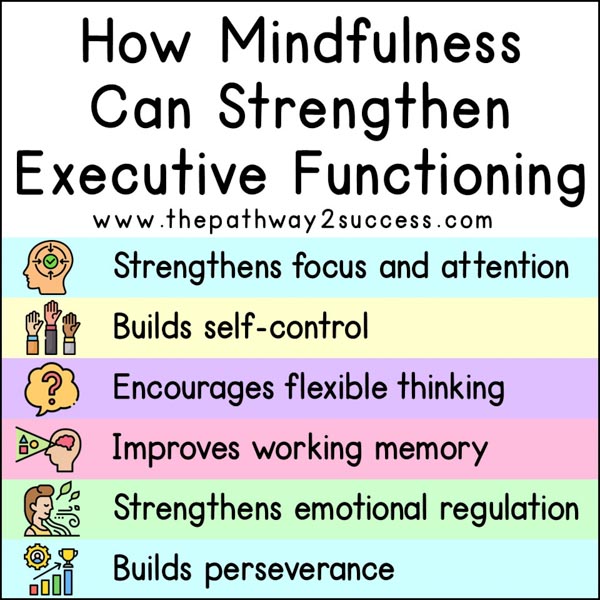
The Six Pillars of Executive Functioning and Their Mindfulness Interventions
[MINDFULNESS PRACTICE]
       │
       ├──► Focus & Attention --------► Training the "Present Moment" Muscle
       ├──► Self-Control -------------► Inhibition of Immediate Impulses
       ├──► Emotional Regulation ----► Awareness Without Overwhelm
       ├──► Working Memory -----------► Clearing Mental Clutter
       ├──► Flexible Thinking --------► Non-Judgmental Acceptance
       └──► Perseverance -------------► Sticking Through Discomfort
1. Focus and Attention
The Clinical Definition: Attention is the sustained capacity to direct cognitive resources toward a specific person, task, or concept over time, filtering out extraneous internal and external distractions.
The Mindfulness Mechanism: Mindfulness exercises serve as direct calisthenics for attentional control. When a child focuses exclusively on the tactile sensation of their breath, they are engaging an attentional loop. Inevitably, the mind wanders. Recognizing that wandering and intentionally redirecting focus back to the breath strengthens the neural networks responsible for sustained attention. Over time, this repetitive loop builds cognitive endurance.
2. Self-Control
The Clinical Definition: Self-control, or inhibitory control, is the ability to pause, evaluate consequences, and inhibit impulsive physical or verbal reactions before taking action.
The Mindfulness Mechanism: Mindfulness creates a psychological "space" between a stimulus and a response. For example, a teenager walking down a hallway and spotting a birthday balloon taped to a locker experiences an immediate impulse to pop it. A regulated brain utilizes mindfulness-trained self-control to pause, breathe, acknowledge the impulse, and let it pass without acting destructively.
3. Emotional Regulation
The Clinical Definition: Emotional regulation is the foundational competency required to identify, understand, and modulate emotional states throughout the day, preventing emotional hijackings.
The Mindfulness Mechanism: Regular contemplative practice teaches youth to observe their emotions as transient weather patterns rather than absolute realities. By developing non-judgmental self-awareness, a student who is excluded from a peer group can recognize feelings of rejection without descending into total emotional dysregulation, allowing them to transition smoothly into constructive problem-solving.
4. Working Memory
The Clinical Definition: Working memory is the mental workspace used to hold, manipulate, and update complex information over short durations—essential for multi-step math problems or following complex verbal instructions.
The Mindfulness Mechanism: Chronic stress fills the working memory with intrusive thoughts, anxiety, and extraneous cognitive clutter. Mindfulness acts as a cognitive "reset button," clearing out mental static and providing a clean slate that optimizes working memory capacity for incoming educational tasks.
5. Flexible Thinking
The Clinical Definition: Cognitive flexibility involves the capacity to switch perspectives, adapt to unexpected environmental shifts, and accept alternative viewpoints without rigid resistance.
The Mindfulness Mechanism: Mindfulness encourages radical, non-judgmental acceptance of reality. When a young adult receives critical feedback on an essay, flexible thinking powered by mindfulness allows them to separate their self-worth from the critique, viewing the feedback as an objective tool for growth rather than a personal attack.
6. Perseverance
The Clinical Definition: Perseverance, closely linked to grit, is the psychological capacity to sustain effort toward long-term goals despite setbacks, boredom, or frustration.
The Mindfulness Mechanism: Maintaining a mindfulness practice is inherently challenging; the mind continually rebels against stillness. By committing to the practice despite discomfort, youth directly cultivate perseverance. They learn that discomfort is temporary and that staying the course yields profound internal rewards.
Official Perspectives & Expert Insights
Educational researchers and child psychologists have increasingly advocated for institutional support of mindfulness-based cognitive training in youth settings.
Dr. Sarah Sterling, a developmental neuroscientist specializing in adolescent brain development, notes:
"We often expect teenagers to plan, organize, and self-regulate as if their prefrontal cortexes are fully mature. When they struggle, we penalize them rather than training them. Mindfulness provides a biological bridge. By calming the amygdala, we allow the prefrontal cortex to come online. It is quite literally a mechanism for building a more resilient, focused brain."
Similarly, clinical child psychologist Dr. Marcus Vance emphasizes the preventative power of these practices:
"Executive functioning deficits are at the root of a vast majority of behavioral and academic referrals in schools. Introducing mindfulness activities—such as mindful breathing, structured journaling, or sensory observation—gives students a portable toolkit. They don’t need specialized equipment or clinical interventions; they simply need to learn how to access their own breath and attention."
Educational administrators who have adopted school-wide mindfulness initiatives report measurable drops in disciplinary infractions and notable improvements in standardized focus metrics, validating the clinical data in real-world environments.
Strategic Implementation: Practical Mindfulness for Classrooms and Homes
Deploying mindfulness effectively with children and teenagers requires moving away from abstract concepts and toward concrete, engaging, and repeatable activities. Experts recommend a phased approach that begins with establishing the "why" before diving into the "how."
1. Transparent Discourse on Benefits
Before introducing exercises, educators and parents should openly discuss why mindfulness matters. Framing mindfulness not as a chore, but as a high-performance tool—akin to a mental warmup before a major athletic contest or a high-stakes public speaking engagement—increases buy-in among skeptical adolescents.
2. Foundational Mindful Breathing
Breathing is the most accessible, portable anchor available.
Execution: Have learners sit comfortably, close their eyes (or soften their gaze), and bring awareness to the physical sensation of air entering the nostrils and filling the lungs.
Advanced Variations: Transition into gamified breathing techniques such as "Cool Off the Pizza" (inhaling deeply, then slowly exhaling as if cooling a hot slice) or "Shape Breathing" (tracing geometric shapes with one’s finger while matching inhales and exhales to the lines). These exercises double as powerful brain breaks during transitions.
3. Mindful Coloring and Artistic Expression
For students who find seated silent meditation difficult, kinetic mindfulness offers an alternative. Mindful coloring requires total absorption in the present moment through pattern and color selection, explicitly discouraging perfectionism. The goal is simply to breathe, color, and exist in the act of creation.
4. Outdoor Mindfulness and Nature Observation
Connecting with the natural environment naturally prompts external attentional grounding. Activities can range from silent nature walks and cloud-watching to mindful gardening or observing local wildlife. The vastness of the outdoors provides endless, non-threatening stimuli to anchor a wandering mind.
5. Mindful Affirmations and Journaling
Starting the morning with structured reflection helps set a calm cognitive tone. Educators can utilize daily journaling prompts or provide students with pocket-sized affirmation cards to keep in desks or binders. Repeating grounding phrases during slow, deliberate breathing helps overwrite negative internal self-talk.
6. Mindful Observance (Object Focus)
To sharpen acute concentration, have learners select a simple, everyday object—such as a pen, a water bottle, or a smooth stone. While breathing slowly, students spend two minutes examining every minute detail of the object: its texture, weight, color variations, and temperature. This exercise trains the brain to lock onto a single data point while filtering out environmental noise.
Future Outlook
As educational institutions navigate the complexities of the 21st century, the integration of contemplative practices into core developmental frameworks is moving from the periphery to the mainstream. The intersection of neuroscience and education makes it abundantly clear: academic excellence cannot be decoupled from emotional and cognitive self-regulation.
Future research initiatives are expected to focus on longitudinal tracking, exploring how early childhood and adolescent mindfulness interventions impact long-term mental health, occupational success, and neuroplasticity well into adulthood. Furthermore, as schools increasingly embrace trauma-informed care and social-emotional learning, mindfulness is poised to become a universal standard of care—a foundational pillar ensuring that every child is equipped not only with academic knowledge, but with the internal cognitive architecture required to navigate an unpredictable world with clarity, resilience, and profound self-control.